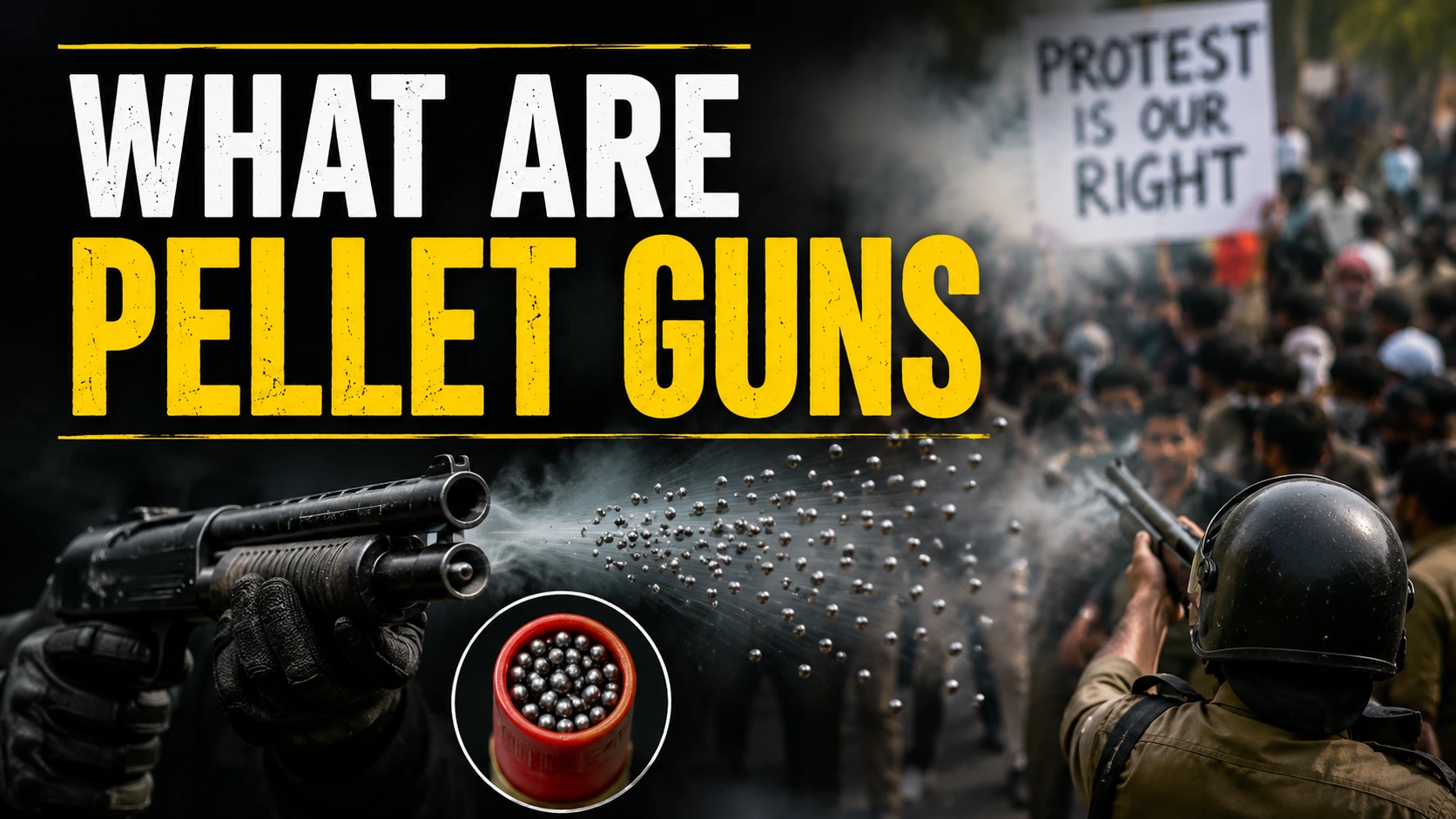
Pellet guns have become one of the most controversial crowd-control weapons in India. Their use during protests has triggered debates over human rights, policing, and public safety. From Kashmir to Delhi, they continue to draw national attention.
If you want to understand what pellet guns are, how they work, where authorities have used them, and what Indian law says about them, this guide explains the key facts.
Manufacturers developed pellet guns as a “non-lethal” alternative to live ammunition. However, they have faced widespread criticism because they can cause severe injuries, including permanent blindness. Allegations of their use during the 2026 Delhi student protests have further increased public interest in pellet guns and their legal status.
What Are Pellet Guns?
Pellet guns, also known as pellet-firing shotguns, are modified 12-gauge firearms that fire cartridges filled with hundreds of tiny metal pellets. Each cartridge typically contains between 450 and 600 lead or steel pellets. Unlike a conventional bullet, these pellets spread in a wide cone-shaped pattern after firing.
The spread allows security forces to disperse crowds over a larger area. State police and the Central Reserve Police Force (CRPF) adopted pellet guns to reduce fatalities during violent protests. The pellets travel at high speed and can cause bruises, deep wounds, and internal injuries. The severity often depends on the firing distance.
Despite their “non-lethal” label, pellet guns remain highly controversial. At close range, the pellets can strike the eyes, face, and vital organs. Such injuries can lead to permanent disability. Doctors have documented blindness, retinal damage, infections, lead poisoning, and severe facial injuries. Because the pellets spread in multiple directions, they can also hit bystanders, journalists, children, and peaceful protesters.
Authorities introduced pellet guns in Jammu and Kashmir around 2010. They wanted a safer alternative after conventional firing caused significant civilian casualties. Since then, pellet guns have remained at the centre of legal, medical, and human rights debates.
Also Read: Delhi Gurdwaras Open Doors to Shelter Protesters After Police Clear Demonstration Sites
History of Pellet Guns in Indian Protests
Authorities first used pellet guns extensively during the 2010 unrest in Jammu and Kashmir. They introduced the weapons after conventional firing killed more than 100 people. Security forces used them to disperse stone-pelting crowds.
Their use increased sharply during the 2016 protests following the killing of militant commander Burhan Wani. Thousands suffered pellet injuries. Doctors reported more than 1,000 eye injuries, along with many cases of partial or complete blindness.
Many victims were teenagers and young adults. Some participated in protests, while others were simply nearby. Human rights groups, including Amnesty International, have repeatedly criticised pellet guns. They argue that the weapons are inaccurate, indiscriminate, and unsuitable for crowd control.
Authorities have also faced allegations of using pellet guns in other parts of India. Reports emerged during the 2023 ethnic violence in Manipur and the 2024 farmers’ protests at the Punjab-Haryana border. Police denied widespread deployment during the farmers’ protests.
In July 2026, pellet guns returned to national headlines after allegations surfaced during the “Chalo Sansad” student protests in Delhi. A 25-year-old protester, Shaikh Irshad Mansoori, reportedly underwent surgery after suffering pellet-like injuries to his face and upper body. Delhi Police denied using pellet guns and called the reports misleading. Even so, the incident intensified the debate over the use of force during student protests.
These incidents show why pellet guns remain one of India’s most controversial crowd-control tools.
Human Impact
Pellet gun injuries often leave lifelong consequences. Victims may lose their vision or suffer facial injuries and permanent disabilities. Such injuries can disrupt education, employment, and everyday life.
Doctors say pellets often fragment inside the body, making surgery more difficult. Eye injuries can damage the retina or cornea and cause irreversible blindness. Many victims also develop anxiety, depression, or post-traumatic stress disorder (PTSD).
The issue becomes even more serious when children and students suffer injuries. Such incidents have intensified concerns over whether current crowd-control methods adequately protect vulnerable groups.
What Does Indian Law Say?
Indian law treats civilian ownership and police use of pellet guns differently.
Civilian Ownership
The Arms Act, 1959, and the Arms Rules, 2016, regulate pellet guns. Low-powered pellet guns with a muzzle energy of up to 20 joules and a bore diameter of 0.177 inches (4.5 mm) generally do not qualify as firearms. People can usually purchase them without a licence for sports or recreational use.
Use by Police During Protests
India has no separate law that specifically regulates pellet guns during protests. Instead, authorities rely on constitutional principles and policing laws.
These include:
- Article 19 of the Constitution, which guarantees freedom of speech and peaceful assembly.
- Article 21, which protects the right to life and personal liberty.
- Criminal procedure governing the use of reasonable and proportionate force.
- Standard Operating Procedures (SOPs) issued by police forces and the CRPF.
Security personnel should use pellet guns only after less harmful methods fail. These include public warnings, tear gas, water cannons, and lathi charges.
What Has the Supreme Court Said?
The Supreme Court has not banned pellet guns nationwide. However, it has repeatedly expressed concern over the severe injuries they cause.
While hearing petitions related to the 2016 unrest in Jammu and Kashmir, the Court said authorities should not use pellet guns indiscriminately or excessively. It directed officials to exercise restraint and consider safer alternatives whenever possible.
The Court also asked governments to explore less harmful crowd-control technologies and ensure proper medical treatment for injured people.
Although the law still allows security forces to use pellet guns, the judiciary has consistently stressed restraint, accountability, and minimum necessary force.
Government Response and Alternatives
Governments have formed expert committees to identify alternatives after facing criticism from courts, doctors, and human rights groups.
Officials have examined advanced rubber projectiles, precision water cannons, acoustic devices, and improved chemical irritants. Some states have also tightened approval procedures before officers can deploy pellet guns.
Police argue that violent protests involving stone-pelting create difficult operational challenges. At the same time, authorities must protect both public safety and the constitutional right to protest.
Experts recommend better police training, body cameras, independent investigations, and stronger community engagement to reduce the need for force.
Why Understanding Pellet Guns Matters
Pellet guns remain one of India’s most debated crowd-control tools because they raise important questions about public safety, human rights, and constitutional freedoms.
Supporters view them as a less-lethal alternative to live ammunition. Critics argue that their indiscriminate nature can cause devastating injuries. As allegations continue to emerge, understanding how pellet guns work and what Indian law permits is essential for an informed public debate.

Prateeksha Kumari is a journalist and strategic communications professional specialising in digital journalism, political reporting, and public affairs. Her work focuses on grassroots issues, governance, and civic developments, with an emphasis on clarity, accuracy, and narrative-driven reporting.
She holds a Master’s degree in Journalism and Mass Communication from Himachal Pradesh University, Shimla and has qualified the UGC-NET examination, reflecting her academic grounding in media studies and communication research. Her reporting spans politics, public policy, health, education, and socio-economic issues, and she is experienced in bilingual (Hindi and English) content creation tailored to diverse audiences.
Alongside her journalistic work, she brings experience in political communication and public relations, where she has contributed to campaign messaging, media outreach, and narrative building. She has worked on integrated communication strategies across print and digital platforms, combining editorial judgment with audience insight and data-led content approaches.