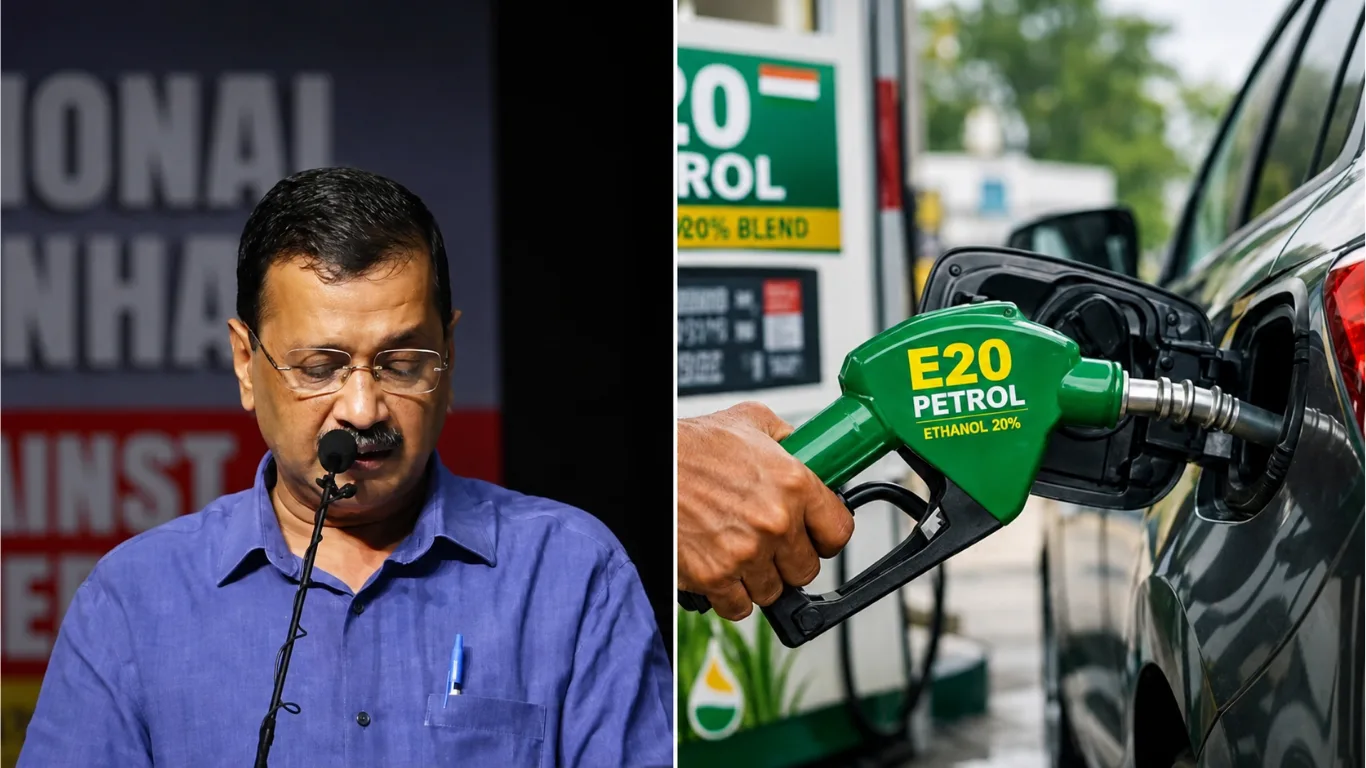
New Delhi: The debate over E20 petrol has intensified across India. The central government calls it a major step towards energy security, higher farmer income and lower pollution. However, the Aam Aadmi Party (AAP) and its National Convenor Arvind Kejriwal say the policy could hurt millions of vehicle owners.
Speaking at the “National Town Hall Against E20” at the Constitution Club in New Delhi on Saturday, Kejriwal criticised the Centre’s E20 policy. He also announced a nationwide campaign against its mandatory implementation.
What Is E20 Petrol?
E20 is a fuel blend that contains 20% ethanol and 80% petrol. Manufacturers produce ethanol mainly from sugarcane, maize and other agricultural crops.
The government wants to reduce crude oil imports, cut carbon emissions and create more income opportunities for farmers. To achieve these goals, it has steadily increased ethanol blending in petrol over the past few years.
According to the Centre, higher ethanol blending will save foreign exchange, reduce pollution and strengthen India’s energy security. The government now plans to expand the use of E20 fuel across the country.
What Did Arvind Kejriwal Say?
At the Town Hall event, Kejriwal clarified that he does not oppose ethanol. Instead, he opposes making E20 compulsory.
He said every vehicle owner should have the freedom to choose fuel based on vehicle compatibility and personal preference.
Kejriwal placed five key demands before the government:
- Fuel stations should sell both E20 petrol and regular petrol.
- The government should not stop the sale of pure petrol.
- E20 petrol should cost less than regular petrol.
- Consumers should have the freedom to choose their fuel.
- The government should clarify who will compensate owners if E20 damages their vehicles.
Kejriwal also claimed that lakhs of people have signed the campaign against mandatory E20. He announced that AAP leaders will march to the Prime Minister’s residence on 4 August and submit a memorandum carrying public signatures.
Why Are Vehicle Owners Concerned?
Many owners of older vehicles worry about E20 fuel. They believe their vehicles were not designed to run on a higher ethanol blend.
Some fear lower fuel efficiency. Others worry about engine performance and higher maintenance costs.
However, no universally accepted scientific evidence confirms these concerns for every vehicle. Automobile manufacturers have issued model-specific guidelines instead.
Most new vehicles now support E20 fuel. Owners of older vehicles should follow the recommendations issued by their respective manufacturers.
Kejriwal Questions Automobile Companies
Kejriwal has also questioned automobile manufacturers.
He alleged that some companies have not clearly explained how E20 could affect older vehicles. He wrote to several leading manufacturers and asked whether they would compensate customers if E20 caused vehicle damage.
Automobile companies have responded differently. However, the industry says manufacturers are developing new vehicles according to E20 compatibility standards.
What Is the Government’s Stand?
The central government considers E20 an important part of India’s long-term energy strategy.
According to the government, the ethanol blending programme will:
- Reduce crude oil imports.
- Create additional income opportunities for farmers.
- Lower carbon emissions.
- Strengthen India’s energy security.
The government also says it is introducing E20 in phases. This approach gives automobile manufacturers enough time to prepare. It also allows companies to develop E20-compatible vehicles before wider implementation.
Why Has E20 Become a Political Issue?
The E20 debate has moved beyond technical discussions. It has now become a political issue.
AAP says mandatory E20 directly affects the middle class and millions of vehicle owners. The BJP and the central government, however, accuse the opposition of creating unnecessary fear without scientific evidence.
Experts say India must balance energy security with consumer interests. They also believe the government and automobile companies should provide clear technical guidance if owners of older vehicles have genuine concerns.
What Happens Next?
Kejriwal has confirmed that AAP will continue its campaign against mandatory E20. The planned march to the Prime Minister’s residence and the nationwide signature campaign are likely to intensify the political debate.
So far, the central government has given no indication that it will change its E20 policy.
The two sides continue to present different arguments. The government sees E20 as an important reform that supports energy independence, cleaner fuel and farmer welfare. The opposition focuses on consumer choice, older vehicle compatibility and the possible financial burden on vehicle owners.
The debate is now likely to extend beyond politics. It could shape future discussions on India’s energy policy, environmental goals and consumer protection. As E20 expands across the country, policymakers will need to balance cleaner fuel initiatives with the concerns of millions of vehicle owners.
Also read: Meta AI Glasses Raise Privacy Concerns: Could Wearable AI Put Bystanders at Risk?