Guides cover credit-loss assessment, loan restructuring, risk management and practical banking requirements
New Delhi: The Institute of Cost Accountants of India (ICMAI) has launched two new handbooks designed to help banks, borrowers, MSMEs and finance professionals navigate the upcoming Expected Credit Loss (ECL) framework and the restructuring of stressed bank loans.
The ECL framework of the Reserve Bank of India is scheduled to come into effect from April 1, 2027. Against this backdrop, ICMAI’s publications aim to provide practical insights into credit-loss recognition and financial-stress management.
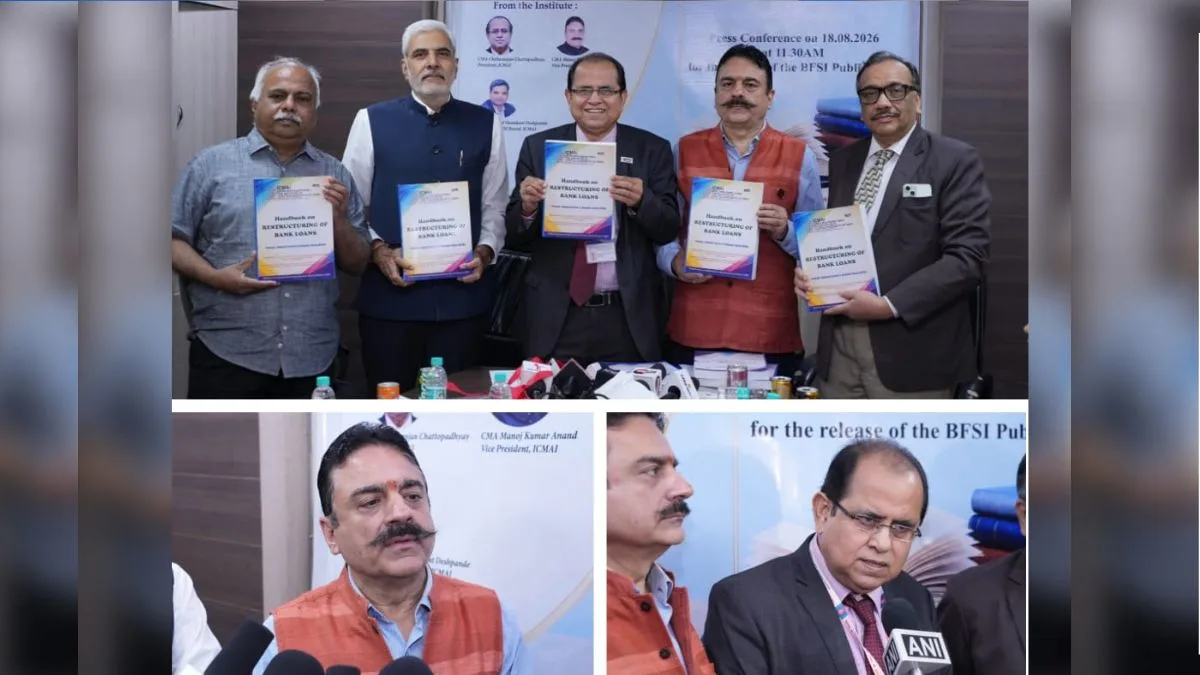
The two publications are titled Expected Credit Loss (ECL) Framework: A Practical Handbook for Indian Banks and Handbook on Restructuring of Bank Loans. They are intended as reference material for bankers, CMAs, corporate borrowers, MSMEs and other stakeholders.
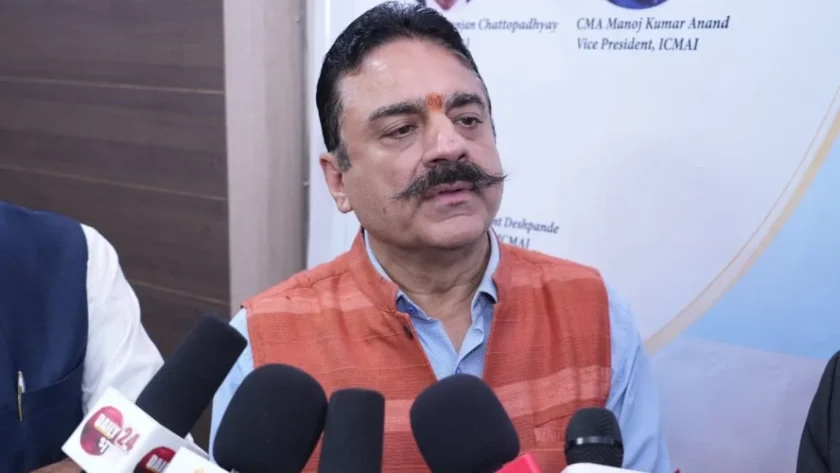
The launch programme was attended by ICMAI President CMA Chittaranjan Chattopadhyay, Vice-President CMA Manoj Kumar Anand, BFSI Board Chairman CMA Harshad Deshpande, NIPSCOM Director CMA Puneet Jain, publication author Dr. P. Siva Rama Prasad and former Bank of Baroda Executive Director Dr. Ramjas Yadav. Former Central Bank of India CMD and former Indian Banks’ Association Chief Executive CMA M. K. Mohan Tanksale joined the event virtually.
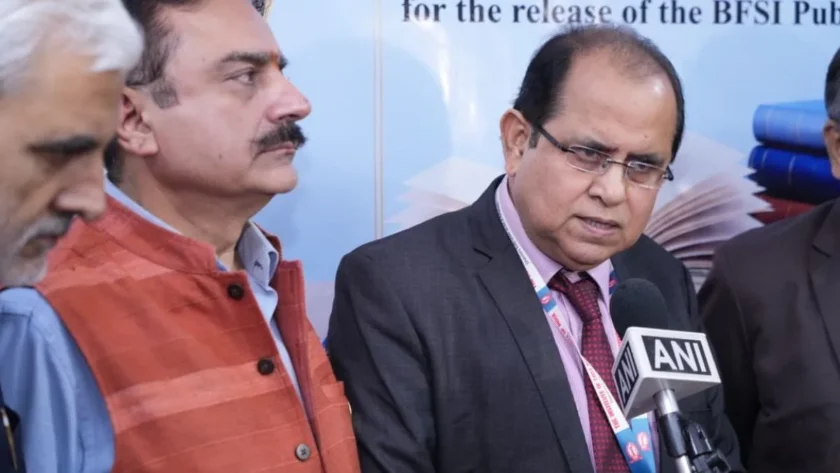
The ECL publication explains the framework’s three-stage classification system and key credit-risk parameters such as Probability of Default, Loss Given Default and Exposure at Default. It also deals with forward-looking economic information, data requirements, credit-risk models, validation, technology adoption, accounting, auditing, disclosures and transition arrangements.
Practical case studies and illustrations have been added to help professionals understand the application of the framework.
The loan restructuring handbook, meanwhile, focuses on identifying financial stress and developing appropriate restructuring strategies. It covers early warning signals, assessment of restructuring proposals, regulatory provisions, financial viability, TEV studies, financial projections, operating expenses, resolution plans, digital footprint assessment and documentation.
Need for early ECL preparedness
ICMAI President CMA Chittaranjan Chattopadhyay said the transition to the ECL system represents an important development for Indian banking and requires timely preparation by all relevant stakeholders.
He said ICMAI intends to help professionals and institutions understand the operational aspects of the new framework and adapt to a forward-looking method of credit-loss recognition.
The event also highlighted the potential of ECL to improve credit assessment by enabling banks and financial institutions to recognise emerging credit risks at an earlier stage. Speakers stressed that borrowers should also be familiar with restructuring options available when businesses experience temporary financial stress.
Helping businesses manage financial stress
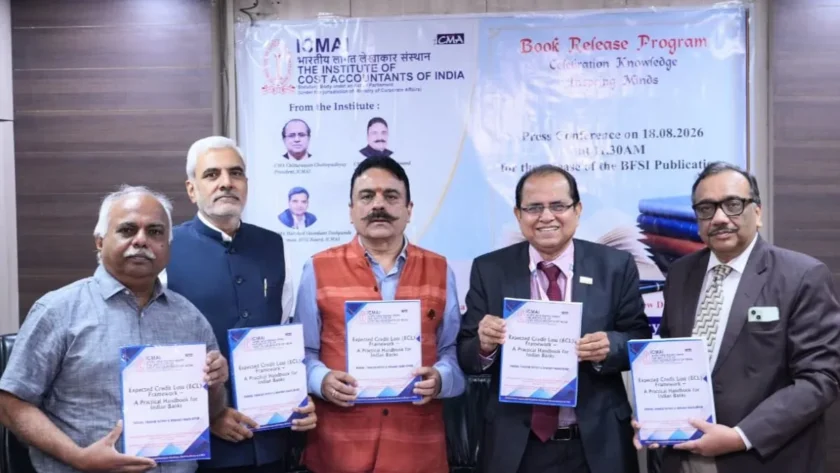
Dr. P. Siva Rama Prasad said the restructuring handbook was based partly on his experience in banking and was developed to address knowledge gaps among SMEs, MSMEs, mid-sized companies and corporates approaching lenders.
He said economic disruptions, geopolitical developments and the COVID-19 pandemic have contributed to financial stress across businesses. The publication seeks to encourage timely restructuring of viable businesses and help prevent avoidable deterioration into non-performing assets.
According to ICMAI, the handbook is designed to supplement awareness rather than replace existing banking procedures.
CMAs’ expanding contribution
CMA Manoj Kumar Anand said the banking sector was increasingly recognising the role of cost professionals in improving efficiency and profitability.
He said CMAs can contribute in several areas beyond conventional accounting, including cost optimisation, credit assessment, risk management, budgeting, performance measurement and strategic planning.
ICMAI also advocated stronger cost governance within banks and suggested the creation of dedicated cost-related roles, including a Chief Cost Compliance Officer.
Training, FinTech and placements
CMA Puneet Jain said four ECL training programmes had already been organised with ICMAI and that additional programmes would be conducted to strengthen the capabilities of banking professionals.
ICMAI’s BFSI initiatives cover credit management, treasury and international banking, concurrent audit, and credit, operational and market risks.
The institute has also introduced an Advanced Certificate Course in FinTech for graduates and professionals such as MBAs, CAs and CMAs.
ICMAI further reported nearly 1,000 successful placements through its campus placement programme over the past year. Major participating institutions included ICICI Bank, Cosmos Co-operative Bank, Saraswat Co-operative Bank, Karur Vysya Bank, Power Finance Corporation, IREDA, Shriram Finance, Bajaj Finserv, HSBC Bank and CSB Bank.
ICICI Bank recruited over 250 CMAs and Cosmos Co-operative Bank recruited more than 80. The highest CTC was ₹36 lakh per annum, while average compensation ranged from ₹12 lakh to ₹14 lakh per annum.
The institute said the participation of financial institutions reflects increasing demand for CMAs across financial management, cost control, credit, risk and strategic decision-making.
The launch concluded with discussions on ECL preparedness, effective restructuring of stressed loans and the growing role of CMAs in strengthening India’s banking and financial services ecosystem.