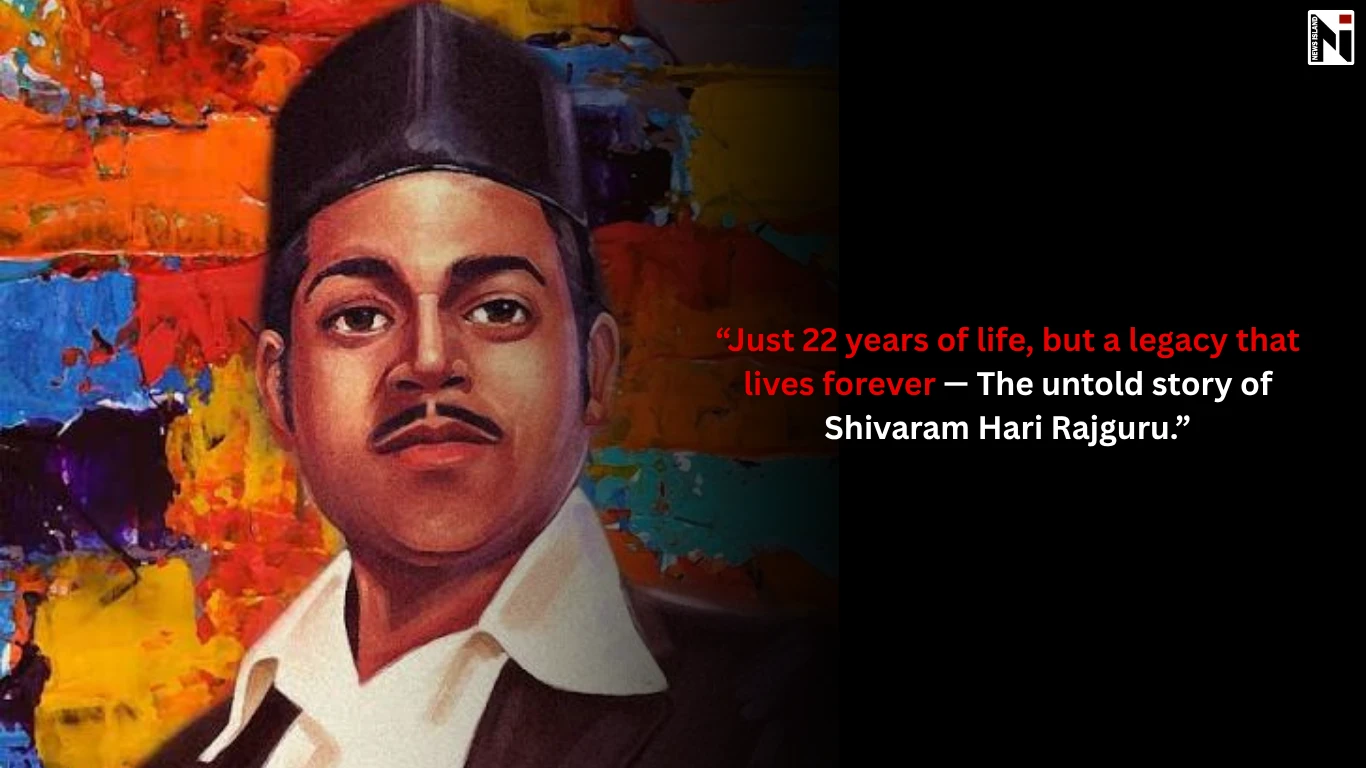
Rajguru Jayanti 2026: Know the complete story of Shivaram Hari Rajguru, his revolutionary journey beyond being known merely as Bhagat Singh’s associate, his association with the HSRA, the Saunders case, the Lahore Conspiracy Case, and his martyrdom at the age of 22.
New Delhi: The history of India’s freedom struggle is not only the story of major movements, political leaders and public gatherings. It also includes young revolutionaries who dedicated the most important years of their lives to the cause of India’s independence. Shivaram Hari Rajguru was one such revolutionary. Every year, August 24 is observed to remember him on his birth anniversary.
Rajguru’s name is often mentioned alongside Bhagat Singh and Sukhdev, but he had an identity and journey of his own. He was a young man who studied Sanskrit and Indian scriptures and was deeply inspired by Chhatrapati Shivaji Maharaj and his guerrilla warfare strategy. He later became part of the armed revolutionary movement against British rule.
According to government records, Rajguru was born on August 24, 1908, in Khed village of Pune district, which was later renamed Rajgurunagar in his honour.
Who Was Shivaram Hari Rajguru?
Rajguru’s full name was Shivaram Hari Rajguru. He was born into a middle-class family. After his early education, he went to Amravati, where an environment of physical training and discipline influenced his personality.
At around the age of 15, he travelled to Varanasi. There, he studied Sanskrit and Indian religious scriptures. According to the Marathi Vishwakosh, he also studied subjects related to jurisprudence and acquired knowledge of several languages along with Sanskrit.
Varanasi became an important turning point in Rajguru’s life. It was here that he came into contact with people involved in revolutionary activities against British rule. During this period, he met revolutionaries such as Sachindra Nath Sanyal and Chandrashekhar Azad.
Rajguru’s personality was not limited to that of a young revolutionary who took up arms. He was physically strong, disciplined and deeply influenced by Indian history. He was particularly inspired by the military strategy and courage of Chhatrapati Shivaji Maharaj.
How Did Rajguru Join the Revolutionary Movement?
During the 1920s, another path of resistance was taking shape alongside the mainstream freedom movement in India. On one side, political movements were being led under the Congress, while on the other, several young revolutionaries were developing a strategy to challenge British rule through armed struggle.
Rajguru became associated with this revolutionary stream.
He initially joined the Hindustan Republican Army, which was later reorganised and renamed the Hindustan Socialist Republican Association (HSRA). Revolutionaries such as Bhagat Singh, Chandrashekhar Azad and Sukhdev were also associated with the organisation.
The HSRA’s objective was not limited to removing British rule. Its revolutionaries also envisioned India’s political future in connection with a new social and economic system.
It was during this period that the activities of young revolutionaries such as Rajguru, Bhagat Singh and Sukhdev intensified.
The Death of Lala Lajpat Rai and the Plan for Revenge
One of the most significant chapters of Rajguru’s life is associated with Lala Lajpat Rai.
On October 30, 1928, a protest against the Simon Commission was held in Lahore. Lala Lajpat Rai was leading the protesters. The police carried out a lathi charge, in which Rai was seriously injured. He later died.
The revolutionary youth were deeply angered by the actions of the British authorities. Bhagat Singh and his associates decided to avenge Lala Lajpat Rai’s death.
The original plan was to target police officer James A. Scott, who was considered responsible for the lathi charge. However, during the action in Lahore on December 17, 1928, J. P. Saunders was killed due to mistaken identity.
According to the Marathi Vishwakosh, Rajguru fired the initial shots during the operation.
The incident became a major challenge for the British government. The police launched a search for the revolutionaries, forcing Rajguru and several others to go underground.
Rajguru’s Life Underground
After the Saunders killing, Rajguru remained away from the police for nearly two years. This period was not simply about hiding but also involved maintaining the revolutionary network.
According to a historical account by All India Radio, Bhagat Singh, Rajguru and Sukhdev successfully escaped from Lahore after the Saunders killing. Rajguru was later arrested by the police.
During this period, the British police continued searching for those linked to the Lahore incident.
Eventually, Rajguru was arrested in Pune on September 30, 1929. He was subsequently tried in connection with the Lahore Conspiracy Case.
Bhagat Singh and the Saunders Murder
The Saunders killing case eventually became known as the Lahore Conspiracy Case. Bhagat Singh, Rajguru and Sukhdev, along with several other revolutionaries, were made accused in the case.
For the British government, the case was not merely a trial concerning a murder. It was also an attempt to curb the growing influence of the revolutionary movement.
The activities of Rajguru and his associates made it clear to the British authorities that some young Indians were not willing to limit their struggle to political demands.
For these young revolutionaries, independence was a goal for which they were prepared to put their personal lives and futures at stake.
March 23, 1931: The Day Three Revolutionaries Were Martyred
Rajguru, Bhagat Singh and Sukhdev were hanged by the British government in Lahore Jail on March 23, 1931.
Rajguru was only around 22 years old at the time. The Ministry of Culture’s Digital District Repository also identifies Rajguru as one of the prominent revolutionaries of the HSRA and records his age as 22 at the time of his martyrdom.
March 23 is remembered in India as Shaheed Diwas. The martyrdom of Rajguru, Bhagat Singh and Sukhdev remains one of the most widely remembered episodes of India’s freedom struggle.
The most significant aspect of Rajguru’s story is that he left a lasting political and historical impact despite living for only a few years.
Why Is It Incomplete to Remember Rajguru Only as ‘Bhagat Singh’s Associate’?
Rajguru’s name is often mentioned alongside Bhagat Singh, largely because both were members of the HSRA and were linked to the Saunders incident and the Lahore Conspiracy Case.
However, focusing only on this association can overlook Rajguru’s individual ideological and personal journey.
His life shows that young people who joined the revolutionary movement came from diverse backgrounds and were influenced by different ideas and experiences. Some drew inspiration from political thought, social reform, historical figures or their own experiences under British rule.
For Rajguru, his study of Sanskrit, interest in Indian traditions, physical training and admiration for Shivaji Maharaj’s military strategy helped shape his revolutionary outlook.
His story therefore offers insight into a significant strand of India’s freedom struggle, in which young revolutionaries relied on personal courage, discipline and organisation as instruments of political resistance.
Rajguru’s Legacy Lives On
Rajguru’s legacy extends beyond the pages of history books.
His birthplace, Khed, was renamed Rajgurunagar in his honour. Maharashtra government records list the Hutatma Shivaram Hari Rajguru Janma Kaksh and Thorla Wada in Rajgurunagar as memorial sites.
Rajguru Wada, his ancestral home, is another important place associated with his memory. Ministry of Culture records also identify the site with his birthplace and memorial.
In 2013, then President Pranab Mukherjee released a commemorative postage stamp in Rajguru’s honour, remembering his courage and dedication to India’s freedom struggle.
What Is the Significance of Rajguru Jayanti?
Rajguru’s life highlights the diverse nature of India’s freedom struggle. Alongside non-violent movements, revolutionary activities played a significant role in challenging British rule.
Remembering Rajguru should go beyond the dramatic events of his revolutionary life. His education, discipline, ideology, organisational work and ultimate sacrifice are equally important to understanding his legacy.
Born on August 24, 1908, Shivaram Hari Rajguru lived for only about 22 years, yet his brief life secured a lasting place in India’s freedom struggle.
His martyrdom is not simply a reminder of the past. It offers an opportunity to understand the different ideologies, struggles and sacrifices that shaped India’s journey to independence.
Rajguru’s story remains relevant as the story of a young man who stood against one of the world’s most powerful empires and dedicated his life to India’s freedom.