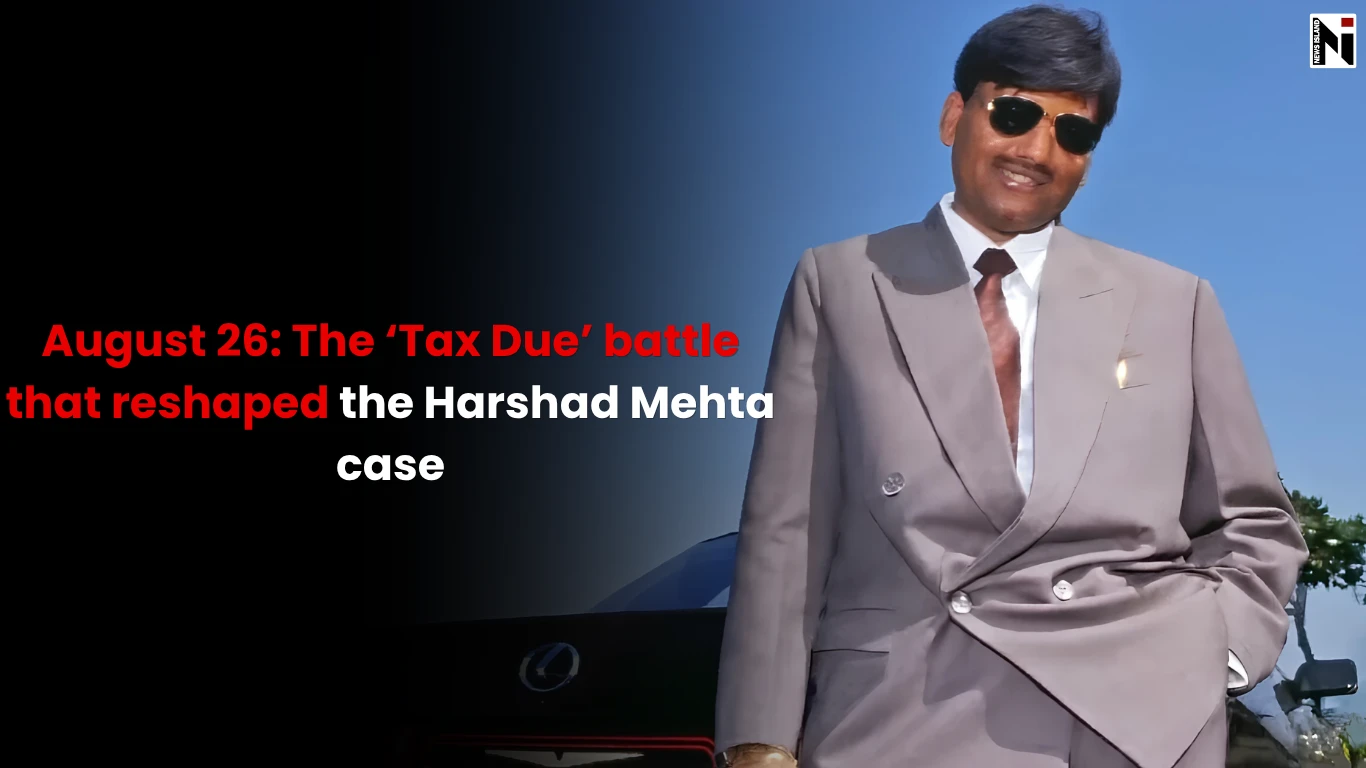
Harshad Mehta Case: How the Supreme Court’s 1996 Interim Payment Led to the 1998 ‘Tax Due’ Verdict
New Delhi: What did the Supreme Court do in New Delhi on August 26, 1996, in the Harshad Mehta case, and why did it matter? The matter concerned payments to the Income Tax Department from the attached assets of Harshad Shantilal Mehta, the notorious stockbroker linked to the 1992 securities scam.
According to Supreme Court records, an interim order passed in 1996 allowed certain payments to be made to the Income Tax Authorities. The key legal issue emerged later, when the court had to decide whether those payments could actually be treated as “taxes due” under the law.
The case, therefore, was not merely about recovering money from Harshad Mehta. It also involved determining how much could legally be paid to the government from his attached assets and the legal basis for making those payments.
The 1992 Scam and the Attachment of Assets
The 1992 securities scam exposed major weaknesses in India’s banking and stock market systems. Under the Special Court (Trial of Offences Relating to Transactions in Securities) Act, 1992, the assets of notified persons connected with securities transactions were attached. Under the law, the Custodian took control of these assets and, subject to the directions of the Special Court, used them toward the payment of relevant liabilities.
The Real Dispute: What Did ‘Tax Due’ Mean?
This is where the story of August 26, 1996, becomes very different from a simple “penalty” narrative. The central question was the meaning of the words “taxes due” under Section 11(2)(a) of the Special Court Act. Could any tax liability claimed by the government immediately be recovered from attached assets, or did the liability first have to be legally assessed, quantified and finalized?
In 1998, the Supreme Court addressed this question and held that “taxes due” referred to a tax liability that had been legally assessed, quantified and had become final.
The 1996 Payment Became a Key Part of the 1998 Judgment
In its 1998 judgment, the Supreme Court noted that payments had been made to the Income Tax Authorities pursuant to its interim order of August 26, 1996. However, the court also recorded an undertaking by the Income Tax Authorities to refund the amounts, if required, along with interest at a rate of at least 18% per annum.
The Special Court was subsequently directed to examine how much of the money paid to the Income Tax Authorities under the 1996 interim orders actually needed to be returned.
Also Read: Maradona’s ‘Hand of God’ Match Ball Sold for $3.35 Million, Know Why It Is So Special*
The Biggest Correction: This Was Not a ‘Penalty Order’
On social media, August 26, 1996, is often presented as the day the Supreme Court ordered Harshad Mehta to pay a “huge penalty.” However, the judicial record presents a considerably more complex picture.
In its May 13, 1998 judgment, the Supreme Court clarified that tax, penalty and interest are separate legal concepts. The court held that the term “taxes” under Section 11(2)(a) did not include penalty and interest under the Income Tax Act. Therefore, describing the August 26, 1996 event simply as a “heavy penalty imposed on Harshad Mehta” is misleading.
The Court Also Set an Important Limit on Tax Recovery
The 1998 judgment was not limited to the question of Harshad Mehta’s individual liability. The court held that the tax liabilities receiving priority under Section 11(2)(a) primarily related to the statutory period between April 1, 1991, and June 6, 1992.
More importantly, a tax liability could be treated as “due” only when it had been legally assessed and had become final. This interpretation ensured that simply raising a large tax demand was not enough to immediately take an equivalent amount from attached assets.
The Lesser-Known Issue: Banks Versus the Government
One of the least discussed aspects of the case is that the dispute was not simply between Harshad Mehta and the Income Tax Department. At its core was another important question: who should receive the money recovered from the attached assets, and in what order?
The law established a framework concerning the priority of tax liabilities and the claims of banks and financial institutions. The Supreme Court also recognized that, in certain circumstances, the Special Court could determine how much of an assessed tax liability should actually be paid from the funds available with the Custodian.
The Bigger Story Was the Legal Scrutiny of the Government’s Claim
Therefore, August 26, 1996, should not be viewed simply as a setback for Harshad Mehta. The larger legal story is that the Supreme Court permitted an interim payment to the Income Tax Authorities in 1996, but in 1998, it examined the nature and finality of the tax liabilities involved, distinguishing taxes from penalties and interest. This paved the way for a fresh examination of the interim payment.
The significance of August 26 therefore goes beyond the simplistic narrative of a “huge penalty imposed on Harshad Mehta.” It marked an important stage in a complex legal dispute over how his attached assets could be used to meet government claims and which liabilities could legally be treated as taxes due.
From August 26, 1996, to May 13, 1998: How the Legal Story Changed
August 26, 1996 Under an interim order of the Supreme Court, payments were made to the Income Tax Authorities.
May 13, 1998: In Harshad Shantilal Mehta v. Custodian, the Supreme Court clarified the scope of “taxes due” and the distinction between tax, penalty and interest.
After the Judgment: The Special Court was directed to examine whether any portion of the amounts paid to the Income Tax Authorities under the 1996 interim orders was required to be returned.
Also Read: An Important Milestone in India’s Virtual Digital Asset Regulatory Journey
The Real Legal Complication of 1996
August 26, 1996, is often remembered in the Harshad Mehta case as the date when the Supreme Court supposedly ordered him to pay a “huge penalty.” However, the court record points to a more complex legal dispute involving attached assets, Income Tax claims, bank recoveries and, most importantly, the legal interpretation of “taxes due.”
The key issue was the interim payment authorised in 1996, which later came under scrutiny before the Supreme Court. This lesser-known legal development makes August 26 significant beyond the simplified “huge penalty” narrative often used in conventional “On This Day” accounts.