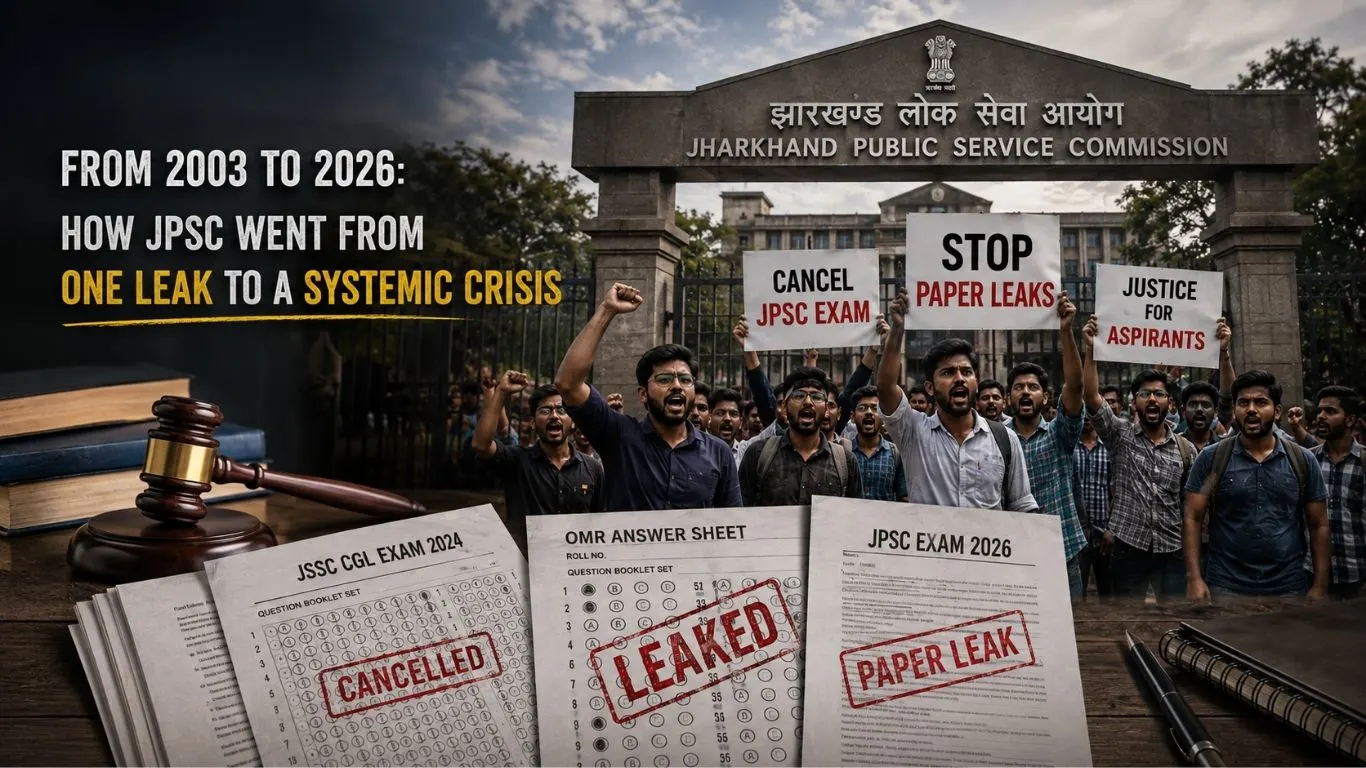
New Delhi: Ranchi has entered the third week of protests over the JPSC exam 2026, with police barricades in place and students continuing hunger strikes against the alleged examination irregularities.
While state officials have treated the latest JPSC paper leak controversy as an isolated incident, the commission’s history points to a much longer pattern of cancellations, court cases, alleged fraud and recruitment disputes.
Since Jharkhand was created in 2000, almost every major JPSC civil service examination cycle has faced some form of controversy. The latest protests, therefore, are not simply about one examination but reflect years of growing distrust among government job aspirants.
JPSC’s Troubled Beginning: The First Civil Services Exam in 2003
Jharkhand established the Jharkhand Public Service Commission (JPSC) soon after the state was carved out of Bihar, giving it a role similar to the Union Public Service Commission (UPSC) at the national level.
The commission recruits officers for important state services, including Deputy Collectors, Deputy Superintendents of Police and Sales Tax Officers through competitive examinations.
JPSC conducted its first Combined Civil Services Examination for 64 posts in 2003, but the recruitment process quickly faced allegations of malpractice that damaged confidence in the newly established system.
The preliminary examination took place in August 2003, but authorities cancelled it soon after allegations emerged that the History paper had leaked. JPSC subsequently reorganised the preliminary examination in 2004, but investigators soon uncovered further concerns involving forged certificates and impersonation.
The commission eventually conducted the mains examination in 2005, but questions over the recruitment process continued to emerge, including concerns about candidates from the same examination centre being selected together, missing OMR sheets and overwritten answer scripts.
Investigators treated these irregularities seriously, and several people connected with the examination process eventually went to prison, while aspirants alleged that political connections influenced the selection of several candidates.
One of the aspirants who experienced this cycle was Manoj Yadav, who began preparing for the JPSC civil services examination in 2003 and later became involved in protests against alleged irregularities.
He faced arrest during protests and fought cases in the Jharkhand High Court, while continuing to remain part of the agitation nearly two decades after his journey with JPSC began.
Second JPSC Exam Turned Into a Major Recruitment Scam
The second JPSC Civil Services Examination offered 172 posts and declared its results in 2008, but the recruitment process soon became associated with allegations of widespread manipulation.
Candidates alleged that officials manipulated or inflated marks in both preliminary and mains answer sheets, while questions also emerged over the selection of evaluators.
The case eventually became widely known as the JPSC scam, and its investigation continued for more than a decade before the chargesheet reached the court.
In 2012, the Jharkhand High Court transferred the investigation from the state Anti-Corruption Bureau to the CBI after the state agency failed to make significant progress. The same year, Justice N. Tiwari froze the salaries and postings of 20 officers from the first batch who faced suspicion.
Between 2012 and 2024, the CBI examined the recruitment of 62 officers from the first batch and 172 officers from the second batch.
Forensic examination of original answer sheets, along with examiner testimony, supported allegations that officials had altered marks through overwriting. Investigators also found that several successful candidates had links to JPSC members, politicians, IAS officers and senior law officers.
On March 8, 2025, a special CBI court took cognisance of the chargesheet and summoned all 60 accused to appear before it.
By that point, several accused officers had already received promotions, with some moving from DSP to SP and others becoming Additional District Magistrates.
The development raised a larger question about accountability because people facing criminal investigations over their recruitment had continued to serve and rise through the government system.
JPSC Exam Controversies Continued Across Multiple Recruitment Cycles
The JPSC recruitment controversy did not end with the first two civil services examinations, as several subsequent exam cycles also faced allegations, court cases and questions over the selection process.
Across the first six completed JPSC civil service examinations, controversies included allegations of manipulated results, unusual selection patterns and missing OMR sheets.
In one case, authorities removed 49 candidates from the results after questions emerged about their selection, while the 7th, 8th, 9th and 10th JPSC examinations faced another major controversy involving missing OMR sheets.
The OMR sheets of 57 candidates went missing, including 49 candidates who had already secured selection, and authorities later cancelled their appointments.
This history explains why the 14th JPSC exam controversy in 2026 has triggered such a strong response from aspirants who say they are reacting not only to a new incident but also to years of recruitment irregularities.
JSSC Exam Controversy Adds to Jharkhand’s Recruitment Crisis
The Jharkhand Staff Selection Commission (JSSC) handles recruitment for Grade III and Grade IV government posts, and its recent examination record has also faced serious controversies.
The JSSC Combined Graduate Level, or JSSC CGL exam, became a major example after its General Knowledge paper appeared online the night before the examination held on January 28, 2024.
Authorities cancelled that examination shift, postponed the planned February re-examination and eventually conducted the test again across 823 centres in September 2024, with more than three lakh candidates appearing.
Fresh allegations of a paper leak followed the re-examination, prompting the Jharkhand High Court to stay the results in December 2024 and order an FIR.
Authorities released the results more than a year after the original examination date, while JSSC later blacklisted TSR Data Processing Pvt Ltd (TDPL) after the company withdrew from its contract.
The same company later handled the 2026 JPSC examination, creating another major point of concern for protesters who are now demanding greater transparency in the recruitment process.
What Triggered the JPSC Protest in 2026?
The 14th JPSC Civil Services Examination advertised 103 posts in January 2026, with nearly half of the vacancies falling under Deputy Superintendent of Police-rank positions.
More than 36,000 candidates appeared for the preliminary examination on April 19, while the results announced on July 2 qualified 2,204 candidates for the mains examination.
The current JPSC protest began after a photograph of a successful candidate’s OMR answer sheet went viral about a week after the results were announced.
The image showed candidate Suman Saurav answering only 48 of the 100 questions in the first paper, yet the candidate qualified for the mains examination.
The photograph quickly became a major flashpoint and helped trigger the indefinite student protest that continues in Ranchi.
The state Criminal Investigation Department registered a case on July 22, 2026, and arrested JPSC deputy controller of examinations Shweta Kumari Gupta, along with two TDPL directors and two employees.
The investigation also raised questions about JPSC hiring TDPL for the 2026 examination despite the company’s earlier blacklisting by JSSC following its withdrawal from the 2024 contract.
Investigation Expands as More Arrests Follow
The investigation later focused on JPSC chairman L. Khiangte, a former Jharkhand chief secretary who faced questioning on four occasions before authorities raided his home and office and he subsequently resigned.
CID investigators also found that a TDPL director, who had been arrested under an alias while working at another government post, had relatives who qualified for the JSSC CGL examination and later served as state employees.
The finding echoed earlier allegations involving insider influence and selection irregularities that have appeared repeatedly in Jharkhand’s recruitment controversies.
By early August, CID had arrested Suman Saurav and 10 others, whom investigators described as organisers of the paper leak.
The arrests, however, did not end the JPSC protest, with student groups arguing that the investigation had strengthened their concerns about deeper problems within the state’s examination system.
What Are JPSC Protesters Demanding?
The JPSC-JSSC Reforms Manch has kept the current agitation largely student-led, although several political organisations have also conducted separate demonstrations and submitted memoranda.
The protesters are demanding cancellation of the 14th JPSC examination following the confirmed paper leak and a CBI investigation into the JPSC case as well as alleged irregularities in earlier JSSC examinations.
They are also seeking cancellation of JSSC examinations such as CGL, JE and PGT conducted after 2019, particularly those linked to TDPL and its director Abhay Tiwari.
Other demands include publication of category-wise cut-offs, OMR sheets and response sheets, along with a fixed annual recruitment calendar similar to UPSC and SSC.
The protesters have also demanded changes in the examination outsourcing system, including the allocation of different stages to different agencies instead of giving one contractor responsibility for the entire examination process.
The government has held talks with student delegations, while Minister Sudivya Kumar has invited suggestions on recruitment reforms.
Although the first round of discussions ended without an agreement, student leaders described the second round as more constructive. At the same time, police have stopped some marches towards the Chief Minister’s residence, while protesters have alleged detentions.
As of August 8, 2026, the JPSC-JSSC protest has entered its 15th day, with the Reforms Manch threatening to march towards the state Assembly on August 10 if the government does not provide firm assurances.
ABVP has also announced a separate demonstration for August 11, leaving the agitation unresolved.
Jharkhand’s JPSC Crisis Reflects a Wider National Problem
The JPSC paper leak controversy is part of a wider problem affecting recruitment and entrance examinations across India.
Major paper leaks and examination irregularities have emerged in states including Uttar Pradesh, Bihar, Rajasthan and Uttarakhand, while cases such as Vyapam and NEET have also triggered nationwide concerns over examination integrity.
The government introduced the Public Examinations (Prevention of Unfair Means) Act, 2024, which criminalises paper leaks, impersonation and other unfair practices.
Despite the legislation, examination controversies continue to surface at the state level, leaving aspirants concerned about whether recruitment systems can provide fair and predictable opportunities.
For Jharkhand’s students and government job aspirants, the current JPSC crisis therefore goes beyond one examination. They are demanding a recruitment system built around transparency, accountability and predictable timelines.
Where Does the JPSC Exam Controversy Stand Now?
The 2024 JPSC scam chargesheet remains before the courts, while the future of the 14th JPSC examination depends on the ongoing investigation into the latest allegations.
With protests, negotiations and fresh demonstrations continuing in Ranchi, the immediate question is whether the Jharkhand government will address the demands raised by students and aspirants.
The larger question is whether Jharkhand can finally break the cycle of JPSC exam controversies, paper leaks, court battles and recruitment disputes that has continued for more than two decades.
Also read: EPS-95 Pensioners Threaten EPFO Office Lockdown Over Pension Hike