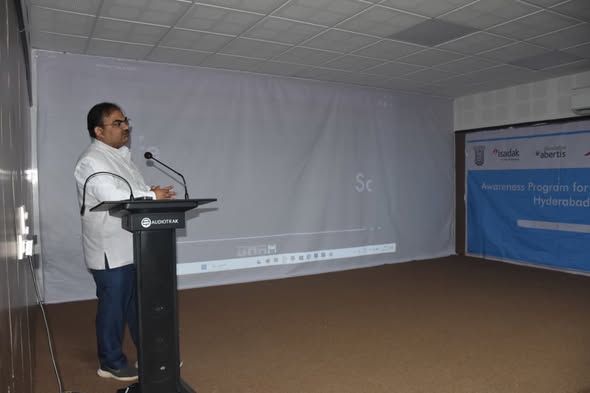
Hyderabad: The Department of Mass Communication and Journalism, Maulana Azad National Urdu University (MANUU), organized an interactive session on Road Safety Awareness with the students of the department, here today. The session aimed to encourage young communicators to view road safety not merely as a matter of traffic discipline but as a broader issue of public health, civic responsibility, and ethical storytelling.
The initiative is part of MANUU’s ongoing effort to connect classroom learning with real-world communication challenges. Faculty members, students, and guest speakers discussed how the next generation of media professionals can shape a culture of safe mobility through responsible journalism, social media campaigns, and community outreach.
Setting the tone for the discussion, Prof. Mohammad Fariyad, Dean, School of Journalism and Mass Communication, MANUU, said that communication students have an important role to play in translating data into awareness. “When students learn to frame stories around social responsibility, like road safety, they not only inform audiences but also save lives,” he remarked.
Prof. Ehtesham Ahmad Khan, Head, Department of Journalism and Mass Communication, MANUU, announced that the Department will create a dedicated resource hub on Road Safety on its website.
Speaking on the health dimensions of road crashes, Dr. Syed Hubbe Ali, Health Specialist, UNICEF India Country Office, emphasized that road traffic injuries are one of the leading causes of death among children and adolescents aged 5–19 years in India. “Road crashes are not only a transportation issue—they are a major but under-recognized health burden. We must strengthen trauma care systems, empower communities with first-response knowledge, and ensure that child safety remains central to all mobility planning,” he said.
The discussion highlighted the need for safer school zones, slower vehicle speeds, and consistent use of helmets and seatbelts as simple, lifesaving measures. The session concluded with an open discussion among students, faculty, and media representatives on how future journalists can drive prevention-focused coverage and promote safety-conscious public discourse. Several students expressed interest in developing road safety features and digital campaigns as part of their coursework.

Prateeksha Kumari is a journalist and strategic communications professional specialising in digital journalism, political reporting, and public affairs. Her work focuses on grassroots issues, governance, and civic developments, with an emphasis on clarity, accuracy, and narrative-driven reporting.
She holds a Master’s degree in Journalism and Mass Communication from Himachal Pradesh University, Shimla and has qualified the UGC-NET examination, reflecting her academic grounding in media studies and communication research. Her reporting spans politics, public policy, health, education, and socio-economic issues, and she is experienced in bilingual (Hindi and English) content creation tailored to diverse audiences.
Alongside her journalistic work, she brings experience in political communication and public relations, where she has contributed to campaign messaging, media outreach, and narrative building. She has worked on integrated communication strategies across print and digital platforms, combining editorial judgment with audience insight and data-led content approaches.