
Amnesty International’s newly released Death Sentences and Executions 2025 report has revealed a sharp global rise in executions, with at least 2,707 people put to death across 17 countries last year. This is the highest figure recorded by the human rights organization since 1981, excluding China where execution data remains secret. The report highlights how a small group of countries, particularly Iran and Saudi Arabia, drove the dramatic 78 percent increase in executions compared to 2024.
Despite the surge in executions, the broader global trend still points toward abolition. More than half of the world’s countries have now completely ended capital punishment, while several others have stopped carrying out executions for years. However, nations across Asia, West Asia and parts of Africa continue to actively use the death penalty, keeping the debate around capital punishment alive in 2026.
According to Amnesty International:
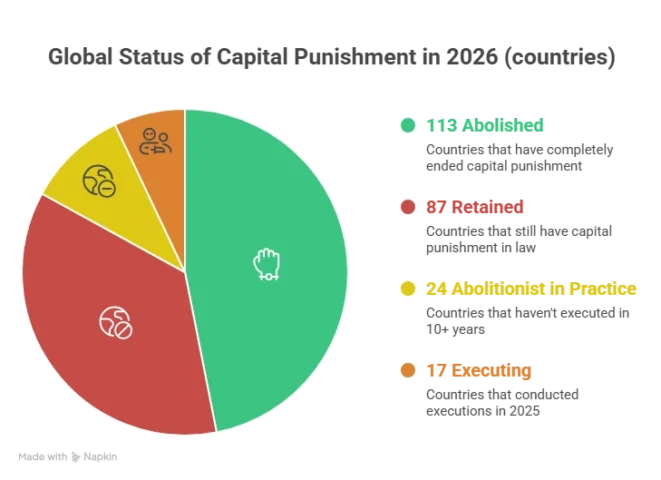
- 113 countries and territories have completely abolished the death penalty.
- 87 countries still retain capital punishment in law.
- Out of those 87 nations, 24 are considered “abolitionist in practice”, meaning they have not carried out executions in at least ten years.
- Only 17 countries were known to have conducted executions in 2025.
Iran Led the Global Rise in Executions
The report states that Iranian authorities executed at least 2,159 people in 2025 — more than double the number recorded in 2024 and the country’s highest figure since 1981 and the country alone contributed to the majority of the global rise in executions.
Several countries recorded sharp increases in executions during 2025:
- Saudi Arabia: at least 356 executions
- United States: 47 executions
- Singapore: 17 executions
- Kuwait: 17 executions
- Egypt: 23 executions
Saudi Arabia continued extensive use of the death penalty for drug-related offences, while the United States nearly doubled its execution count compared to 2024.
Death Penalty in Asia
Asia continues to be one of the regions where the death penalty remains widely present in the countries including:
- India
- Thailand
- Indonesia
- Singapore
- Vietnam
- China
Among these Afghanistan was the only country in South Asia to have carried out executions in 2025.
Europe Has Almost Completely Abolished Capital Punishment
In Europe, Belarus is currently the only European country where the death penalty still legally exists. However, Amnesty International noted that 2025 was the first year since President Alexander Lukashenko came to power in 1994 that no new death sentences or executions were recorded in the country.
Russia technically still retains the death penalty in law but is classified as “abolitionist in practice” because it has not carried out executions for over a decade.
Also read: India Condemns Drone Strike Targeting UAE’s Barakah Nuclear Plant, Calls It ‘Dangerous Escalation’
United States Remains the Only Executioning Nation in the Americas
The United States continued to be the only country in the Americas to carry out executions. In 2025:
- 47 executions took place across 11 states
- Florida alone accounted for 19 executions
- The total nearly doubled from 25 executions in 2024
Africa and West Asia Continue Active Use
In Sub-Saharan Africa, only Somalia and South Sudan carried out executions in 2025. Meanwhile, Iran and Saudi Arabia together accounted for a significant portion of global executions.
Also read: Why Petrol and Diesel Prices Jumped ₹3 in a Single Day — And Is the Worst Still to Come?
Countries That Recently Abolished the Death Penalty
The global movement against capital punishment has continued to grow in recent years, with countries such as Zambia, Ghana, Zimbabwe and Equatorial Guinea moving toward abolishing the death penalty either completely or for most crimes. Many governments have cited concerns over wrongful convictions, misuse of state power, unfair judicial processes and broader human rights violations as key reasons behind ending capital punishment.
Why the Death Penalty Remains Controversial
The death penalty continues to remain one of the most debated issues in the global justice system. Supporters argue that capital punishment serves as a strong deterrent against serious crimes such as murder and terrorism. However, human rights organizations and critics argue that the system carries significant risks, including the possibility of wrongful executions, political misuse by governments, discrimination against marginalized communities and unfair trials. Opponents also maintain that the death penalty violates the fundamental right to life and can never be reversed once carried out.
FAQs
Around 87 countries still retain the death penalty in law, although only 17 countries were known to carry out executions in 2025.
China is believed to execute the most people globally, though official figures are secret. Among publicly available data, Iran recorded the highest number with at least 2,159 executions.
Almost entirely. Belarus is the only European country where the death penalty still legally exists.
Yes. India retains the death penalty for rare and severe crimes, although executions are infrequent.
Recent countries include Zambia, Ghana, Zimbabwe and Equatorial Guinea.
Yes. The United States was the only country in the Americas known to conduct executions in 2025.
Human rights groups argue that the death penalty violates the right to life and can lead to wrongful executions, political misuse and unfair judicial outcomes.

Prateeksha Kumari is a journalist and strategic communications professional specialising in digital journalism, political reporting, and public affairs. Her work focuses on grassroots issues, governance, and civic developments, with an emphasis on clarity, accuracy, and narrative-driven reporting.
She holds a Master’s degree in Journalism and Mass Communication from Himachal Pradesh University, Shimla and has qualified the UGC-NET examination, reflecting her academic grounding in media studies and communication research. Her reporting spans politics, public policy, health, education, and socio-economic issues, and she is experienced in bilingual (Hindi and English) content creation tailored to diverse audiences.
Alongside her journalistic work, she brings experience in political communication and public relations, where she has contributed to campaign messaging, media outreach, and narrative building. She has worked on integrated communication strategies across print and digital platforms, combining editorial judgment with audience insight and data-led content approaches.


