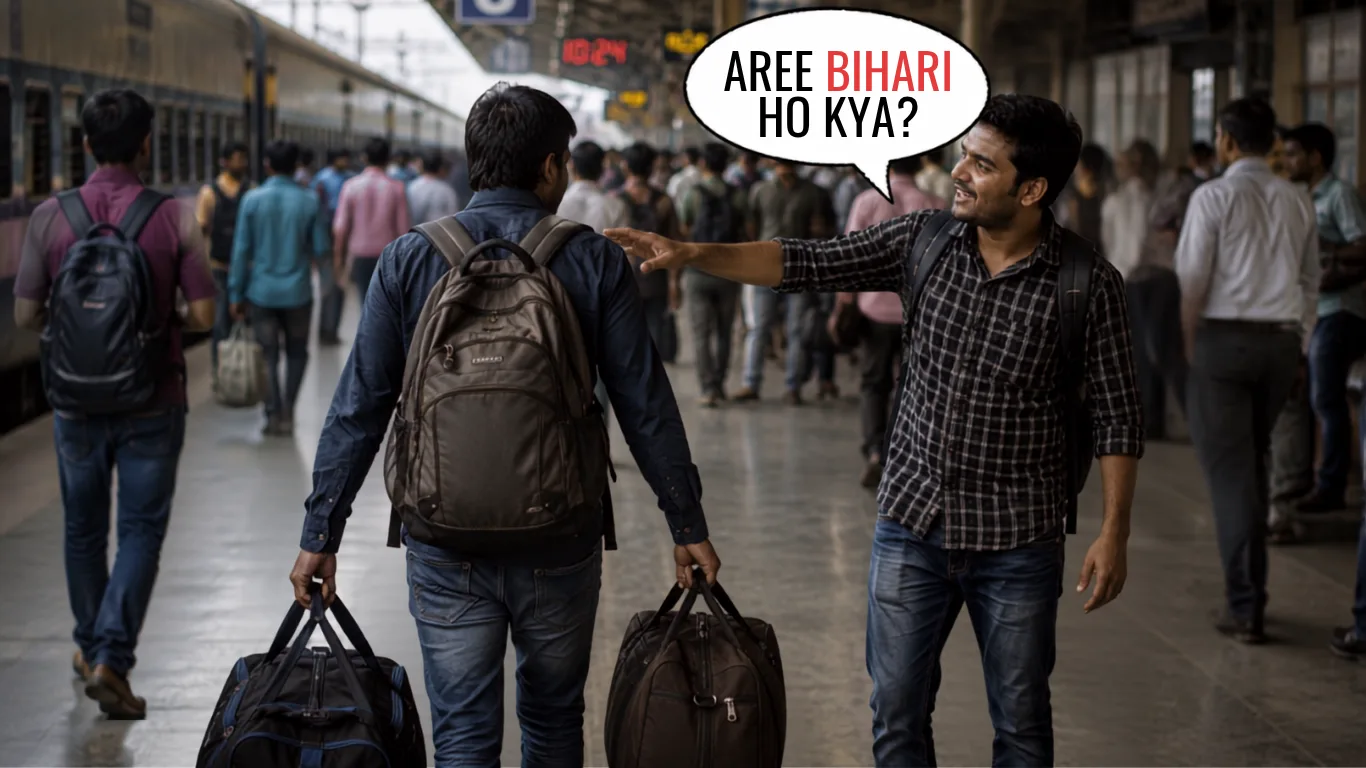
New Delhi: At a railway station or bus stand in a big city, a person steps down holding a bag on his shoulder and another in his hand, with hope in his eyes. While walking out, he accidentally bumps into someone, and that person jokingly says, “Are you a Bihari?”
This is not just a question—it reflects the image now associated with Bihar: poverty, migration, labor, and backwardness. Is this really Bihar’s only identity today?
Was Bihar always like this?
If someone traveled back 1500 years and arrived in Bihar, they would probably see one of the most developed and knowledge-rich regions in the world.
This was the land from which empires rose, where science was born, where some of the greatest works of political thought were written, and where the world’s largest university once stood.
So what changed? How did Bihar, once a global center of knowledge, fall behind in the race of development? Why is Bihar now seen differently?
Also read: The Mystery of Kuldhara: Why Was This Rajasthan Village Abandoned Overnight?
When Bihar was the world’s knowledge hub
Today, when we talk about the world’s greatest universities, we mention Harvard, Oxford, and Cambridge.
But centuries before these institutions existed, Bihar had the Nalanda University. In the 7th century, the famous Chinese traveler and scholar Xuanzang wrote that thousands of students and teachers studied there. According to historians, Nalanda had around 10,000 students and 2,000 teachers. Students from China, Korea, Japan, Tibet, and Southeast Asia also came to study here.
Along with Nalanda, Bihar also had Vikramshila University, which was considered one of the world’s leading centers of learning at that time.
This is also the land where mathematician Aryabhata gave a new direction to astronomy and mathematics. This is the region where Chanakya wrote political and governance theories that are still studied today.
The land of empires
Bihar was not only a center of education. It was ancient Magadh, from where the Maurya Empire rose under Chandragupta Maurya. From here, Emperor Ashoka ruled and spread Buddhism across Asia.
While much of Europe was divided into small kingdoms, the Bihar-Magadh region was among the most powerful political centers in the world.
How did the decline begin?
No civilization collapses in a single day. Bihar’s decline also happened gradually. In the 12th century, during foreign invasions, major educational institutions like Nalanda and Vikramshila were destroyed, and their libraries were burned.
It is said that Nalanda’s library was so vast that the fire kept burning for several days.
However, historians have different opinions on this, but it is certain that the destruction of these institutions was a major blow to India’s knowledge tradition.
The British era and changing realities
To understand Bihar’s economic backwardness, colonial rule cannot be ignored. The British colonial system was focused not on development but on resource extraction. Bihar’s fertile land generated revenue, but there was little investment in industries or modern infrastructure. The zamindari system further weakened farmers’ conditions.
While some parts of India began industrial development, Bihar remained largely dependent on agriculture and fell behind.
Why didn’t Bihar improve after independence?
After independence in 1947, Bihar’s challenges did not end. Other states focused on industry, construction, and urbanization. Maharashtra developed automobile industries, Gujarat became a trade hub with ports, and Karnataka became a technology center.
But Bihar was largely left out of the industrial revolution.
In 2000, Jharkhand was separated from Bihar. With this, most of Bihar’s mineral resources and several industrial regions also went to the new state. This became a major setback for Bihar’s economy.
Politics vs development
Bihar’s politics did bring social change. Marginalized communities gained representation, and debates on social justice strengthened. However, many experts believe that for decades, caste-based politics remained central, while issues like industry, education, employment, and investment did not progress at the same pace.
As a result, despite a large population, employment opportunities remained limited.
Migration: Bihar’s biggest identity
Today, there is hardly any family in Bihar whose member does not work outside the state.
From construction sites in Delhi to farms in Punjab, from factories in Mumbai to offices in Bengaluru, Biharis are visible everywhere.
Ironically, the same hardworking people who contribute to other states’ development are forced to migrate due to lack of opportunities in their own state. Gradually, the word “Bihari” became less a regional identity and more associated with labor and migration.
Impact of natural disasters
Bihar’s geography also creates challenges. Due to rivers like the Kosi, Gandak, and others, North Bihar faces floods every year, affecting millions of people and destroying crops. Roads and infrastructure also suffer repeated damage.
But is Bihar only a story of backwardness?
Even today, Bihar is one of the states providing the largest youth population to India. Students from Bihar consistently succeed in IAS, IPS, engineering, medical, and competitive examinations.
Not only this, many of India’s leading journalists, scientists, teachers, writers, and administrators come from Bihar. The problem is not talent. The problem is opportunity.
The bigger question
When someone hears the name Bihar and thinks of poverty, labor, and corruption, they are only seeing the present.
But Bihar’s story is much larger than the present. It is the story of a land that once gave the world universities, empires, mathematicians, philosophers, and governance systems.
Perhaps the real question is not why Bihar is backward today. The real question is: when will the state that once gave knowledge to the world regain its lost identity?