
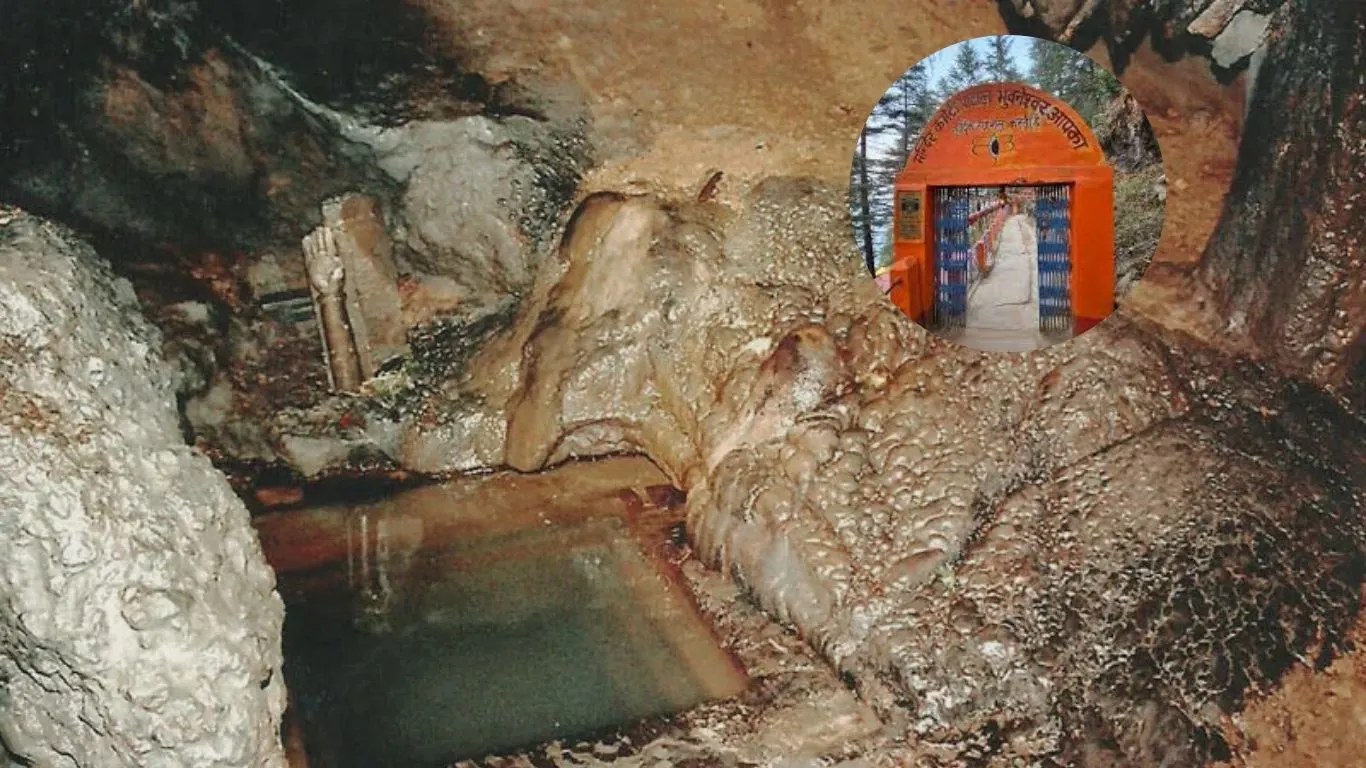
New Delhi: Hidden in Uttarakhand’s Pithoragarh district, Patal Bhuvaneshwar is one of India’s most remarkable cave temples. Located near Gangolihat at an altitude of about 1,350 metres, the limestone cave stretches through a naturally formed underground network shaped by flowing water over thousands of years.
The cave’s significance extends beyond its geological beauty. For centuries, devotees and local priests have linked its chambers and rock formations to stories from Hindu mythology. Many of these traditions draw from the Skanda Purana and other sacred texts, while others survive through generations of local oral tradition.
Why the Cave Remains Off the Main Pilgrimage Circuit
Patal Bhuvaneshwar lies about 14 kilometres from Gangolihat in the Kumaon Himalayas. Unlike Kedarnath or Badrinath, it sits away from Uttarakhand’s busiest pilgrimage routes. Visitors must make a deliberate journey through mountain roads to reach the temple, which partly explains why many travellers still overlook it.
Despite its relative isolation, local tradition places the cave among Hinduism’s most sacred sites. Many devotees believe that visiting Patal Bhuvaneshwar offers spiritual merit equal to completing the Char Dham Yatra. The Manas Khand section of the Skanda Purana also describes Bhuvaneshwar as a place where devotees can experience divine presence.
The Sacred Landscape Begins Before the Cave
Most pilgrims begin their journey at nearby temples such as Haat Kalika and Varadh Bhuvaneshwar before entering the cave. Local belief treats these shrines as part of one larger sacred landscape that stretches across Gangolihat and the surrounding hills.
For devotees, the cave is not an isolated monument. It forms the spiritual centre of an ancient network of temples that has attracted pilgrims for centuries.
Descending Into Another World
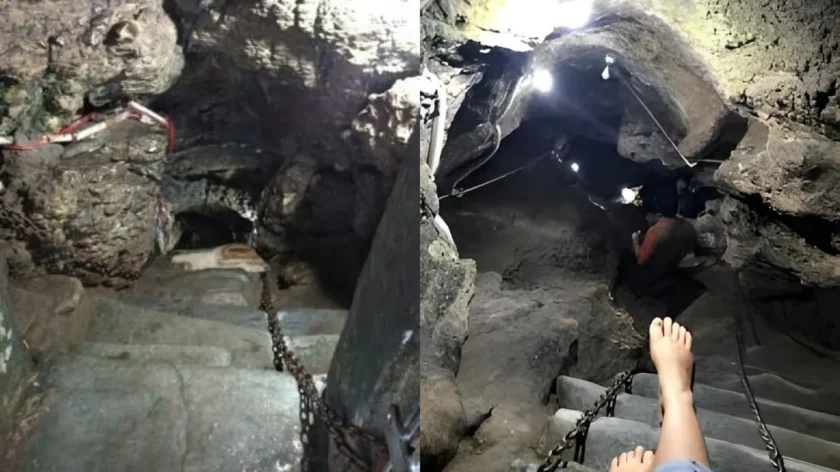
The entrance appears as a narrow opening in the earth. Local tradition says it resembles the hood of Sheshnag, the cosmic serpent. After ringing the temple bell, visitors squeeze through the opening, hold iron chains for support and descend 82 steep steps into a cave that stretches nearly 160 metres underground.
Inside, the cave unfolds into a series of interconnected chambers. Each chamber carries its own story from Hindu mythology. Mineral-rich water created every formation naturally over thousands of years, yet priests identify almost every rock as a deity, sacred animal or mythological event.
According to local belief, the cave itself represents the body of Sheshnag. Guides point to several formations that they identify as parts of the serpent’s body. Many pilgrims believe they are literally walking through the cosmic serpent that supports the universe.
The oldest legend connected with the cave traces back to King Rituparna. Tradition says Sheshnag personally guided the king through these hidden chambers during the Treta Yuga.
Every Chamber Opens a New Chapter
No single legend defines Patal Bhuvaneshwar. Every chamber introduces another episode from Hindu mythology. As visitors move deeper underground, the cave unfolds like a living map of stories that span from the Treta and Dwapara Yugas to the end of Kali Yuga.
The Hawan Kund of King Janamejaya
The first feature visitors encounter is a hawan kund near the entrance. Priests say this is not a modern ceremonial structure. According to tradition, King Janamejaya, son of King Parikshit, performed the legendary Sarpa Satra here. Hindu scriptures describe the ritual as an attempt to destroy all serpents after Takshaka caused his father’s death.
Nearby, a limestone formation represents Takshaka himself, frozen at the moment before the great sacrifice began.
Lord Narasimha
A narrow passage between two stairways contains a formation that devotees identify as Lord Narasimha, the half-man, half-lion incarnation of Lord Vishnu. The deity occupies a transitional space between chambers, matching his unique place in Hindu mythology.
The Head of Adi Ganesha
One of the cave’s most revered formations appears deeper inside. Devotees believe it represents the original human head of Lord Ganesha before Lord Shiva replaced it with an elephant’s head.
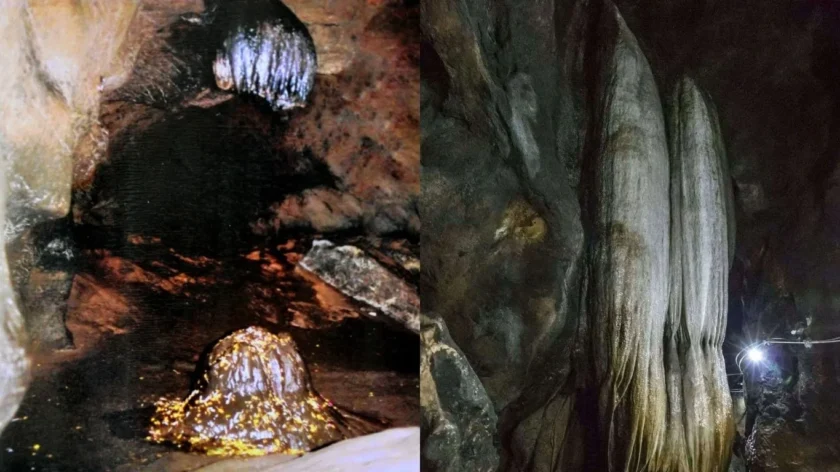
Above the formation hangs a naturally formed eight-petalled limestone lotus known as the Brahmakamal. According to tradition, Lord Shiva placed it there after severing Ganesha’s head. The lotus continues to release drops of water into the mouth-shaped rock below. Devotees regard these drops as the nectar of life that has flowed continuously since ancient times.
No sculptor created these formations. Nature shaped them over thousands of years, while faith gave them meaning.
The Hundred Legs of Airavata
Several thick stalagmites rise naturally from the cave floor. Local tradition identifies them as the hundred legs of Airavata, the white elephant of Lord Indra that emerged during the Samudra Manthan.
Nearby formations also represent Kamadhenu, the wish-fulfilling divine cow, and Kalpavriksha, the celestial tree believed to grant every wish. Together, these formations recreate some of Hindu mythology’s most enduring symbols.
The Passage Through Kal Bhairav
As visitors move deeper into the cave, the pathway narrows sharply. At one point, many must bend or crawl to continue. Local guides identify this passage with Kal Bhairav, the fierce manifestation of Lord Shiva associated with time, death and protection.
According to tradition, passing through this narrow section symbolizes crossing through Kal Bhairav’s realm before entering the cave’s holiest chambers.
Shiva’s Jatas and Bhagirath’s Prayer
Large stalactites hang from the cave ceiling throughout the underground complex. Devotees identify them as the matted locks, or jatas, of Lord Shiva.
Beneath the largest formation lies a small natural water pool. According to tradition, King Bhagirath prayed here while seeking to bring the River Ganga from heaven to earth. He wanted the sacred river to liberate the souls of his 60,000 ancestors, who had perished under Sage Kapil’s curse.
Hindu tradition says Ganga agreed to descend but warned that her force would shatter the earth. Bhagirath then prayed to Lord Shiva, who caught the river in his matted hair before gently releasing it onto the earth.
Devotees believe the water collected in the kund represents that sacred descent.
Beside the pool stands another formation that local priests identify as the hand of Vishwakarma, the divine architect. Tradition says he built the kund during the Pandavas’ visit. Priests also believe no one knows its true depth.
The Greedy Swan
One chamber contains a limestone formation shaped like a bird with its neck turned backward.
Guides identify it as the Hamsa, the divine swan of Lord Brahma. According to local tradition, the swan once guarded the celestial nectar pool. Greed overcame it, and it drank the nectar it had been assigned to protect.
The gods punished the bird by twisting its neck backward forever. The unusual rock formation preserves that story in stone.
The Three Dhams in Stone
Further inside, guides point to three natural limestone formations that resemble Amarnath, Kedarnath and Badrinath.
These formations form the basis of a long-standing belief that Patal Bhuvaneshwar shares an underground spiritual connection with the Char Dham shrines and Kailash Mansarovar.
For devotees, the cave serves as more than another pilgrimage destination. It represents the spiritual centre from which many of Hinduism’s holiest places remain connected beneath the Himalayas.
The Sanctum Sanctorum
The deepest section open to visitors has noticeably thinner air, so priests advise pilgrims not to remain there for long.
At its centre stands a crystal-like formation worshipped as the Shiva-Shakti Lingam. Devotees believe it symbolizes the unity of Brahma, Vishnu and Mahesh.
Three formations above the lingam represent the divine trinity. Water falls continuously onto the lingam from the cave ceiling, creating a natural stream that devotees consider sacred.
The Four Pillars of Time
One of the cave’s most discussed features is a group of four stone pillars.
Local tradition associates each pillar with one of Hindu cosmology’s four yugas—Satya, Treta, Dwapara and Kali.
The first three pillars remain shorter than the fourth. Devotees believe the pillar representing Kali Yuga continues to grow naturally. According to tradition, the present age will end when this pillar finally touches the cave ceiling.
A Sacred History Across Three Yugas
Local tradition traces the cave’s history across three different yugas.
In the Treta Yuga, King Rituparna of the Surya dynasty is believed to have discovered the cave with the guidance of Adishesha. Tradition says he became the first human to witness Lord Shiva and other deities inside Patal Bhuvaneshwar.
During the Dwapara Yuga, the Pandavas are believed to have rediscovered the cave and worshipped here during their final journeys.
In the Kali Yuga, tradition credits Adi Shankaracharya with reviving the temple’s rituals during the medieval period. Priestly families associated with the shrine continue to preserve those traditions through successive generations.
The Underground Connection
One of the cave’s most enduring beliefs concerns the passages that extend beyond the areas open to visitors.
According to local tradition, these hidden tunnels continue beneath the Himalayas and connect Patal Bhuvaneshwar with Kedarnath, Badrinath, Amarnath and Kailash Mansarovar.
No archaeological evidence confirms this belief. Nevertheless, generations of devotees have accepted it as part of the cave’s sacred geography.
This belief also explains why many pilgrims consider a visit to Patal Bhuvaneshwar spiritually equal to completing the Char Dham Yatra.
What Visitors Leave Behind
Before entering the cave, visitors usually deposit their phones and cameras outside. Inside, they move through narrow limestone passages in single file, using iron chains for support. Water drips steadily from the ceiling, while the air grows cooler and thinner with every step underground.
The experience extends beyond individual rock formations or legends. The silence, darkness and scale of the cave leave a lasting impression on most visitors. Every chamber blends natural geology with centuries of mythology and oral tradition.
Some arrive as pilgrims seeking blessings. Others come to explore history, architecture or the natural landscape of the Himalayas. Many simply arrive out of curiosity.
Whatever draws people to Patal Bhuvaneshwar, most leave with the same conclusion. Few places in India bring together geology, faith and mythology in quite the same way.
Hidden beneath the Kumaon hills, the cave continues to preserve stories that devotees have passed down for generations. Whether viewed through the lens of religion, history or geology, Patal Bhuvaneshwar remains one of the Himalayas’ most distinctive sacred sites.


