
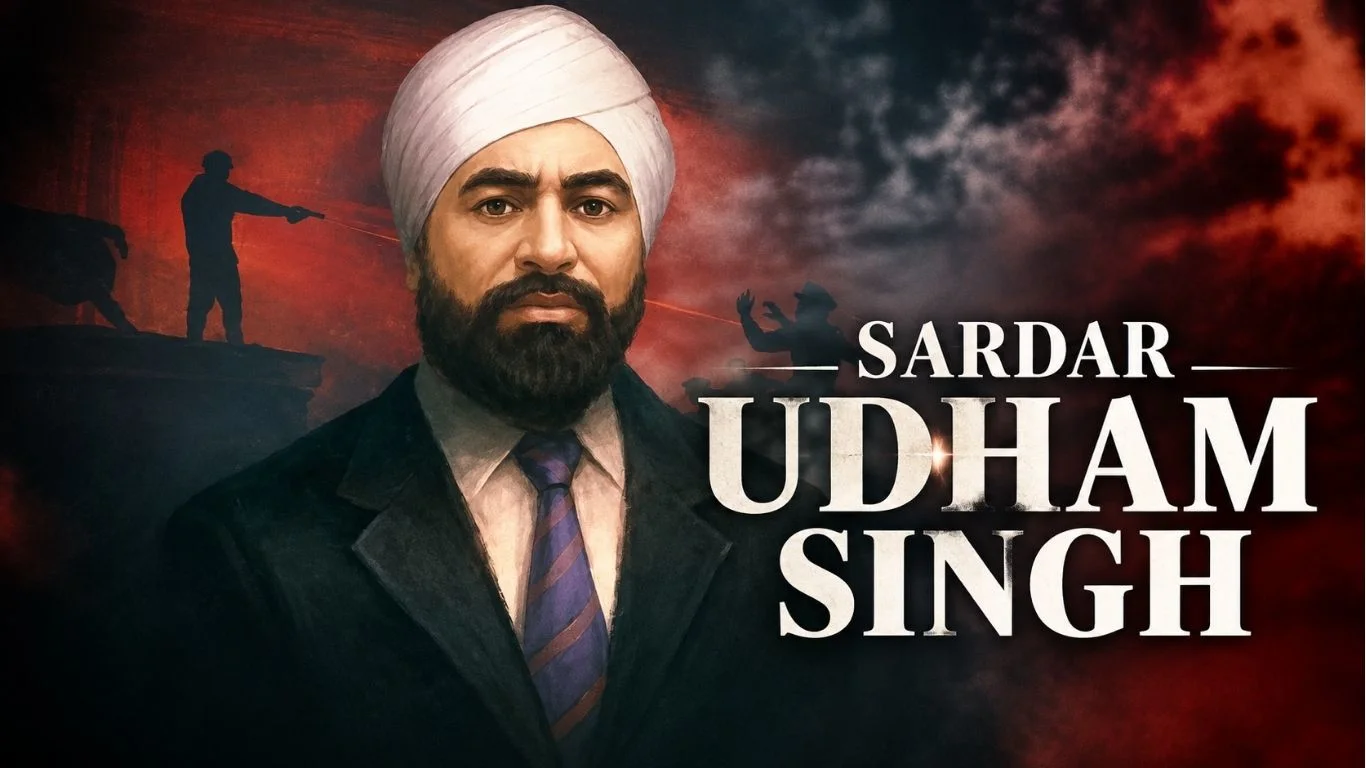
New Delhi: On 31 July 1940, British authorities hanged Udham Singh at Pentonville Prison in London, ending the life of one of India’s most determined revolutionaries. But his story had begun decades earlier, shaped by personal loss and the political upheaval of colonial India.
His life of sacrifice, secrecy, and unwavering conviction still holds a significant place in India’s freedom struggle.
A Childhood Shaped by Loss
Udham Singh was born on 26 December 1899 in Sunam, then part of the princely state of Patiala and now in Punjab’s Sangrur district.
Tragedy struck early in his life. He lost both his parents while still a child, leaving him and his elder brother without immediate family to care for them. The brothers eventually found refuge at the Central Khalsa Orphanage in Putlighar, Amritsar.
The orphanage gave Udham Singh shelter, an education, and the discipline that shaped his future. He passed his matriculation examination in 1917. Soon afterward, colonial India’s political turmoil changed the course of his life.
Also read: Martyrs’ Day 2026: The Story of 17-Year-Old Girl Who Faced British Guns Unarmed
The Massacre That Changed Everything
Two years after finishing school, the Jallianwala Bagh massacre changed Udham Singh’s life forever.
On 13 April 1919, the day of Baisakhi, thousands of people gathered at Jallianwala Bagh in Amritsar. Some came to celebrate the harvest festival. Others gathered to protest British repression and the recently imposed Rowlatt Act.
Brigadier-General Reginald Dyer marched into the enclosed garden with British and Indian troops and ordered them to fire on the unarmed crowd. The soldiers fired continuously for several minutes, killing and injuring hundreds of people.
British records put the death toll at 379. Indian sources and many historians estimate that more than 1,000 people died.
The enclosed garden had only a few narrow exits, trapping many people inside. Some tried to climb over the walls, while others jumped into a nearby well in a desperate attempt to escape.
Accounts differ on whether Udham Singh witnessed the massacre or arrived shortly afterward as a volunteer from the Khalsa Orphanage to help the wounded. What remains undisputed is that the tragedy left a lasting impact on him. From that day, Jallianwala Bagh became central to his life.
Twenty-One Years of Preparation
Udham Singh did not act immediately. Instead, he spent the next two decades working with revolutionary groups, underground networks, and anti-colonial movements.
He joined the Ghadar Party, a revolutionary organisation founded by Indians abroad to fight British rule. While in the United States in 1924, he became part of the movement. Later, he returned to India carrying weapons and revolutionary literature.
Police arrested him in 1927 for possessing illegal arms and sentenced him to five years in prison. After his release in 1931, authorities kept him under close surveillance. He later escaped through Kashmir and travelled to Europe.
Over the years, he travelled across Asia, Africa, North America, and Europe, including the United States, Canada, Mexico, Germany, France, and the Soviet Union. To avoid British intelligence, he used aliases such as Frank Brazil and Mohammad Singh Azad.
By 1935, he had settled in London. He worked as a carpenter, motor mechanic, signboard painter, and engineer to support himself. Behind this ordinary life, however, remained a revolutionary who had never forgotten Jallianwala Bagh. He continued waiting for his moment.
Caxton Hall, 13 March 1940
On 13 March 1940, Udham Singh finally got the opportunity he had waited 21 years for.
The East India Association and the Royal Central Asian Society held a joint meeting at Caxton Hall in London. Michael O’Dwyer, the former Lieutenant Governor of Punjab, attended the gathering.
Udham Singh entered the hall carrying a revolver. Some accounts say he hid the weapon inside a book. He quietly took his position and waited.
As the meeting ended, Udham Singh drew his revolver and fired at Michael O’Dwyer. Two bullets struck O’Dwyer, killing him instantly.
The shooting also injured Lord Zetland, then Secretary of State for India, Louis Dane, a former Lieutenant Governor of Punjab, and Lord Lamington, a former Governor of Bombay.
Udham Singh made no attempt to escape. Police arrested him at the scene. For him, the 21-year wait had finally ended.
Trial and Execution
Authorities charged Udham Singh with murder on 1 April 1940 and lodged him in Brixton Prison before his trial. He neither denied the killing nor sought mercy.
When asked to state his name, he refused to reveal his real identity. Instead, he introduced himself as “Ram Mohammad Singh Azad,” a name that reflected his belief in unity among India’s religious communities and his commitment to freedom.
During the trial, he described his actions as a response to the suffering that British rule had inflicted on Indians. The court found him guilty and sentenced him to death.
On 31 July 1940, British authorities hanged Udham Singh at Pentonville Prison in London. He was forty years old.
His execution came exactly 21 years after the Jallianwala Bagh massacre that had shaped his revolutionary mission.
Legacy Reclaimed
For decades after Independence, Udham Singh received less public attention than several other revolutionaries, including Bhagat Singh. Colonial restrictions and wartime secrecy also limited access to records about his life.
Over time, India gave greater recognition to his contribution to the freedom struggle. In 1974, the government brought his remains back from England and cremated him in his birthplace, Sunam. His family later immersed his ashes at Jallianwala Bagh, the place that had shaped his life and mission.
In 1995, the government of Uttarakhand named a district Udham Singh Nagar in his honour.
Efforts to preserve and study his legacy have continued. In February 2023, Punjabi University, Patiala, established the Shaheed Udham Singh Chair on the initiative of the Government of Punjab.
The Chair also studies how Punjabi literature, folklore, and cinema portray Udham Singh. Its work ensures people remember him not only for avenging Jallianwala Bagh but also as a revolutionary shaped by colonial violence, political conviction, and an unwavering commitment to India’s freedom.
Man Behind the Legend
Udham Singh’s life remains a remarkable story of patience, determination, and conviction. For 21 years, he carried the memory of Jallianwala Bagh. He travelled across continents, lived under assumed names, worked ordinary jobs, and stayed connected to revolutionary networks while waiting for the chance to confront the man he believed responsible for the massacre.
Historians continue to debate Udham Singh’s killing of Michael O’Dwyer and the role of revolutionary violence in the anti-colonial struggle. Yet many Indians regard him as a symbol of the anger and sacrifice born from Jallianwala Bagh.
Today, people remember Udham Singh not simply as the man who avenged Jallianwala Bagh. They also remember him as a revolutionary whose journey from an orphaned child to a freedom fighter became inseparable from one of the darkest chapters of British colonial rule.
His story reminds us that India’s freedom struggle relied not only on mass movements but also on the courage, sacrifice, and determination of individuals who refused to forget.


