
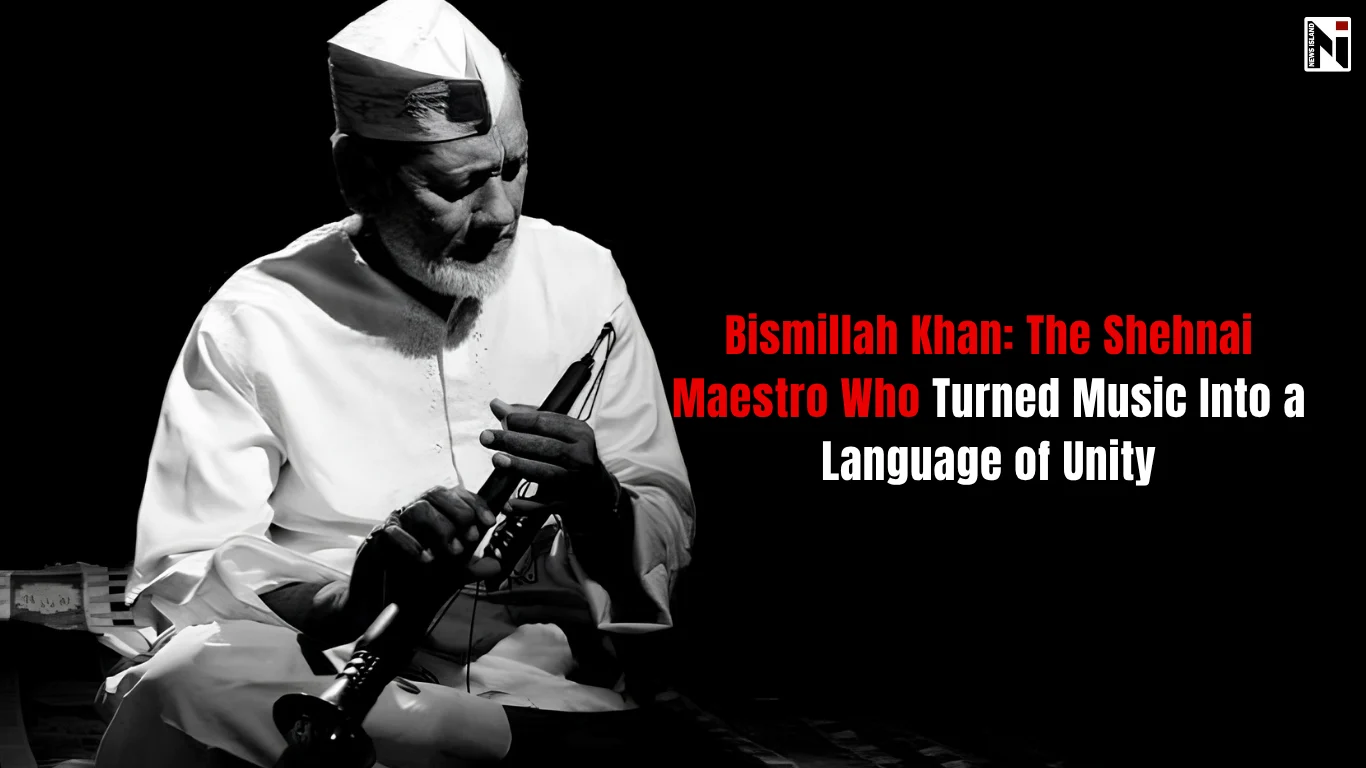
New Delhi: “Look, both things are here the Ganga is in front of us, so bathe in it. There is a mosque, so offer your prayers. We came running from here, offered namaz, and then went to the Balaji temple, where we practised.”
These words of Ustad Bismillah Khan capture the essence of a man who never saw music through the boundaries of religion. For him, the Ganga, the mosque and the temple were all part of the same spiritual journey, and the Shehnai was his way of expressing it. The man who took the Shehnai from weddings and ceremonies to the world’s most prestigious stages was honoured with the Bharat Ratna in 2001, India’s highest civilian award.
When he passed away on 21 August 2006, the country lost not just a legendary musician, but a voice that had turned the Shehnai into a symbol of India’s cultural unity. Even today, his music echoes the message he lived by sur has no religion, music has no boundaries, and art has the power to bring people together.
Music Was His Family Legacy
Ustad Bismillah Khan was born on 21 March 1916 in Dumraon, Bihar. He was born into a family where music had been a part of life for generations. His father, Paigambar Bakhsh Khan, played the Shehnai in the court of the Maharaja of Dumraon. Several generations of his family before him were also associated with court music.
At the time of his birth, he was named Qamaruddin. It is said that when his grandfather, Rasool Bakhsh Khan, saw the newborn child, the word “Bismillah” came from his lips, and that name eventually became his identity.
Music surrounded him from childhood. But for Bismillah Khan, the Shehnai was not merely a family tradition. Gradually, it became his entire world.
The Shehnai Journey Began at the Age of Six
Bismillah Khan came to Banaras, now known as Varanasi, at a young age. There, a meeting with his maternal uncle and guru, Ali Bakhsh ‘Vilayatu’, changed the course of his life. Ali Bakhsh was a prominent Shehnai player associated with the Kashi Vishwanath Temple. He recognised the talent of young Bismillah and began teaching him the Shehnai.
From then on, a major part of his life was devoted to practice. He spent hours practising the Shehnai at Balaji Temple, along the banks of the Ganga and at other temples. The flowing Ganga and the spiritual atmosphere of Banaras gave his music a unique character.
Through years of intense practice, he experimented with ragas and musical notes that were considered difficult to perform on the Shehnai at that time.
This was the period when the Shehnai in his hands stopped being just a musical instrument. It became a form of devotion and spiritual practice.
When Did He First Play the Shehnai?
Bismillah Khan began learning the Shehnai in childhood and started performing publicly at a very young age. There are some differences among sources regarding the exact year of his first major public performance. According to records of the Sangeet Natak Akademi, he gave his first public musical performance at the age of 14 at the All India Music Conference in Allahabad, where he began gaining wider recognition.
Later, his performance at the All India Music Conference in Calcutta in 1937 became a major turning point in his career. Following this performance, the perception of the Shehnai in the world of music began to change rapidly.
At that time, the Shehnai was primarily associated with weddings, religious ceremonies and traditional occasions. Very few artists had established it as a serious instrument for classical music. Bismillah Khan changed that perception.
He Gave the Shehnai a Place in Classical Music
One of Bismillah Khan’s greatest achievements was taking the Shehnai beyond weddings and religious ceremonies and bringing it onto the stage of Indian classical music. His style carried the depth of ragas, the sweetness of musical notes and the essence of Banaras.
The Sangeet Natak Akademi also recognises his extraordinary contribution in giving the Shehnai its important position in Indian classical music.
By the late 1930s, his music had also begun reaching a much wider audience through radio. Broadcasts by All India Radio brought his music to thousands and eventually millions of listeners. Gradually, Bismillah Khan’s name became synonymous with the Shehnai across India.
The Dawn of Independent India and Bismillah Khan’s Shehnai
15 August 1947 is one of the most important dates in Indian history. The country became independent, and Prime Minister Jawaharlal Nehru hoisted the national flag from the Red Fort. On this historic occasion, Bismillah Khan’s Shehnai gave a musical voice to the dawn of independent India.
His Shehnai was also heard during the early Republic Day celebrations. In this way, his music became more than just a part of Indian classical music it became a part of the country’s national memories.
Banaras’ Shehnai Reached the World
Bismillah Khan performed in several countries outside India. He took Indian classical music to Europe, the United States, Canada, Japan, the Middle East and the then Soviet Union, among other places. He performed at prestigious music festivals and gave the Indian Shehnai international recognition.
Despite achieving such immense fame, however, his heart remained in Banaras. He loved the lanes of Banaras, the banks of the Ganga and its spiritual atmosphere. For him, music was a path towards connecting with the divine.
His Music Rose Above Religious Boundaries
One of the most beautiful aspects of Bismillah Khan’s life was his cultural harmony. He was a devout Muslim, yet he practised the Shehnai inside temples in Banaras. For him, the Ganga, the mosque and the temple were not separate identities; they were all parts of the same life.
This philosophy could be heard in his Shehnai. He believed that music could bring people together. His life became an example of the fact that art has no religious boundaries.
This is also why his popularity went far beyond music lovers. He became a symbol of India’s cultural unity.
A Life Filled With Honours
Bismillah Khan received some of the country’s highest honours for his contribution to music. He was awarded the Sangeet Natak Akademi Award in 1956. He was later honoured with the Padma Shri in 1961, the Padma Bhushan in 1968 and the Padma Vibhushan in 1980.
In 2001, he was awarded the Bharat Ratna, India’s highest civilian honour.
These honours were not merely recognition for an individual artist. They were also a tribute to the Shehnai, the instrument that he had taken to an entirely new level on the world stage.
The Shehnai Fell Silent on 21 August 2006
After a life spanning nearly nine decades, Ustad Bismillah Khan passed away on 21 August 2006 at the age of 90.
But like the greatest artists, his voice never truly fell silent. Even today, whenever the melodious sound of the Shehnai is heard, the name of Bismillah Khan is among the first to come to the minds of Indian music lovers.
He proved that an artist’s true identity is not determined simply by the instrument in their hands, but by how much soul they can put into it. He did not merely play the Shehnai; he gave it a new life.
His practice along the banks of the Ganga, his Shehnai echoing through temples, his prayers at the mosque and his performances on the world’s greatest stages all of these together made Bismillah Khan much more than just the ‘Shehnai maestro’.
He became a voice of Indian culture a voice that continues to remind us that music has no caste, melodies have no boundaries, and true art has the power to connect one human being with another.


