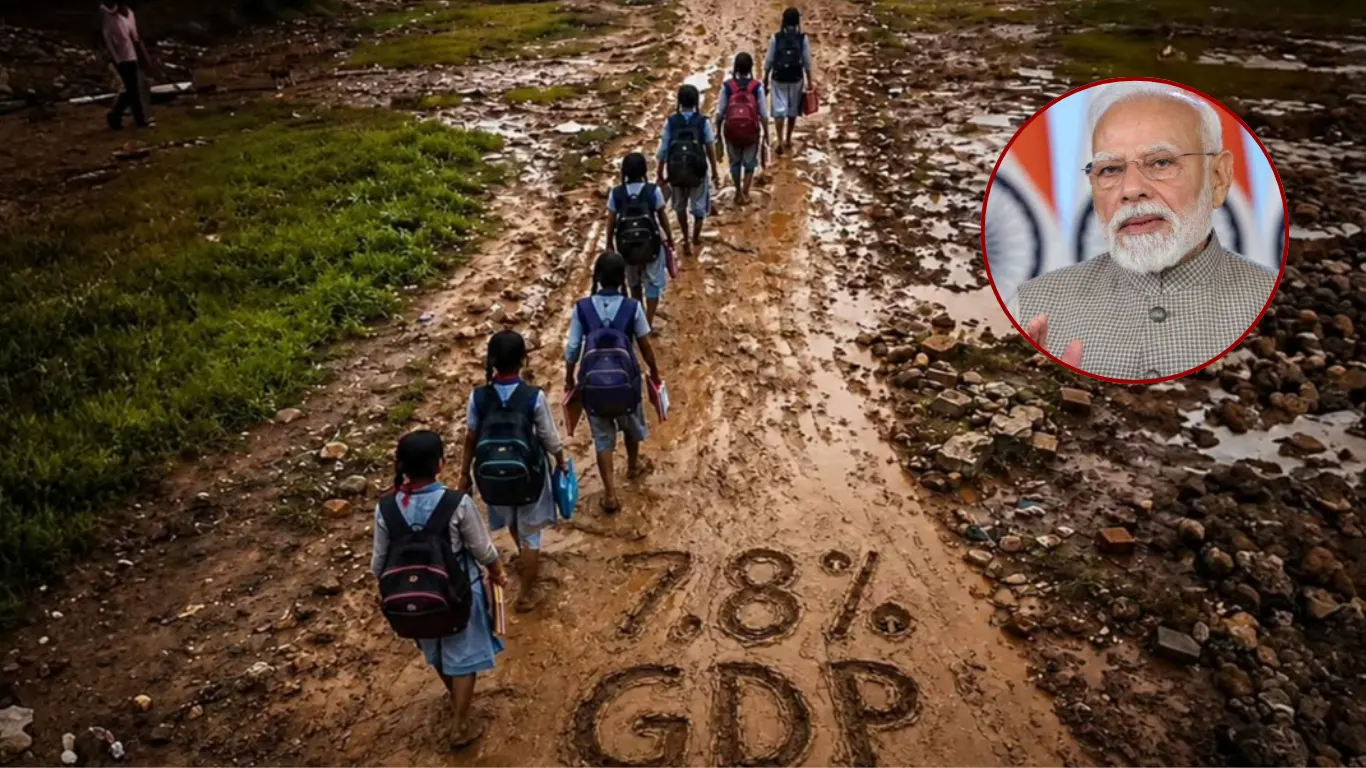
India’s economy recorded real GDP growth of 7.8% in the first quarter of financial year 2026-27. But amid strong economic growth, how big are the challenges related to cities, rural India, employment, infrastructure and inclusive development?
New Delhi: India’s economy recorded real GDP growth of 7.8% in the first quarter of financial year 2026-27. The figure points to strong economic performance and rapid growth. However, conditions in many cities, towns and rural areas tell a different story.
Across several parts of India, people still struggle with basic necessities such as roads, drinking water, drainage, public transport, healthcare and education. After heavy rain, many areas become waterlogged, while village roads often turn into muddy tracks. Meanwhile, long traffic jams have become a daily problem in cities.
This contrast raises an important question: Is rapid economic growth translating into better living conditions for people across India?
Major cities such as Delhi, Mumbai, Bengaluru, Chennai and Hyderabad are key centres of economic activity. However, they continue to face challenges such as waterlogging, traffic congestion, pollution, waste management, public transport and inadequate drainage.
In smaller cities and towns, infrastructure has not always kept pace with population growth. The expansion of roads, sewerage systems, drinking water networks and healthcare facilities remains a challenge.
Rural areas often face even greater difficulties. Poor road connectivity during the monsoon can disrupt access to schools, hospitals and markets.
These conditions present two contrasting pictures of India. One reflects rapid economic growth, while the other highlights gaps in the infrastructure needed to ensure that people benefit from that growth.
The key question is whether infrastructure development is keeping pace with the country’s economic growth.
How Strong Has India’s Economy Become?
India is now among the world’s important and fastest-growing major economies. In the first quarter of financial year 2026-27, from April to June, real Gross Domestic Product (GDP) grew by 7.8%.
According to government data, real Gross Value Added (GVA) grew by 8.2% during the quarter. Gross fixed capital formation increased by 11.9%, while domestic consumption rose by 7.1%. Exports also recorded a 12% increase.
These figures indicate that economic activity remains strong across consumption, investment and production.
According to Reuters, the 7.8% growth was better than market expectations and the Reserve Bank of India’s 7% estimate. The manufacturing sector grew by 9.2%, while financial, real estate, information technology and professional services recorded growth of 12.1%.
This suggests that India’s economic expansion is not dependent on a single sector. Both manufacturing and services are playing an important role in supporting growth.
However, rising GDP does not tell the complete story of development. While assessing the strength of an economy, it is equally important to examine how economic growth is affecting people’s incomes, employment, education, healthcare and access to basic infrastructure.
Why Is the Ground Reality Different Despite Strong GDP Growth?
The biggest question surrounding economic growth is how much of it is reflected in the everyday lives of ordinary citizens.
Mumbai is home to major financial institutions and corporations. Bengaluru is a leading information technology hub, while Delhi continues to expand as the national capital. However, these cities also face recurring challenges such as monsoon waterlogging, traffic congestion, waste management and pressure on public services. These issues raise questions about whether urban infrastructure is keeping pace with population growth and economic activity.
The infrastructure challenge goes beyond roads. In many areas, roads are built without adequate drainage systems. Sewerage networks also struggle to cope with rising populations. At the same time, heavy demand on public transport means millions of people spend hours commuting each day.
Rural India faces its own infrastructure challenges. In villages, towns and remote areas, roads can become muddy during the monsoon. This can make it harder for children to reach schools, patients to access hospitals and farmers to reach markets. Damaged roads and bridges can disrupt connectivity. Access to drinking water and healthcare also remains a challenge in some areas.
However, it would be incorrect to suggest that India has seen no progress in rural and urban infrastructure. Over the past several years, significant investments have been made in rural roads, highways, railways, urban transport and digital infrastructure.
The challenge is that infrastructure construction and its long-term maintenance require equal priority.
This is precisely the gap that GDP figures alone cannot capture.
The Real Question Is Not GDP, But the Reach of Development
India’s economic growth is undoubtedly important, as a growing economy gives the government and private sector greater capacity to invest in infrastructure, welfare programmes and public services. However, economic growth can translate into broad-based development only when its benefits reach different sections of society and regions across the country.
Employment remains another major challenge. India’s young population can become a demographic advantage, but this will require quality education, relevant skills and access to productive employment opportunities.
According to the World Bank, India will need sustained improvements in investment, productivity, human capital and job creation to achieve its goal of becoming a high-income economy by 2047.
Therefore, India’s success in the coming years will not be measured solely by the size of its GDP or how quickly it reaches the trillion-dollar milestones. The real measure of progress will be whether economic growth translates into higher incomes, better living standards and an improved quality of life for people.
Investment and Manufacturing Are Giving the Economy New Strength
Investment and manufacturing are playing an increasingly important role in India’s current economic growth.
According to data from the National Statistical Office, gross fixed capital formation increased by 11.9% during the April-June 2026 quarter. The manufacturing sector recorded growth of 9.2%, while the secondary sector grew by 8.6%. Production of capital goods also increased by 15.2%.
According to Reuters, there were also signs of strengthening private investment. During the April-June 2026 quarter, private sector capital investment gained momentum, while gross fixed capital formation reached 34.3% of GDP.
This is significant for India because sustaining rapid economic growth over the long term requires private investment and expansion of production capacity.
If this momentum in manufacturing and investment continues, India could get a greater opportunity to increase its share in global supply chains. But achieving this will require continued improvements in roads, railways, electricity, ports, skilled labour and the overall business environment.
Exports Are Rising, But Imports Remain a Challenge
To understand India’s economic picture, it is also important to look at foreign trade.
According to data from the Ministry of Commerce and Industry, India’s total exports of goods and services stood at around $80.14 billion in July 2026, an increase of 13.31% compared with the same period last year. During the same period, total imports stood at around $95.16 billion.
One of India’s major strengths is its services exports. Information technology and professional services have helped India establish a strong position in global markets. However, the country continues to face a significant deficit in merchandise trade.
Crude oil imports play a major role in meeting India’s energy requirements. According to Reuters, India imports around 85% of its crude oil needs. Therefore, a rise in international oil prices can put pressure on India’s import bill and trade balance.
According to Reserve Bank of India data, India’s merchandise trade deficit increased to $86.1 billion during April-June 2026, while the current account deficit stood at $4.2 billion, or 0.5% of GDP.
For India, therefore, the challenge is not simply to increase exports but also to improve export competitiveness and balance dependence on essential imports.
Is Foreign Corporate Confidence in India Increasing?
The picture appears positive on this front.
India’s large consumer market, digital infrastructure, skilled workforce and manufacturing potential make it an attractive destination for foreign companies.
Investment interest is increasing in sectors such as technology, electronic equipment, semiconductors, renewable energy, infrastructure and data centres. According to Reuters, major technology companies such as Google and Amazon have committed more than $40 billion towards data-centre infrastructure in India.
This suggests that foreign companies are not looking at India merely as a large consumer market but also as a potential technology and infrastructure hub for the future.
However, the foreign investment picture is not entirely one-sided. Investors consider several factors alongside India’s economic potential, including regulations, taxation, infrastructure, availability of skilled workers and global economic conditions.
India’s Image in the Eyes of the World
India is increasingly seen by the world as an economy that is growing rapidly and strengthening its role in the global economic system.
Its large population, vast consumer market, digital infrastructure, expanding services sector and strategic importance are among its major strengths.
At the same time, challenges related to per capita income, employment, education, healthcare, and rural and urban infrastructure show that India still has a long way to go.
The challenges at the city level are also significant. As economic activity in major cities grows, the demand for housing, transportation, water supply, sewerage, waste management and public transport is also increasing. If the infrastructure of cities that serve as economic hubs fails to keep pace, it could affect both productivity and citizens’ quality of life.
This is why looking at India only through the lens of GDP growth would provide an incomplete picture.
The Story Beyond 7.8% Growth
India’s 7.8% GDP growth is certainly a strong economic signal. Growth in investment, manufacturing, services and domestic consumption shows that economic momentum remains strong.
But a waterlogged road in a city is also part of India’s story.
A village road that becomes difficult to cross after heavy rain is also part of India’s story.
The long traffic jam in a metropolitan city is also India’s story, just as inadequate drainage in a small town is.
These two pictures need to be viewed together.
One picture shows India’s economic potential, while the other highlights how much more needs to be done to convert that potential into a better quality of life on the ground.
India’s challenge now is not simply to increase GDP. The challenge is to convert GDP growth into inclusive development.
Better roads, stronger public transport, effective drainage systems, quality government schools, a robust healthcare system, employment opportunities, rural industries and improved public services if all of these advance alongside economic growth, only then can India’s growth truly be described as broad-based development.
Because ultimately, a country’s real progress is not reflected only in its GDP figures. It is reflected in the everyday lives of its citizens.