National seminar on Integral Humanism brings scholars together; over 100 research papers presented on Indian thought and Upadhyaya’s philosophy
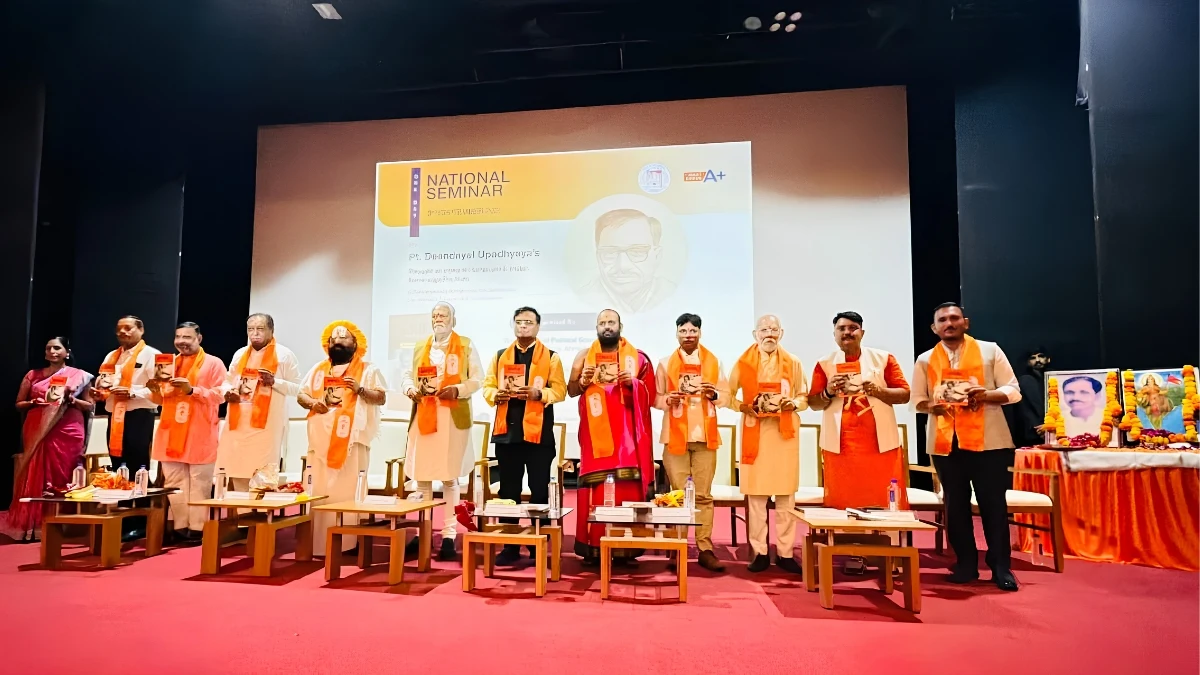
Ahmedabad, Gujarat: Gujarat University hosted the release of the Gujarati edition of Samarpan: Deendayal Upadhyaya, a book highlighting the life, dedication and contribution of Pandit Deendayal Upadhyaya.
The university organised the book launch at the Dr. Shyama Prasad Mukherjee Auditorium. Alongside the release, the Department of Political Science conducted a one-day national seminar on Integral Humanism.
Over 100 Research Papers Presented
The national seminar attracted scholars, researchers, thinkers and senior academicians from across India. Participants discussed different aspects of Pandit Deendayal Upadhyaya’s political and philosophical ideas.
Researchers presented more than 100 papers during the seminar. The presentations examined Integral Humanism along with subjects such as Indian culture, social harmony, nationalism, economic policy and human-centric development.
Chandan Kumar Suggests Publishing Research Papers
Author Chandan Kumar said that Samarpan: Deendayal Upadhyaya has already reached readers through translations into several Indian languages.
He proposed that Gujarat University publish the research papers presented at the seminar. He said this step would help make the discussions on Pandit Deendayal Upadhyaya and Integral Humanism accessible to a larger audience.
Purushottam Rupala Explains Upadhyaya’s Philosophy
Former Union Minister Purushottam Rupala called Pandit Deendayal Upadhyaya a significant thinker of modern India.
Rupala said that Upadhyaya examined the limitations of Western political thought during the early years of independent India and offered an approach rooted in Indian thinking.
He pointed to different Western ideological traditions, including individualism, capitalism, socialism, communism and nationalism. According to Rupala, Integral Humanism takes a different approach by connecting the individual, society and nation rather than treating them as separate or conflicting interests.
Integral Humanism Emphasises Complementarity
Rupala said Upadhyaya’s philosophy sees the interests of individuals, society and the nation as complementary.
He also highlighted values associated with Indian philosophical thought, including dialogue, mutual affection, universal brotherhood and global unity. He said these principles resonate strongly with the philosophy of Integral Humanism.
Vice-Chancellor Highlights Role of Students
Gujarat University Vice-Chancellor Dr. Jagdishbhai Joshi welcomed the participating scholars and academicians.
He said the presence of experts from different parts of India added significance to the seminar and brought academic diversity to the university campus.
Dr. Joshi said the university would examine the research papers presented during the sessions. He added that the discussions would help students gain a deeper understanding of Pandit Deendayal Upadhyaya’s ideas and the foundations of Indian philosophy.
Indian Thought and India 2047
Dr. Joshi said young people who draw inspiration from Indian thought and values can make an important contribution to the vision of India 2047 and a developed India.
He also expressed appreciation for Prof. Dr. Hiteshbhai Patel and his team, as well as the university’s faculty members, students and staff, for organising the programme.
He said the speakers’ addresses gave students and other participants fresh motivation and guidance.
Seminar Creates Platform for Academic Exchange
The Department of Political Science organised the national seminar to encourage academic discussion on Integral Humanism and Pandit Deendayal Upadhyaya’s philosophy.
With more than 100 research papers presented, the seminar brought together diverse perspectives on Indian culture, social harmony, nationalism, economic policy and human-centric development.