
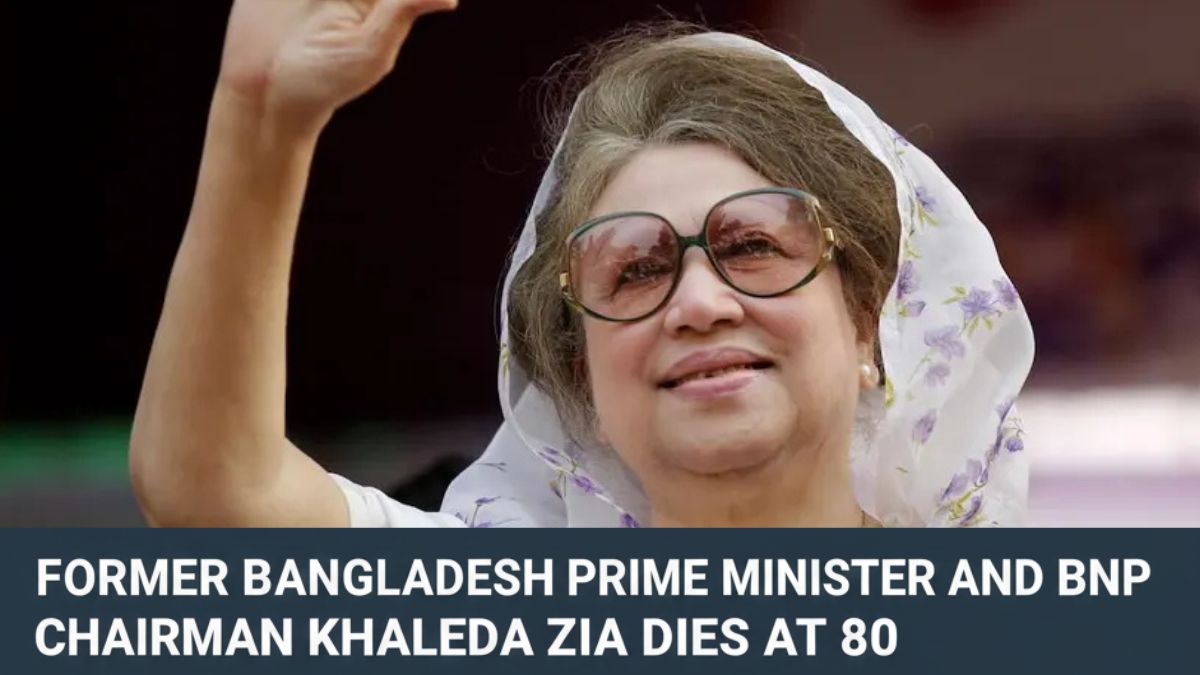
India’s Prime Minister Narendra Modi mourns Khaleda Zia’s death, recalls her role as Bangladesh’s first woman Prime Minister
Former Prime Minister and Bangladesh Nationalist Party chairperson Begum Khaleda Zia passed away in Dhaka at the age of 80 after a prolonged illness. According to senior BNP leaders, doctors treated her at a private hospital for several weeks as her condition steadily worsened.
Meanwhile, medical teams kept Khaleda Zia in the intensive care unit of Dhaka’s Evercare Hospital, where her health remained critical for months. As a result, her death triggered nationwide mourning and brought a defining political era to an end.
A trailblazer who shaped modern Bangladeshi politics
Throughout her career, Khaleda Zia made history as the first woman Prime Minister of Bangladesh. During her tenure, she steered the nation through crucial phases of democratic transition and played a key role in restoring parliamentary democracy after years of military rule.
Subsequently, her rise in politics gained momentum after the assassination of her husband, former President Ziaur Rahman. Over time, that turning point transformed her into a formidable force in national politics.
At the same time, a prolonged rivalry with Awami League leader Sheikh Hasina came to dominate Bangladesh’s political landscape. Consequently, the contest influenced elections, governance, and public discourse for more than three decades.
Also Read: Do You Know Sonam Yeshey? Bhutan Spinner Creates History with Stunning 8-Wicket Haul
Prolonged illness and intensive medical care
Khaleda Zia battled multiple long-term medical conditions, including heart disease, liver and kidney disorders, diabetes, respiratory complications, and arthritis. Doctors fitted her with a permanent pacemaker and carried out stent procedures to manage serious cardiac issues.
Declining health limited her public engagements in recent years. Continuous medical supervision kept her away from active political life.
Achievements, struggles, and a lasting legacy
Her tenure as prime minister focused on strengthening democratic institutions and expanding multiparty politics. Supporters remember her as a leader who upheld the role of the opposition during turbulent political times.
Legal battles and illness later curtailed her political activity. Despite controversies, her imprint on Bangladesh’s democratic evolution remains profound.
Prime Minister Narendra Modi pays tribute
Indian Prime Minister Narendra Modi expressed deep sorrow over Khaleda Zia’s passing and extended condolences to her family and the people of Bangladesh. He said her demise marked a moment of loss for the region.
He noted that Khaleda Zia, as Bangladesh’s first woman prime minister, made lasting contributions to the country’s development and played a role in strengthening India-Bangladesh relations. Her leadership, he said, would always be remembered.
Prime Minister Modi also recalled his warm meeting with her in Dhaka in 2015. He expressed hope that her vision and legacy would continue to guide bilateral ties and prayed for peace for her departed soul.
Nation and region remember a towering leader
Political leaders, diplomats, and citizens across Bangladesh and South Asia paid tributes to Khaleda Zia. Many acknowledged her impact on democratic politics and regional engagement.
BNP supporters gathered at party offices and memorial sites to mourn their longtime leader. Condolence messages continued to pour in from across the world.
End of a defining chapter
Khaleda Zia’s death closes a defining chapter in Bangladesh’s political journey. Her life will continue to inspire debate and reflection, while her place as a pioneer for women in politics remains firmly secured.
FAQs
Q1. Who was Khaleda Zia
Khaleda Zia was a former Prime Minister of Bangladesh and the chairperson of the Bangladesh Nationalist Party. She led the nation as its first woman head of government.
Q2. How old was Khaleda Zia when she died
She was 80 years old.
Q3. What were her major political contributions
Her leadership helped restore parliamentary democracy and strengthen multiparty politics in Bangladesh.
Q4. What did Prime Minister Narendra Modi say
He expressed deep sorrow, praised her contributions to Bangladesh and bilateral ties with India, recalled meeting her in 2015, and offered condolences to her family and the Bangladeshi people.
Q5. Why is her death important for Bangladesh
Her passing signals the end of a long era in Bangladeshi politics shaped by her leadership and her rivalry with Sheikh Hasina.

khushisikarwar is an award-winning journalist and content creator who thrives on telling stories that matter. As a key contributor to Newsisland, [she] focus on cultural commentary, providing readers with thought-provoking insights.


