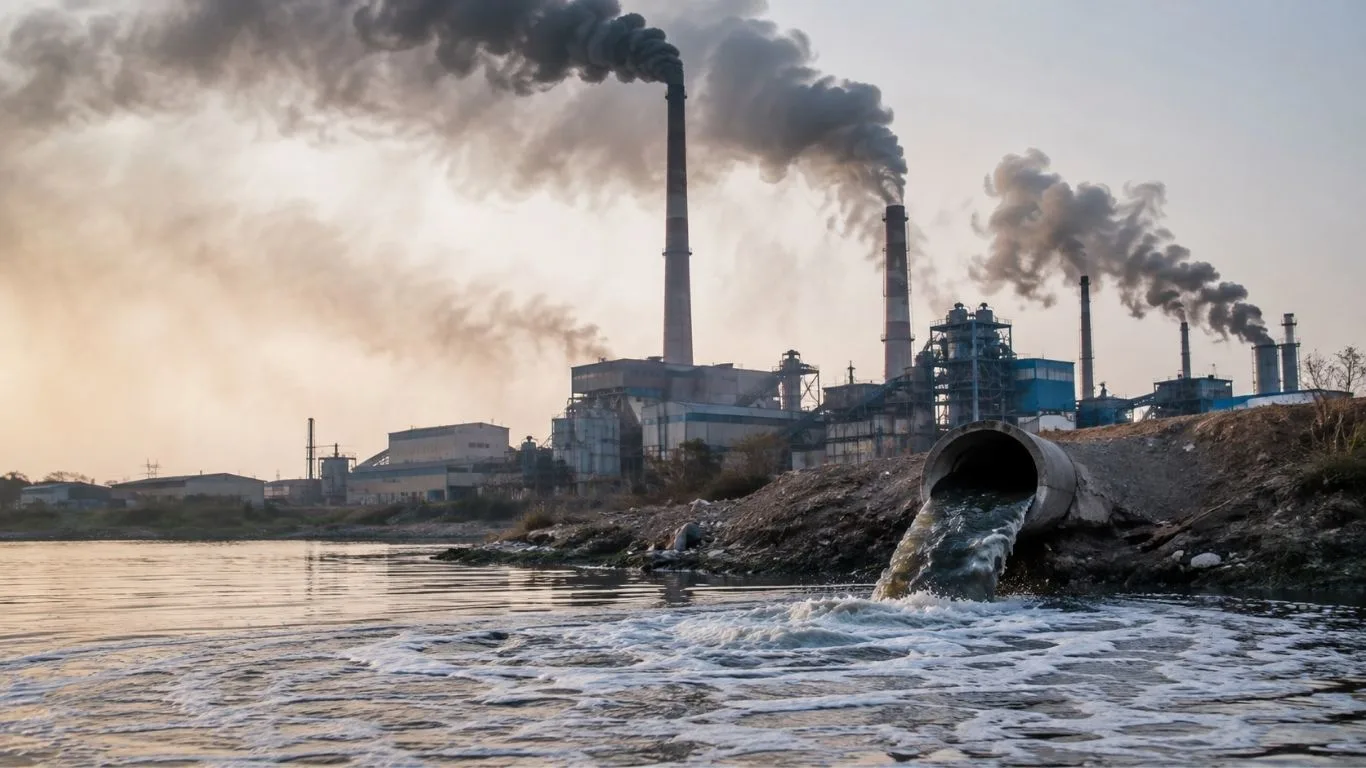
India’s factories are driving economic growth but also leaving polluted rivers, toxic waste and contaminated groundwater in communities across industrial clusters
New Delhi: India’s industrial expansion has come with an environmental cost that is rarely counted alongside its growth figures. Hundreds of river stretches remain polluted, most urban and industrial wastewater still flows untreated, and communities living near factories continue to pay the highest price — even as the country faces one of the world’s most severe water scarcity crises.
Hundreds of river stretches remain polluted
According to the Central Pollution Control Board’s 2025 assessment, 296 polluted river stretches have been identified across 271 rivers in 32 states and union territories. That is down from a peak of 351 stretches in 2018, but still more than four times the 71 stretches recorded in 2005.
Maharashtra has the highest number, with 54 polluted stretches, including several around heavily industrialised and urbanised areas. Kerala follows with 31, while Madhya Pradesh and Manipur each record 18.
Thirty-seven stretches remain in the most polluted Priority 1 category, which covers stretches with Biochemical Oxygen Demand (BOD) above 30 mg/L. The figure is far above the CPCB’s designated bathing-water criterion for BOD.
Most Urban Wastewater Still Goes Untreated
India generates large volumes of sewage, while treatment capacity and actual treatment remain far below the total amount of urban wastewater generated. Of the country’s sewage treatment capacity, only about 26,869 MLD is operational, and roughly 20,235 MLD is actually treated.
A substantial share of urban wastewater therefore remains untreated, putting additional pressure on rivers, lakes, groundwater and other receiving water bodies. Rivers are polluted by a mix of untreated municipal sewage, industrial effluent, agricultural runoff and solid waste. Industrial pollution, however, is particularly concentrated around specific manufacturing clusters.
Also Read: Why More People Are Saving in Digital Dollars and Why Governments Are Paying Attention
Water scarcity and pollution happen together
India supports roughly 18 per cent of the world’s population but has only about 4 per cent of global freshwater resources. Per capita water availability has fallen from around 5,000 cubic metres per year in 1947 to about 1,400 cubic metres per year today, and is projected to fall below 1,200 by 2050.
Hundreds of millions of Indians face significant water stress, with several assessments warning that pressure on freshwater resources is intensifying. Groundwater supplies more than 60 per cent of India’s irrigation needs and roughly 85 per cent of rural drinking water. But in more than 1,100 assessment units across 15 states, groundwater extraction is outpacing natural recharge.
Despite this scarcity, investment in restoring existing water bodies remains far smaller than spending on expanding water-supply infrastructure. Under India’s urban rejuvenation missions, an estimated 62 per cent of funds are spent on expanding water supply, while only about 3 per cent is spent on actually restoring polluted lakes, ponds and rivers. The result is a system that keeps drilling for new water while allowing the water already available to become unusable.
Air and land pollution add to the burden
A landmark toxic-site mapping exercise identified 221 industrial point-sources of pollution in India posing direct risk to public health. A Global Burden of Disease analysis estimated that air pollution was associated with 1.67 million premature deaths in India in 2019, around 18 per cent of all deaths that year— according to the Global Burden of Disease study published in The Lancet Planetary Health.
Air pollution also cost India an estimated $36.8 billion in 2019, equivalent to roughly 1.36 per cent of GDP, through lost output caused by premature deaths and illness. The World Bank has also estimated that environmental degradation costs India around 6 per cent of GDP. Hazardous industrial waste remains unevenly distributed across the country. A 2010 CPCB assessment found that Gujarat alone generated about 29 per cent of India’s hazardous waste.
Communities near factories suffer the most
Peer-reviewed research consistently finds that proximity to industrial pollution sources is associated with higher rates of gastrointestinal illness, skin disorders, blood abnormalities, respiratory disease, adverse birth outcomes, and premature mortality. Waterborne diseases remain common in areas where industrial effluent and sewage mix. Children are especially vulnerable when households lack access to clean water.
What industrial pollution looks like on the ground
Jojari River, Rajasthan
Industrial effluent from textile and other manufacturing units has severely polluted parts of the Jojari River near Rajasthan’s major industrial clusters. Residents report dark, contaminated water. Thousands of bighas of farmland across about 50 villages have become unusable. Villagers also report crop losses and water contamination. After years of protests, the pollution has led to legal proceedings, including cases before the Supreme Court.
Perundurai SIPCOT, Erode, Tamil Nadu
Residents and farmers around the SIPCOT estate have long raised concerns about industrial pollution. They say factories have contaminated groundwater, streams, ponds and lakes. Farmers report declining groundwater quality and reduced agricultural activity. Some residents now depend on water brought in from outside the area due to concerns over industrial discharge.
Meghnagar, Madhya Pradesh
In Madhya Pradesh’s Meghnagar industrial area, residents have reported red and dark discolouration in the Anas and Padmavati rivers, which they link to industrial discharge. Villagers have also raised concerns about contaminated groundwater, saying some hand pumps provide discoloured water. They have further reported health problems affecting both people and livestock in nearby villages.
Jeedimetla and Quazi Lake, Hyderabad, Telangana
Pharmaceutical and chemical factories continue to release effluents into Quazi Lake and nearby water bodies. Residents report a persistent chemical odour and instances of dead fish in the lake, while some families living closest to the polluted water body say the conditions have made the area difficult to inhabit. Residents and local reports have documented pollution concerns in the area for more than two decades.
Dengajaniguda, Korapaut, Odisha (NALCO)
Residents of Dengajaniguda village near NALCO’s alumina refinery allege that the red mud pond contaminates their water sources and farmland. About 600 people from mostly Scheduled Caste and Scheduled Tribe families report health problems, including vision issues and swelling of limbs.
Even tube wells allegedly supply contaminated water, forcing villagers to travel nearly 8 km for safe drinking water. Local elected representatives have raised the issue and warned of intensified protests. NALCO rejects the claims, stating that its pond follows zero-discharge norms and regular testing shows pH levels within prescribed limits.
Lanjigarh, Kalahandi, Odisha (Vedanta)
In September 2024, a process-water pond linked to Vedanta’s red mud facility breached and released an estimated 30 crore litres of highly alkaline wastewater. The spill flooded agricultural land and entered the Bansadhara River. Locals protested and sought compensation. The National Green Tribunal’s Eastern Zone Bench admitted a related case in March 2026.
Jajmau, Kanpur, Uttar Pradesh
Tanneries continue to discharge chromium-laden effluent into groundwater and the Ganga. Health surveys have long shown higher rates of illness among nearby residents and workers. Despite effluent-treatment infrastructure and regulatory measures, concerns over groundwater and river pollution remain, with the National Green Tribunal continuing to hear matters related to the cluster.
Also Read: Dr. Bhargav Mallappa Meets MSME Minister, Invites Him to South India
What the government is doing, and where it falls short
India has a broad framework for controlling pollution. It includes the Water Act, Air Act and Environment (Protection) Act. The country also has Central and State Pollution Control Boards, the National Green Tribunal, Namami Gange and the National Clean Air Programme. The government has introduced online systems to monitor emissions and effluent. Zero-liquid-discharge rules also apply to several industrial sectors.
Yet enforcement remains slow and uneven. State pollution control boards, municipal bodies and central agencies share responsibility. This can create gaps in enforcement and accountability. Authorities have also imposed investment moratoriums in “Critically Polluted” areas. However, they have sometimes lifted these restrictions before resolving the underlying contamination.
Inspection records show that some industries still violate monitoring and effluent-treatment requirements. The National Green Tribunal has repeatedly stepped in after petitioners alleged delayed or inadequate action by local authorities. Pollution can also leave a lasting legacy. Even after authorities identify a source, environmental and health damage may continue for decades without proper remediation.
India’s industrial growth has delivered clear economic gains. But untreated effluent, polluted rivers, waste ponds and contaminated groundwater reveal another cost. Communities living near industrial sites often bear the greatest burden. Without stronger enforcement and accountability, pollution will continue to undermine India’s water, air and land.