
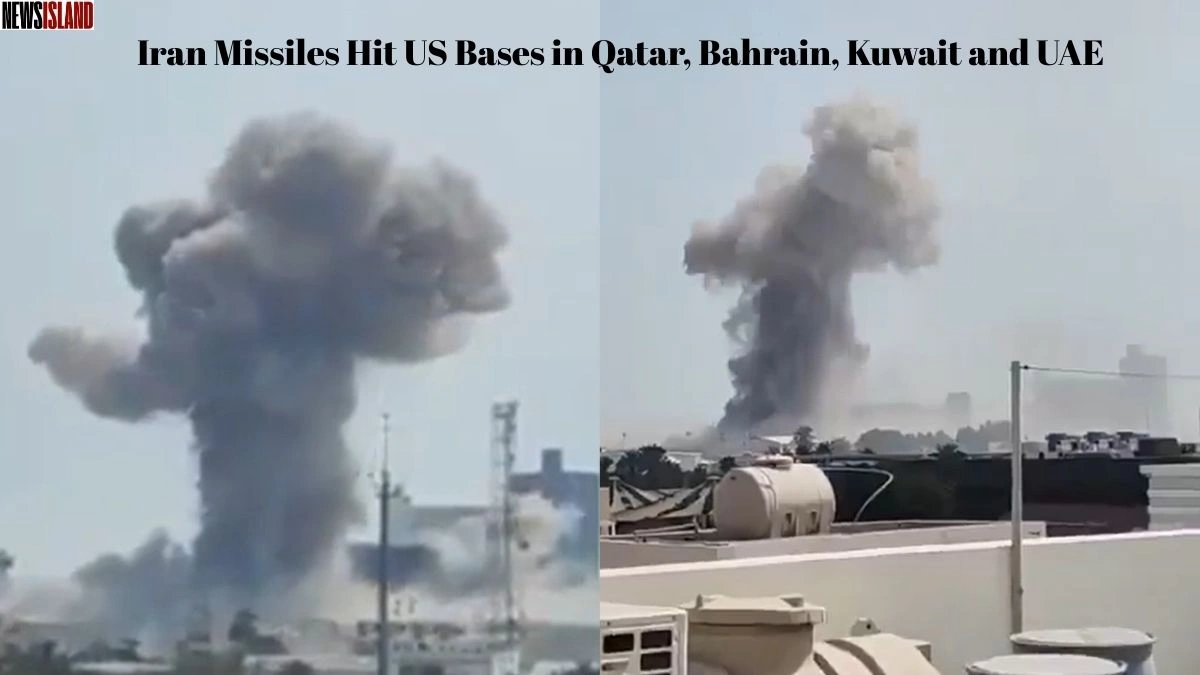
Iran launches missile strikes on key US military bases in Qatar, Bahrain, Kuwait and the UAE after joint US–Israel attacks
The Middle East witnessed a dramatic escalation on February 28, 2026, after Iran launched missile and drone attacks on several United States military bases located in Qatar, Bahrain, Kuwait and the United Arab Emirates. The strikes came hours after the United States and Israel carried out coordinated military attacks on Iranian targets, in what Washington described as a move to weaken Iran’s nuclear and missile capabilities.
Iran responded swiftly. The Islamic Revolutionary Guard Corps (IRGC) announced retaliatory operations, targeting American military installations across the Gulf. The attacks marked one of the most serious direct confrontations between Iran and US forces in recent years.
Qatar: Missile Intercepted Near Al Udeid Air Base
In Qatar, Iran targeted Al Udeid Air Base, one of the most important US military hubs in the region. The base hosts US Central Command operations and serves as a key strategic center for American air operations across the Middle East.
Qatar’s Ministry of Defense confirmed that its Patriot air defense systems successfully intercepted at least one incoming missile. Air raid sirens were heard across Doha, and residents received emergency alerts urging them to stay indoors and seek shelter.
As a precautionary measure, Qatar temporarily closed its airspace to civilian flights. Airlines suspended or diverted flights to ensure passenger safety. Officials later stated that there were no immediate reports of casualties, but security forces remained on high alert.
Bahrain: Fifth Fleet Headquarters Targeted
In Bahrain, Iranian missiles struck near the headquarters of the US Navy’s Fifth Fleet in Manama. The Fifth Fleet oversees naval operations across the Persian Gulf, Red Sea and parts of the Indian Ocean, making it one of America’s most strategically important military installations in the region.
Witnesses reported seeing smoke rising from the area, and civil defense sirens were activated. Authorities urged residents to remain calm and follow safety instructions. Bahrain also implemented emergency security protocols as part of its response to the attack.
The strike on the Fifth Fleet headquarters significantly raises tensions, as it directly targets US naval command infrastructure in the Gulf.
UAE: Al Dhafra Air Base Under Threat
In the United Arab Emirates, explosions were heard near Abu Dhabi as Iran targeted Al Dhafra Air Base. The base hosts the US Air Force’s 380th Air Expeditionary Wing and plays a critical role in surveillance, reconnaissance and aerial refueling missions.
The UAE government confirmed that it temporarily restricted parts of its airspace following the missile threats. Air defense systems were activated, and authorities monitored the situation closely.
Al Dhafra Air Base is a joint facility used by both the UAE and US forces, and it has long been considered a vital component of America’s military presence in the Gulf.
Also Read: US and Israel Launch Strikes on Iran; Trump Announces “Major Combat Operations”
Kuwait: US Installations Placed on High Alert
Kuwait also faced threats as Iranian missiles targeted American military sites, including Ali Al Salem Air Base and Camp Arifjan. These installations serve as major logistics and command centers for US forces in the region.
In response, Kuwait temporarily closed its airspace and activated defensive measures. Authorities emphasized that the closures were precautionary steps designed to protect civilians and prevent aviation risks during the missile activity.
Iran’s Justification for the Strikes
Iranian officials described the attacks as a direct response to the earlier US–Israel strikes on Iranian territory. Tehran stated that American military bases in the region became legitimate targets once the United States launched attacks inside Iran.
Iran’s leadership framed the retaliation as self-defense, arguing that it had the right to respond to what it called foreign aggression. The IRGC declared that it would continue to respond if further attacks were carried out against Iranian territory.
Airspace Closures and Civilian Precautions
Following the missile launches, multiple Gulf nations including Qatar, Bahrain, Kuwait and the UAE restricted or closed their airspace to commercial flights. Major airlines in the region suspended or rerouted flights due to safety concerns.
Residents in several cities received emergency alerts advising them to remain indoors. Sirens were heard in Doha, Abu Dhabi and Manama as defensive systems were activated.
Authorities across the region stressed that the measures were precautionary but necessary given the scale of the escalation.
A Broader Regional Crisis
The strikes represent a serious widening of the conflict. Instead of limiting confrontation to Israel and Iran, the situation has now drawn in US military installations across the Gulf.
The attacks increase the risk of a broader regional conflict that could involve Iran-backed groups in Iraq and Yemen, as well as other regional actors. Military analysts warn that further retaliation from either side could lead to a sustained and potentially dangerous escalation.
The Gulf region is critical to global energy supplies, and any prolonged instability could affect oil markets and international trade routes.
Previous Confrontations Highlight Ongoing Tensions
This is not the first time Iranian missiles have threatened US military assets in the region. In June 2025, Iran launched missiles toward Al Udeid Air Base in Qatar in response to US strikes on its nuclear facilities. Most of those missiles were intercepted, and no casualties were reported at the time.
However, the current wave of attacks appears broader and more coordinated, targeting multiple countries simultaneously.
Also Read: Madurai Bench Orders FIR, Fines S. Selvaganesh ₹1 Lakh in Adoptive Mother Property Dispute
Region on Edge
The Iranian missile strikes on US military bases in Qatar, Bahrain, Kuwait and the UAE mark a dangerous moment in Middle Eastern geopolitics. By directly targeting American installations across four Gulf nations, Iran has significantly escalated tensions.
While initial reports suggest that many missiles were intercepted and air defense systems were effective, the situation remains fluid. Governments across the region continue to monitor developments closely, and military forces remain on high alert.
The coming hours and days will determine whether the crisis stabilizes or moves toward a deeper and more prolonged confrontation.
Video Credit: X

khushisikarwar is an award-winning journalist and content creator who thrives on telling stories that matter. As a key contributor to Newsisland, [she] focus on cultural commentary, providing readers with thought-provoking insights.


