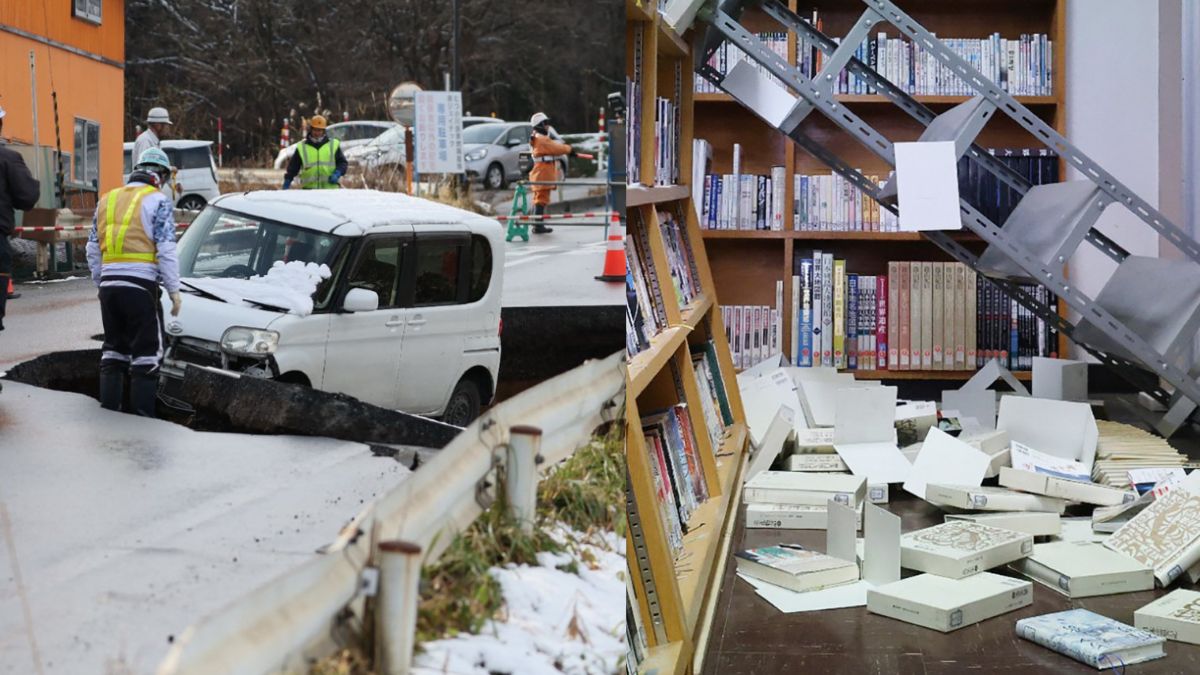
Japan strengthens emergency systems following intense earthquake activity that unsettles northern coastal prefectures significantly.
Japan has faced a tense few days after a series of strong earthquakes struck the country in rapid succession. The first and strongest quake occurred on 8 December 2025, when a magnitude 7.5 to 7.6 earthquake shook the Sanriku region off the northeastern coast near Aomori Prefecture.
The earthquake originated at a depth of about 44 to 54 kilometers and sent powerful tremors across northern communities, with shaking even felt in Tokyo. The impact caused injuries to around 51 to 52 people in Aomori, Iwate, and Hokkaido. Many were hurt by falling objects, broken glass, and structural damage.
Authorities briefly issued tsunami warnings, and smaller waves measuring 60 to 70 centimeters reached some coastal areas. Fortunately, nuclear facilities reported no irregularities.
Two More Earthquakes Follow the Main Shock
In the 72 hours following the initial quake, two more significant tremors struck the region, increasing anxiety among residents. One of these measured roughly magnitude 6.5 and was felt strongly across eastern Aomori and parts of Hokkaido. It occurred at a depth of about 30 kilometers.
Also Read: Meesho Share Listing Shocks Market With 46% Jump Over IPO Rate
Soon after, another earthquake measuring around magnitude 5.7 hit off the east coast of Honshu. This third quake within three days intensified concerns about ongoing seismic instability. Although the later quakes did not produce tsunami warnings, they prompted authorities to step up monitoring and emergency preparedness efforts.
Authorities Issue a Megaquake Advisory
In response to the major earthquake and subsequent tremors, the Japan Meteorological Agency issued a rare advisory warning of the possibility of a much larger earthquake. According to the agency, there is now an increased, though still low, probability of a magnitude 8 or stronger quake occurring along the Pacific coast. The elevated alert covers 182 municipalities from Hokkaido in the north down to Chiba Prefecture near Tokyo.
Experts emphasize that this advisory is not a prediction but a precaution aimed at encouraging preparedness. Japan lies on the Pacific Ring of Fire, and the region’s tectonic plates have produced some of the world’s most powerful earthquakes, including the 2011 disaster.
Why Experts Are Urging Caution
Seismologists explain that a strong earthquake like the one on December 8 can change pressure levels underground and potentially trigger further large tremors. The pattern of a major quake followed by several moderate ones resembles activity seen before significant seismic events in the past.
Government studies highlight the potential scale of destruction if a megaquake were to occur in offshore regions near Hokkaido and Sanriku. A worst-case scenario includes tsunami waves up to 30 meters high, destruction of more than 220,000 buildings, and nearly 199,000 casualties. These possibilities underline why the advisory is being taken seriously even though the chances remain small.
Current Situation and Preparedness Measures
Aftershocks continue in the region, but no major tsunami threat has been issued since the first quake. Schools in northern prefectures have reopened with enhanced safety measures, and communities have been urged to stay prepared.
Authorities advise residents in at-risk coastal zones to keep emergency kits ready, secure heavy furniture, and stay aware of evacuation routes. While life is slowly returning to normal in many areas, officials urge the public to remain alert, as seismic activity in the region is expected to continue for some time.

khushisikarwar is an award-winning journalist and content creator who thrives on telling stories that matter. As a key contributor to Newsisland, [she] focus on cultural commentary, providing readers with thought-provoking insights.