New Dehli:It sounds like the plot of a Hollywood movie, but this is not fiction. It is the true story of José Salvador Alvarenga, a fisherman who survived one of the longest known ordeals at sea in modern history. His journey is more than a story of luck. It showcases remarkable mental strength, adaptability, and an extraordinary will to live.
Ordinary Fisherman Whose Life Changed Forever
José Salvador Alvarenga was originally from El Salvador, but he had spent many years working as a fisherman in Costa Azul, a coastal community in the Mexican state of Chiapas. The sea was familiar to him. He was an experienced fisherman who had completed many long fishing trips.
On the morning of November 17, 2012, he set out on what seemed like another routine fishing expedition. Accompanying him was a young assistant, Ezequiel Córdoba, who was far less experienced. The two men boarded a seven-meter fiberglass fishing boat equipped with an outboard engine, fuel, ice, fishing nets, a GPS device, and a two-way radio.
The weather appeared normal, and they expected to return home within a few days. Neither of them could have imagined that the journey would last for more than a year.
When the Ocean Revealed Its True Power
Only a few hours after leaving shore, the weather changed dramatically. Strong winds turned into a violent storm, and towering waves repeatedly tossed their small boat across the Pacific Ocean.
Alvarenga managed to contact his employer over the radio and requested help, providing his approximate location. However, the storm was so severe that rescue teams were unable to find them.
The storm raged for several days. During that time, the boat’s engine failed. Soon afterward, harsh conditions knocked out both the GPS and the radio. Without an engine, navigation equipment, or any means of communication, ocean currents and strong winds carried the boat wherever they pleased.
Running Out of Food
At first, the small amount of food and fresh water they had on board was carefully rationed. Within days, however, every supply was gone. Soon, they had no food or drinking water left.
To survive, Alvarenga turned to the ocean itself. He caught fish with his hands or by using small fishing nets. At times, he managed to catch seabirds, while small sea turtles also became part of his diet. Since he had no way to start a fire, everything had to be eaten raw.
Every Drop of Water Became Precious
Although they were surrounded by water, not a single drop of it was safe to drink. Drinking seawater would quickly lead to severe dehydration, so Alvarenga avoided it completely.
Whenever rain fell, he collected fresh water in plastic containers, empty cans, and every other container he could find.
During long periods without rain, the situation became desperate. To stay alive, he drank turtle blood and, in limited amounts, his own urine. Survival experts note that drinking urine is not a safe long-term solution, but in life-threatening emergencies, some people resort to it. Alvarenga later said he did so only because he had no other choice.
The Greatest Loss
Physical hunger was not the hardest challenge. The emotional burden of isolation proved even more difficult.
His companion, Ezequiel Córdoba, refused to eat raw fish and other sea creatures. Starvation and dehydration gradually weakened his body. About four months into their ordeal, he died.
For Alvarenga, it was the most painful moment of the journey. Unable to bear the loneliness, he kept Córdoba’s body in the boat for several days. The thought of being completely alone terrified him, and he could not bring himself to let his companion go.
Eventually, Alvarenga realized he had no choice. With a heavy heart, he committed his friend’s body to the sea and continued the journey alone.
Hope Became His Greatest Strength
Spending 438 days without speaking to another human being is almost unimaginable.
Alvarenga later recalled that he talked to himself to stay mentally strong. He thought constantly about his family, imagined a future beyond the ocean, and prayed every day.
To keep track of time, he counted sunrises and sunsets. He also watched birds, hoping they would lead him toward land. Occasionally, ships appeared on the horizon, but none came close enough to rescue him.
Every missed opportunity was heartbreaking, yet he refused to give up.
Journey Across Thousands of Kilometers
According to oceanographers, Alvarenga’s boat drifted with the powerful currents of the Pacific Ocean for thousands of kilometers.
Without an engine or navigation equipment, winds and ocean currents slowly pushed the vessel westward. The journey carried him far away from the Mexican coast, across one of the world’s largest oceans.
January 30, 2014
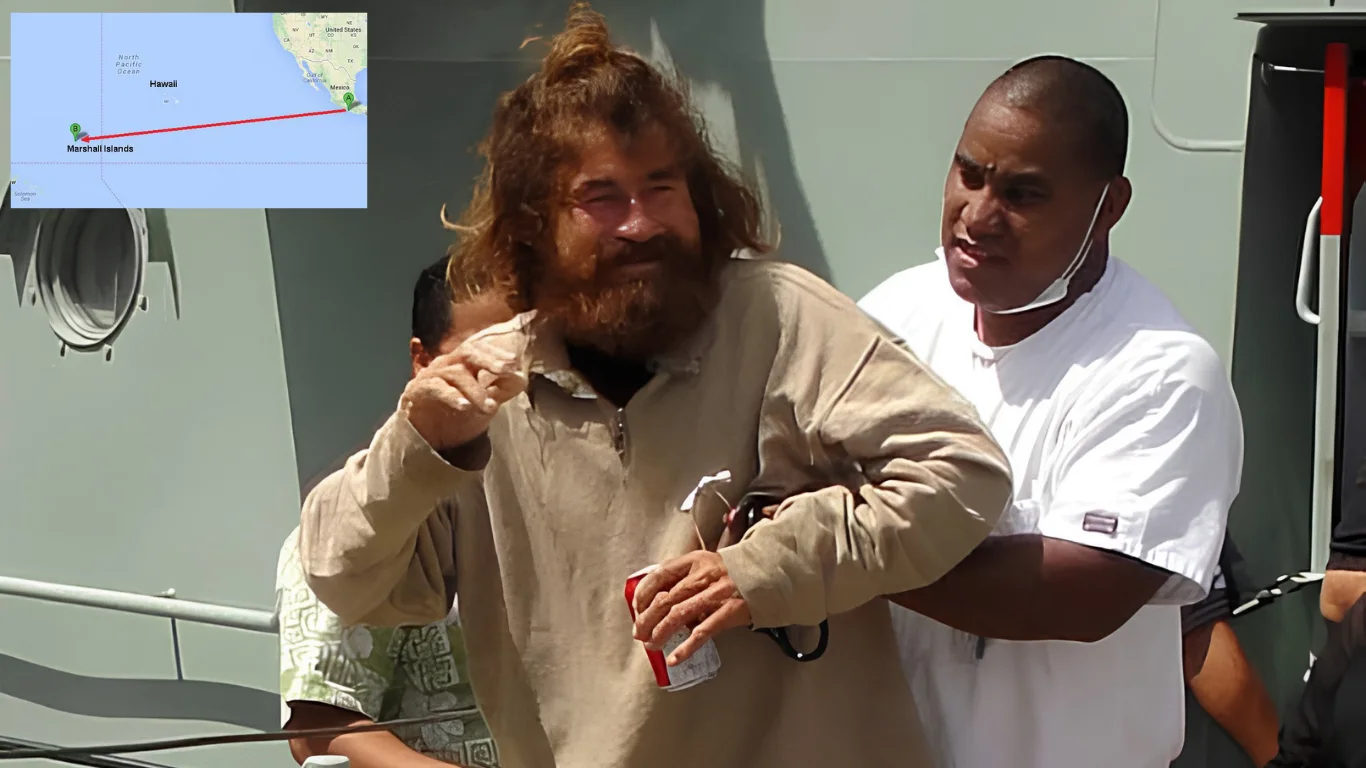
After approximately 438 days at sea, Alvarenga noticed what appeared to be a small island in the distance. At first, he could hardly believe his eyes.
Eventually, ocean currents carried his boat to Ebon Atoll in the Marshall Islands.
He managed to climb out of the boat and stagger onto the shore. Local residents found him extremely weak, severely sunburned, and dangerously thin. His hair and beard had grown long during his time at sea.
Local residents immediately took him to a health center, where doctors were astonished that he had survived such a prolonged ordeal.
Did People Believe His Story?
When Alvarenga returned, many people found his account difficult to believe. Some argued that no human could survive so long alone in the open ocean.
Journalists, oceanographers, and researchers later examined his claims in detail.
Scientists studied ocean current models, historical weather records, possible drift routes, and many details from his account. Although experts could not independently verify every day of his journey, they concluded that Pacific currents could have carried his boat from the Mexican coast to the Marshall Islands. Their research found that most key details of his account matched the available evidence.
Was José Salvador Alvarenga Accused of His Companion’s Death?
After returning home, Alvarenga also faced suspicion regarding the death of Ezequiel Córdoba. Córdoba’s family questioned how he had died while Alvarenga survived.
However, no investigation found any evidence suggesting that Alvarenga had harmed or murdered his companion. According to the available records, Córdoba died from prolonged starvation, dehydration, and malnutrition.
Although many people questioned his account, authorities never charged Alvarenga with any crime, and no court found him guilty of wrongdoing in connection with his companion’s death.
His Story Became a Book
Alvarenga’s extraordinary survival story was later documented by journalist Jonathan Franklin in the book 438 Days: An Extraordinary True Story of Survival at Sea.
Using Alvarenga’s firsthand account, scientific evidence, and extensive research, Franklin reconstructed one of the most extraordinary survival stories ever recorded.