
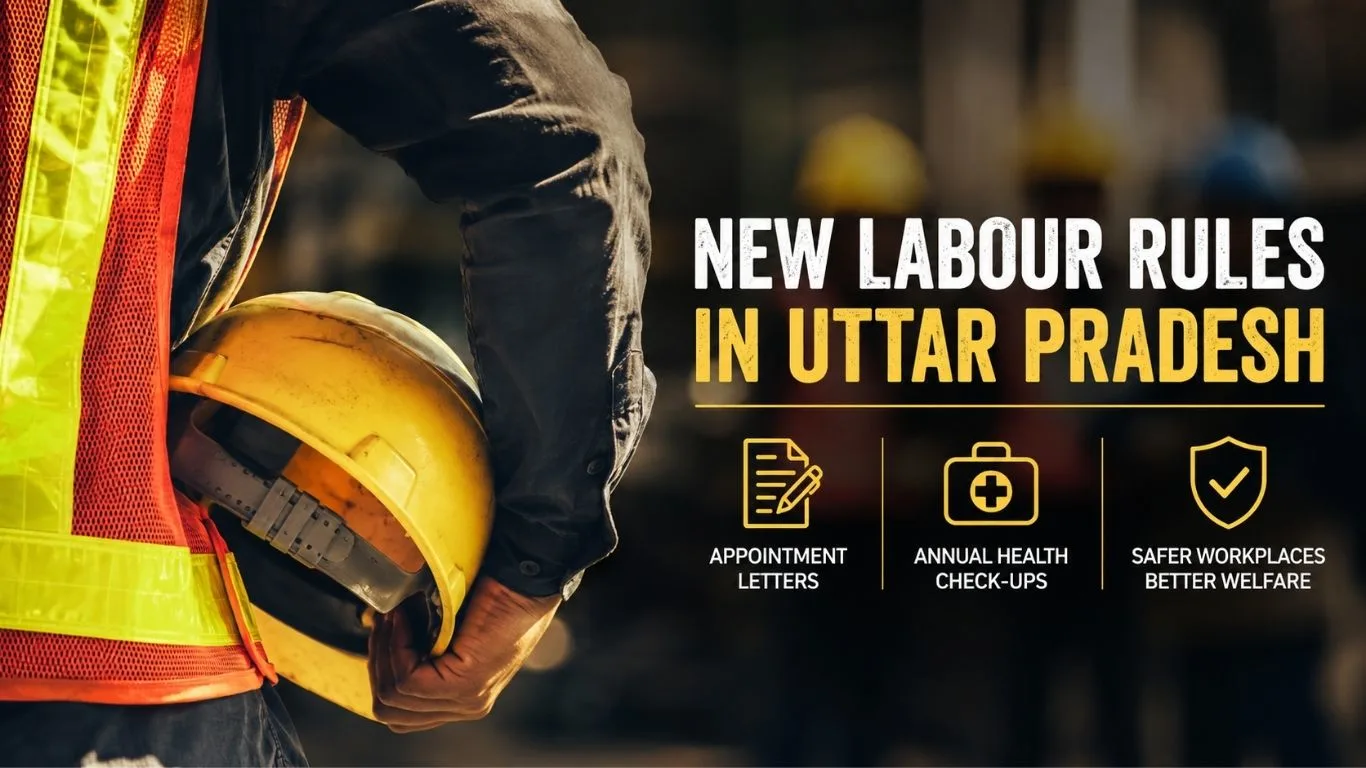
Uttar Pradesh approves new labour rules mandating appointment letters and employer-funded health checks, with stricter safety and welfare norms for workers
New Delhi:The Uttar Pradesh Cabinet on Tuesday approved the Uttar Pradesh Occupational Safety, Health and Working Conditions Rules, 2026. The rules make written appointment letters mandatory for workers in covered establishments. They also require employers to provide free annual health check-ups.
Chief Minister Yogi Adityanath chaired the meeting that approved the rules. The framework has been prepared under the central Occupational Safety, Health and Working Conditions Code, 2020.
The new measures aim to improve workplace safety, health monitoring and basic welfare facilities across the state. They also address concerns related to informal employment, limited health safeguards and inadequate workplace facilities.
The rules seek to formalise employment relationships and set clearer responsibilities for employers. These include assessing workplace risks, providing safety equipment and taking steps to prevent occupational hazards.
Also Read: Hathras YouTuber Chhavi Varshney Dies in Road Accident Before Mahakal Darshan
Stricter Workplace Safety Rules
The framework also includes separate provisions for contract workers, inter-State migrant workers, women workers and construction workers.
Under the new rules, employers in covered establishments will have to issue written appointment or joining letters. These documents will provide formal proof of employment and specify key terms of service. The requirement is expected to help workers establish their employment status and access statutory benefits. It could also reduce disputes over undocumented or oral hiring.
The rules regulate the engagement of contract labour and set specific welfare and regulatory requirements. They also incorporate restrictions under the Occupational Safety, Health and Working Conditions Code on using contract labour for core activities, subject to legal exceptions.
Employers will also have to arrange free health check-ups for workers, as prescribed under the applicable framework. The employer will bear the cost. The provision aims to improve regular health monitoring, especially for workers exposed to occupational risks.
Employers must also assess workplace health and safety risks. They will have to provide appropriate protective equipment and take preventive measures against accidents and occupational diseases. Serious accidents and specified occupational hazards must be reported to the competent authority, which may order further action or an inquiry.
The framework also covers basic workplace facilities. Covered establishments will have to provide clean drinking water, toilets, first-aid facilities and other prescribed welfare amenities.
Larger establishments will face additional requirements, including canteen facilities where the prescribed thresholds apply. The rules also regulate working hours, weekly holidays and rest periods according to applicable norms.
Special provisions have also been included for the safety, health and welfare of building and other construction workers.
More Opportunities for Women
Women workers will have wider employment opportunities under the new rules. They may work in covered establishments, including during night shifts, with their consent and subject to prescribed safety measures. The provision aims to expand job opportunities while requiring employers to ensure adequate safeguards during late hours.
The framework also seeks to simplify administrative compliance. It provides for a unified registration system and common regulatory mechanisms for covered establishments and specified categories of contract labour.
Registration, licensing, record-keeping and return filing are expected to move towards digital processes. The rules also provide online procedures for approvals and other compliance requirements.
Inter-State migrant workers receive specific attention under the framework. Provisions covering their registration, welfare and access to prescribed facilities aim to improve transparency and accountability in their employment and deployment.
Also Read: Women’s Equality Day 2026: The long fight for women’s rights in the U.S
Rules Follow 2020 Labour Code
The Cabinet’s approval follows the central Occupational Safety, Health and Working Conditions Code, 2020. The Code consolidates several earlier labour laws related to occupational safety, health and working conditions.
The state rules provide the framework for implementing the Code in Uttar Pradesh. The UP government had earlier published draft Occupational Safety, Health and Working Conditions Rules, 2026, in March for public consultation.
The draft rules sought to replace or consolidate several existing state-level regulations covering factories, contract labour, inter-State migrant workers and construction workers. The government invited stakeholders to submit their objections and suggestions before finalising the rules.
The new framework will require employers to update practices related to employment documentation, health monitoring, workplace risk management and welfare facilities. Labour authorities are expected to conduct compliance and awareness activities as the rules are implemented.
By focusing on formal employment documentation and workplace health protections, the Uttar Pradesh government aims to strengthen basic standards of occupational safety and worker welfare.
The framework also covers night-shift employment, workplace amenities, contract labour and inter-State migrant workers. Together, these provisions are intended to create a more standardised system of workplace safety and compliance across the state.


