Pakistan launches airstrikes in Kabul and border regions as Afghanistan retaliates, while Russia and Iran urge immediate dialogue and restraint
New Delhi: Tensions between Pakistan and Afghanistan have sharply escalated, with Pakistan formally declaring what it calls an “open war” after launching airstrikes deep inside Afghan territory. The latest military confrontation marks one of the most serious flare-ups between the two neighbours in recent years, as both sides exchange heavy fire and issue competing claims about casualties and battlefield gains.
Pakistan Declares Open War
Pakistan’s Defence Minister Khawaja Mohammad Asif announced that Islamabad now considers itself in “open war” with Afghanistan after days of intense clashes along the border. He said Pakistan’s patience had run out following repeated hostile actions from across the frontier.
Pakistan carried out airstrikes not only in border regions but also deeper inside Afghanistan, including in Kabul, Kandahar and Paktia. Officials in Islamabad said the strikes targeted Taliban military infrastructure and militant hideouts that they claim threaten Pakistan’s security.
Prime Minister Shehbaz Sharif strongly supported the military’s actions. He said Pakistan’s armed forces are fully capable of crushing any aggression and defending the country’s territorial integrity. The government described the operation as a necessary and firm response to cross-border threats.
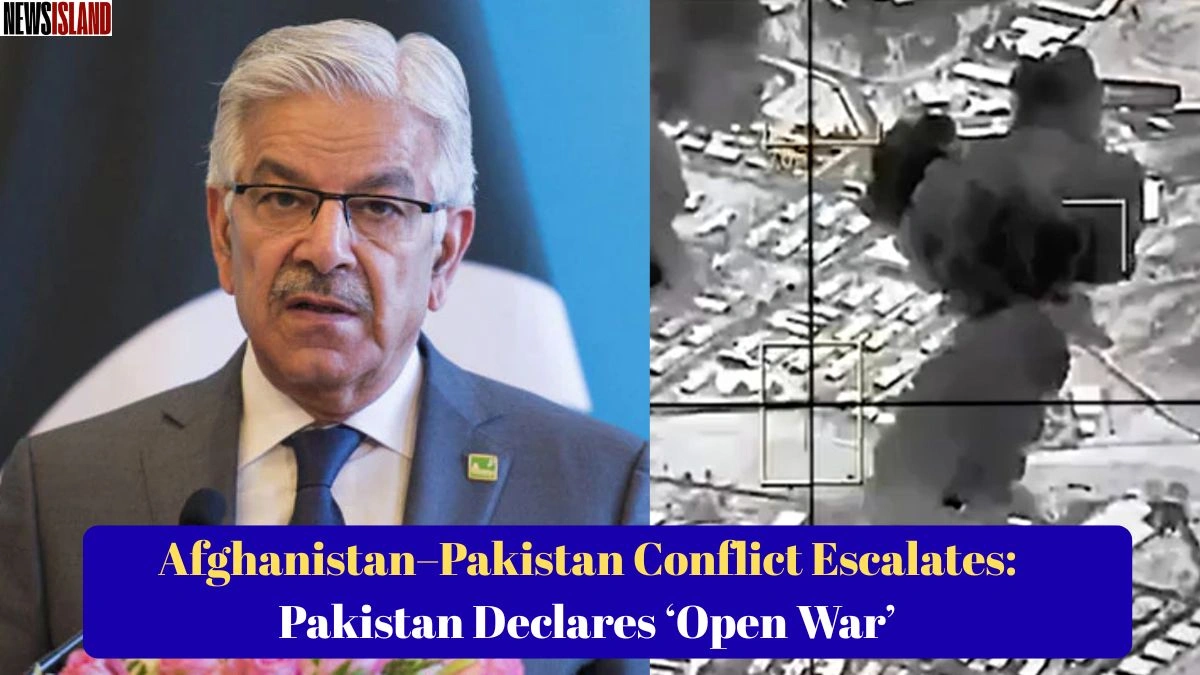
Pakistan’s Ministry of Information and Broadcasting also released video footage of overnight air operations in Kabul, that shows black-and-white aerial footage of smoke rising over parts of Kabul. The government said the video captures the impact of its airstrikes carried out during the ongoing conflict.
Afghanistan Launches Retaliation
In response, Afghanistan’s Taliban-led administration said it launched coordinated retaliatory attacks along the Durand Line, the disputed border between the two countries. Afghan officials claimed their forces targeted Pakistani military posts and captured several outposts during the fighting.
Also Read: US Deploys F-22 Raptors to Israel; Trump Calls It ‘Most Substantial’ Military Reinforcement
Taliban authorities further claimed that dozens of Pakistani soldiers were killed and that weapons and equipment were seized. Pakistan firmly rejected these claims, saying only a small number of its personnel were killed and denying that any posts were captured or soldiers taken prisoner.
Afghan officials also alleged that Pakistani airstrikes hit civilian infrastructure, including areas near refugee settlements, causing civilian casualties. Islamabad has maintained that it targeted militant facilities and not civilian sites.
Unverified reports on social media suggested that a Pakistani F-16 fighter jet may have been shot down. Pakistan denied losing any aircraft and dismissed those claims as false. Independent verification of casualty figures from either side remains difficult because access to the conflict zones is limited.
Background Of Dispute
The Afghanistan–Pakistan conflict has deep historical and political roots. At the centre of the tension lies the Durand Line, a roughly 2,600-kilometre border drawn during British colonial rule. Afghanistan has never formally recognised it as an official international boundary. This long-standing disagreement has created mistrust and periodic clashes for decades.
Security concerns have further worsened relations. Pakistan has repeatedly accused militant groups such as Tehrik-e-Taliban Pakistan (TTP) and Islamic State – Khorasan Province (ISKP) of operating from Afghan territory and carrying out attacks inside Pakistan. Afghan authorities have denied providing safe haven to these groups and rejected Islamabad’s accusations.
Several ceasefire efforts in recent years, including a truce brokered by Qatar and Turkey in late 2025, temporarily reduced tensions. However, both sides accused each other of violating agreements, and the fragile peace eventually broke down.
Recent Triggers Of Escalation
The latest round of violence began earlier this week when Pakistan carried out airstrikes in eastern Afghanistan’s Nangarhar and Paktika provinces. Islamabad described these as intelligence-based operations targeting militant hideouts responsible for attacks inside Pakistan.
Afghan officials said the strikes killed civilians, including women and children, and condemned them as violations of Afghan sovereignty.
After those strikes, Taliban forces launched what they described as a large-scale retaliatory offensive across several border areas. They claimed they inflicted heavy losses on Pakistani forces. Pakistan disputed those claims and insisted its military remains in control of all positions.
The situation escalated further when Pakistan declared “open war” and carried out additional airstrikes, including in Kabul.
International Diplomatic Reactions
As fighting intensified, regional powers stepped in and called for restraint and dialogue. Russia urged both Pakistan and Afghanistan to immediately stop cross-border attacks and resolve their differences through diplomatic channels. Moscow warned that continued fighting could destabilise the wider region and stressed the importance of peaceful negotiations.
Iran also appealed for calm. Iran’s Foreign Minister Seyed Abbas Araghchi said on X that during the blessed month of Ramadan, which is a time of self-restraint and strengthening solidarity in the Islamic world, it is appropriate for Afghanistan and Pakistan to manage and resolve their differences within the framework of good neighbourliness and through dialogue. He added that the Islamic Republic of Iran is ready to provide any assistance in facilitating dialogue and strengthening understanding and cooperation between the two countries. His statement clearly signalled Tehran’s willingness to mediate and help reduce tensions between Kabul and Islamabad.
Rising Humanitarian Concerns
The conflict threatens to displace more civilians in already fragile border regions and disrupt trade and daily life along the frontier. Reports from Afghan officials suggest civilian areas have suffered damage, while Pakistan insists it only targeted militant infrastructure. The risk of further displacement and humanitarian stress remains high as clashes continue.
Also Read: How Crypto Assets Are Shaping the Next Stage of Tax Transparency Worldwide
What Happens Next
The current crisis marks a shift from limited border skirmishes to open and declared military confrontation. Pakistan’s use of air power in major Afghan cities and Afghanistan’s coordinated retaliation have significantly raised the stakes.
While both governments show strength and determination, international actors continue to push for de-escalation through dialogue. Whether Islamabad and Kabul choose continued confrontation or return to negotiations will determine how the situation develops in the coming days.
For now, the conflict remains tense and unpredictable, with both sides standing firm and diplomatic efforts working urgently to prevent further escalation.

khushisikarwar is an award-winning journalist and content creator who thrives on telling stories that matter. As a key contributor to Newsisland, [she] focus on cultural commentary, providing readers with thought-provoking insights.