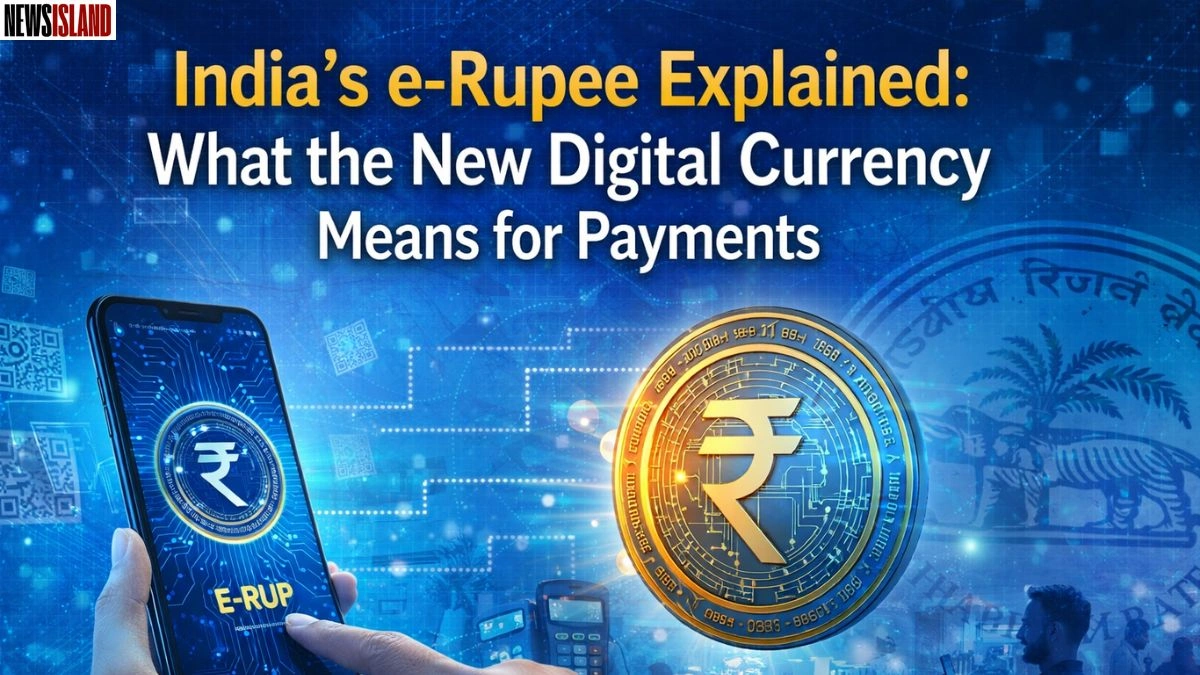
India’s e-Rupee is digital version of the country’s currency issued by the central bank to support the growing digital economy
New Delhi: India has taken an important step toward the future of digital finance by introducing the e-rupee, the country’s official digital currency. The Reserve Bank of India launched the digital rupee as a Central Bank Digital Currency (CBDC) to work along with India’s rapidly growing digital payment systems, including the widely used Unified Payments Interface.
The digital rupee is a new type of money that exists only in digital form, but it has the same value and legal status as physical cash.
What Is the e-Rupee
The digital rupee, also known as e₹, is the electronic version of India’s currency. It works like normal cash, but instead of paper notes or coins, it is stored and used digitally.
The central bank issues and controls it, which means it is legal tender just like traditional money.
The Reserve Bank of India started testing the digital rupee through pilot projects. The wholesale pilot began in November 2022, and the retail pilot started in December 2022.
Some major elements of the digital rupee are:
It is legal tender issued by the Central Bank.
It comes in the same denominations as physical cash.
People can keep it in digital wallets on their mobile phones.
It enables direct payments between individuals and merchants.
Simply put, the e-rupee functions as a digital banknote that can be sent directly to others.
Why did India introduce the Digital Rupee?
India introduced the digital rupee for a variety of reasons, including technological advancements, increased efficiency, and the future of finance.
Strengthening Digital Payments
India already boasts one of the world’s largest digital payment systems, thanks to the success of the Unified Payments Interface.
The digital rupee adds another payment option by offering a government-backed digital currency that can work together with existing digital payment platforms.
Reducing Dependence on Cash
Handling physical cash is expensive. It involves printing banknotes, transporting them, and maintaining security.
By promoting digital currency, authorities hope to reduce the cost of printing and managing cash. Digital currency may also help reduce problems like fake or counterfeit banknotes.
Expanding Financial Inclusion
The digital rupee may help more people become part of the formal financial system, especially those living in rural or remote areas.
Because the digital rupee works through mobile wallets and may facilitate offline transactions, it may enable digital payments even in areas with limited internet availability.
Offering an alternative to Cryptocurrency
The digital rupee also arrives at a time when cryptocurrencies such as Bitcoin are gaining traction.
Unlike cryptocurrencies, which are decentralized and frequently volatile, the digital rupee is completely regulated by the central bank and supported by the government. This makes it a more safe and reliable digital currency choice.
How The Digital Rupee Works
The Reserve Bank of India distributes the digital rupee via participating commercial banks.
Users can download a digital rupee wallet app provided by these banks and link it to their bank accounts. After that, they can load digital rupees into the wallet and use them for payments.
There are two main ways to use the digital rupee:
Person-to-Person (P2P): sending money directly to another individual
Person-to-Merchant (P2M): paying businesses for goods or services
Users can also make payments by scanning QR codes, similar to how payments are made using Unified Payments Interface.
Difference Between UPI and e-Rupee
Although the digital rupee may look similar to UPI payments, they are actually different.
UPI is a payment system that allows money to move between bank accounts, while the digital rupee itself is the money being transferred.
In simple terms, UPI is the payment platform, while the digital rupee is the digital form of currency issued directly by the central bank.
Growth and Adoption
Since its launch, the digital rupee pilot program has slowly expanded across India.
By March 2025, the total circulation of the digital rupee had crossed ₹1,000 crore, and millions of users had joined the pilot through participating banks.
Authorities are also testing several new features, including:
Offline payment systems
Programmable payments for government programs
Experiments with cross-border digital transactions
In 2025, the Reserve Bank of India also introduced a digital currency sandbox, allowing financial technology companies to develop new products and services using the digital rupee system.
Use in Government Programs
The digital rupee may also improve how government benefits are distributed.
Authorities are exploring programmed e-rupee vouchers for specific uses, such as food subsidies or welfare programs.
This approach could assist ensure that government monies are used correctly and reduce misuse.
How It Could Impact Payments
The digital rupee may cause various changes to India’s payment system.
Faster transactions: Digital currency allows money to move instantly between users.
Lower costs: Fewer intermediaries could reduce transaction expenses.
Better transparency: Digital records may help track financial activity more clearly.
More innovation: The digital rupee may encourage companies to create new financial apps and services.
In the future, the digital rupee could facilitate international payments and money transfers.
Also Read: Delhi Hosts ISPI 2026 Inauguration by Ajay Bhadoo, Focus on Packaging Innovations to Boost Exports
Future of Digital Money
India’s digital rupee initiative is still in development, but it is a significant step toward modernizing the country’s financial system.
While the Unified Payments Interface altered the way people sent and received money, the digital rupee has the potential to alter the appearance of money in the digital age.
As pilot programs expand and new technologies are deployed, the e-rupee might play an essential role in India’s burgeoning digital economy.
Estimated reading time: 5 minutes

khushisikarwar is an award-winning journalist and content creator who thrives on telling stories that matter. As a key contributor to Newsisland, [she] focus on cultural commentary, providing readers with thought-provoking insights.