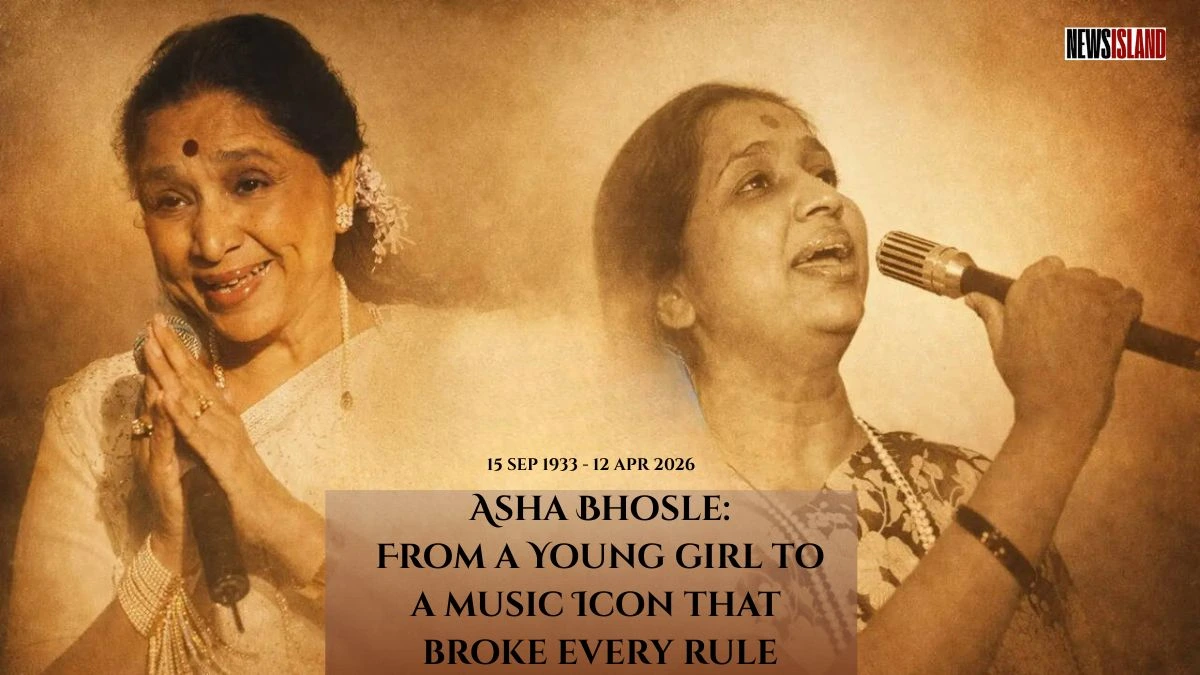
Asha Bhosle was far more than Bollywood’s boldest voice — she was a woman who broke every rule life threw at her, from a runaway marriage at 16 to recording songs well into her 90s
Mumbai: In Mumbai 1943 a 10 year old girl walked into a modest recording studio, nervous but determined. Her father- singer actor Master Dinanath Mangeshkar had died just a year before, leaving behind a grieving family with very little money.
Young Asha Mangeshkar stabled herself, stood before the microphone, and sang her first film song, “Chala Chala Nav Bala”, for a Marathi movie called Majha Bal.
Nobody in that room could have imagined that this small, shy girl would go on to record over 12,000 songs across eight decades, reshape Indian cinema’s sound, and become one of the most celebrated voices the world has ever heard.
“Aaiye Meherbaan” – Asha found her Own Sound
From child artist to playback singer, Asha quickly carved her own identity. While her elder sister Lata Mangeshkar became the epitome of classical purity and emotional restraint, Asha Bhosle embraced the bold, the sensuous, and the modern.
She sang for vamps, dancers, and the new urban woman who dared to flirt, dance, and live freely. This was no accident — it was rebellion. “Aaiye Meherbaan” (Howrah Bridge, 1958) — the moment she truly found her own sound — became a defining milestone in this journey.
At just 16, Asha secretly got married to 31-year-old Ganpatrao Bhosle, against her family. The marriage brought three children but ended in separation.
Thrown out of the Mangeshkar household, she raised her kids while recording songs day and night. Those years of struggle forged her signature style — a voice full of life, mischief, and unapologetic energy.
Song That Changed Everything
The recording session for “Piya Tu Ab To Aaja” became legendary. Composer R.D. Burman (Pancham) pushed her into new territory with its cabaret rhythm, heavy breathing, and raw seduction. Asha initially hesitated, feeling it was too westernised. But she rehearsed for days and delivered one of Bollywood’s most iconic raunchy numbers — picturised on Helen. That song didn’t just break rules; it shattered them.
This marked the golden era of the Asha-R.D. Burman collaboration. From “Dum Maro Dum” (the ultimate 70s anthem of rebellion) to “Chura Liya Hai Tumne” and “Yeh Mera Dil”, their chemistry created a new sound for Bollywood — youthful, Western-influenced, and irresistibly fun. What started as a professional partnership blossomed into marriage in 1979. Pancham became her greatest musical and emotional anchor.
More Than the Cabaret Queen
While the world celebrated her cabaret queen image, Asha proved her classical and ghazal prowess too. Her work in Umrao Jaan showed a mature, soul-stirring side that matched any classical singer.
Songs like “In Aankhon Ki Masti Ke” revealed a singer of rare emotional complexity — soulful, restrained, and achingly beautiful. She could match any classical vocalist when the song demanded it.
She recorded in over 20 languages and earned Guinness recognition for the sheer volume of her work.
Two Sisters, One Beautiful Story
For years, Asha lived in the long shadow of comparisons to her elder sister. The early estrangement from her family after her elopement added a layer of personal pain to what was already a professional rivalry in the public imagination. But over time, the two sisters found their way back to each other. Asha often spoke of Lata as her greatest inspiration, and the mutual admiration that eventually defined their relationship
Personal Stories
Asha’s Restaurant: In the 1980s–90s, she opened “Asha’s” — a fine-dining Indian restaurant in the UK and later other cities. She personally curated the menu and often dropped in to greet guests. It was her way of staying connected to food, culture, and people beyond the studio.
Bond with Grandchildren: In her later years, Asha took special pride in grooming her granddaughter Zanai Bhosle as a singer. She described Zanai’s voice as “a beautiful mix of mine and Lata didi” and actively mentored her, even recording songs together. Their duets and shared stage moments warmed millions of hearts.
The Eternal Echo
On April 12, 2026, at the age of 92, Asha Bhosle’s voice fell silent after a brief illness. Yet the spirit she breathed into Indian music — bold, modern, resilient, and joyfully defiant — will continue to echo for generations.
She was never just a singer. Asha Bhosle became the unforgettable voice of every woman who refused to be confined — by tradition, by expectation, or by societal norms. Whether on screen or in her own life, she represented freedom, sensuality, strength, and unapologetic individuality.

Amulya Shrivastav is a journalist who loves cricket and enjoys telling stories around it. Her interest in the sport is what led her to choose journalism as a career. She holds a Master’s degree in Journalism and writes mainly on sports, while also exploring topics like politics, health, tech, and lifestyle. Her work focuses on simple, engaging storytelling that connects with readers.