
Key Takeaways
- Gen Z (born 1997–2012) is turning to Instagram, YouTube, and podcasts — not temples or elders — for religious knowledge
- Research shows 62% of Gen Z describe themselves as spiritual, even as formal religious affiliation declines
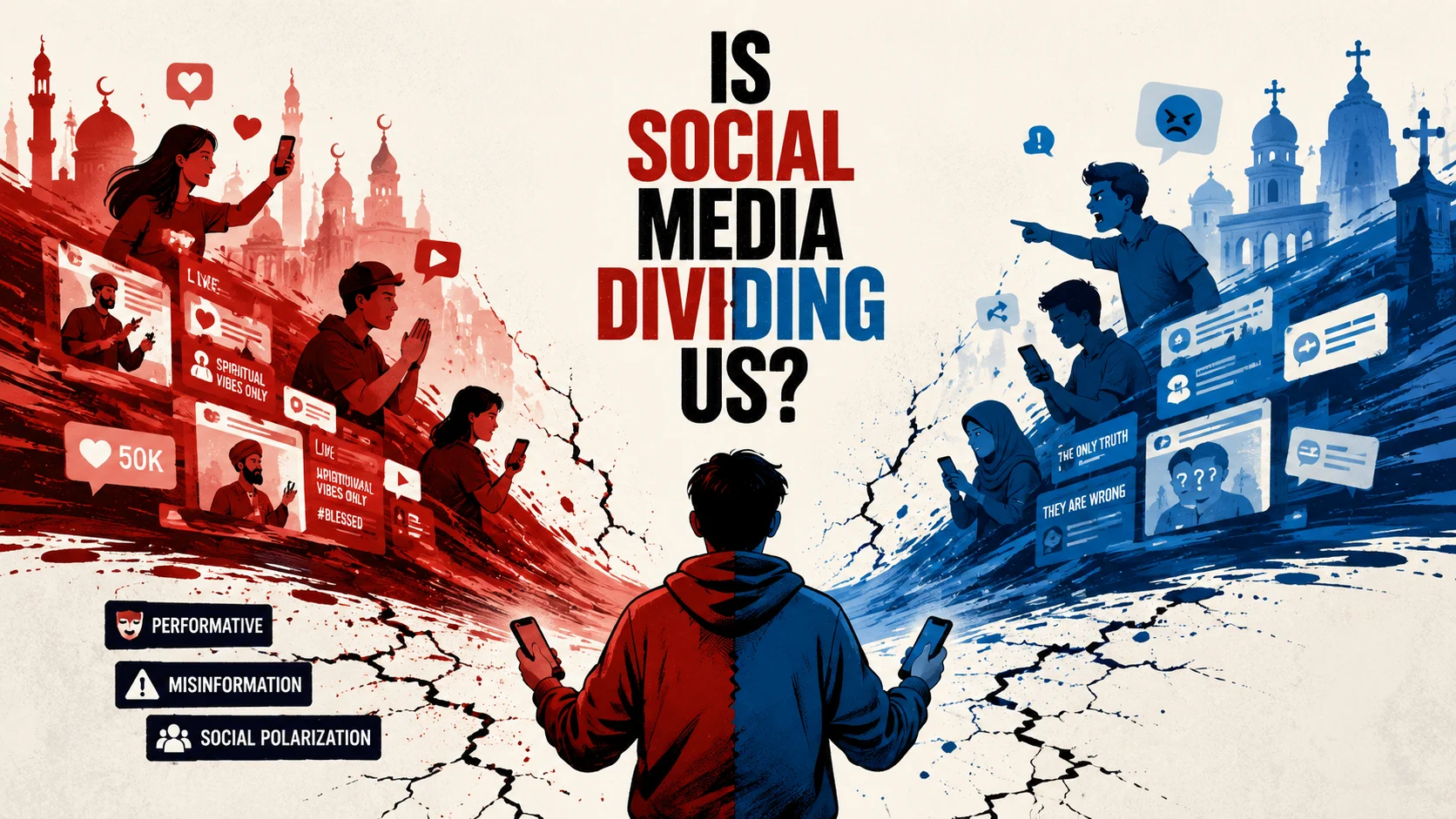
- A new phenomenon called “performative religiosity” is reshaping how faith is expressed publicly online
- Social media algorithms risk deepening religious polarization by creating information filter bubbles
- Misinformation spreads faster than verified religious content due to the way platforms prioritise engagement
There was a time when religious knowledge had a fixed address — the temple, the mosque, the gurudwara, the church, the scripture on the shelf, or the elder whose voice carried the weight of decades. Today, all of that fits inside a smartphone. A 90-second reel. A recommended podcast. A YouTube algorithm.
For Gen Z — the generation born between 1997 and 2012, now between 14 and 29 years old — this is not a departure from faith. It is simply where faith now lives.
The shift raises urgent questions: Is social media deepening genuine religious understanding, or is it creating a curated version of spirituality optimised for likes? Is it connecting communities across boundaries, or quietly feeding the divisions between them?
- 62% of Gen Z describe themselves as “spiritual” — vs 35% of those over 65
- 40% of Gen Z identify as religiously unaffiliated
- 15pts rise in Gen Z men’s religious commitment between 2019 and 2025 (Barna)
- 2026 studies show a “quiet revival” of spirituality among Gen Z — UK YouGov data
The Digital Transformation of Religion
Religious content is now among the most-consumed categories on social media. Short devotional videos on Instagram, full-length sermons on YouTube, spiritual guidance on Spotify podcasts — and behind each of these, millions of followers who have made digital platforms their primary point of contact with faith.
Many young people no longer begin their day by opening a scripture. They open a reel that offers a Quranic verse, a meditation prompt, a 60-second interpretation of the Gita, or a motivational extract from a Sikh morning prayer. The format is new. The underlying need — for meaning, for grounding, for a sense of something larger than the self — is ancient.
“Social media has not killed religion for Gen Z. It has relocated it — from stone buildings and printed pages to glass screens and infinite scroll.”
For a generation under relentless career pressure, facing economic uncertainty and a climate crisis, spiritual content is also serving a practical function. Studies consistently show that mindfulness, meditation, and religious engagement improve mental health outcomes. When a three-minute podcast delivers that in the gap between metro stations, the appeal is obvious.
Is Gen Z Moving Away From Religion? The Data Is More Complicated
The popular assumption — that young people are abandoning faith — is only partially supported by evidence. Formal religious affiliation is declining: roughly 40% of Gen Z in the United States identify as religiously unaffiliated. Daily prayer has dropped to around 25%. Church attendance among the broader population has plateaued.
But the story does not end there. A major 2025-2026 study by YouGov and the Bible Society found what researchers called a “quiet revival” of religiosity among Gen Z in the United Kingdom. Separately, Barna Group data showed that commitment to faith among Gen Z men rose by 15 percentage points between 2019 and 2025. An extraordinary 62% of Gen Z describe themselves as spiritual — nearly double the 35% figure among those over 65.
What the Research Shows
- Gen Z is not abandoning religion — it is abandoning organised religion
- They identify as “spiritual but not religious” at far higher rates than previous generations
- They want the logic behind traditions, not just the tradition itself
- Explanatory religious content, history-based videos, and interfaith podcasts consistently outperform purely devotional content among Gen Z audiences
In other words, this generation is not walking away from the question of faith. It is walking away from inherited answers — and going online to find its own.
Also read: The History of Kaaba: Story of Islam’s Holiest Site
Performative Religiosity: When Faith Becomes Content
There is a behaviour pattern that researchers now call performative religiosity — and social media has accelerated it significantly.
People have always shared religious experiences. Pilgrimage photographs. Family temple visits captured on film. These are not new. What is new is the scale, the speed, and — crucially — the incentive structure. On Instagram, a photograph of a sunrise prayer gets engagement. A video of a holy dip at the Kumbh attracts thousands of views. The religious experience and its public display have become inseparable — and for some, the display has overtaken the experience.
“Turning on a camera before entering a shrine. Composing the caption before leaving the courtyard. This is not hypocrisy — but it is a question worth asking: for whom is this act being performed?”
The concern is not about individual intent — most people sharing religious content do so with genuine feeling. The concern is systemic. When platforms reward visibility over depth, when an algorithmically optimised thumbnail of a pilgrimage gets 10 times more reach than a 20-minute lecture on religious philosophy, the incentives pull content toward spectacle and away from substance.
A significant portion of Gen Z’s identity is shaped online. Religious expression, for this generation, is identity expression. That is neither good nor bad on its own — but it means the performance of faith and the practice of faith are now tangled in ways they never were before.
The Misinformation Problem: When Viral Beats Verified
Religious content online carries a specific and serious risk that other content categories do not: it deals in questions of deep personal conviction, historical complexity, and community identity. Get it wrong and the consequences extend far beyond a corrected tweet.
Yet social media algorithms do not optimise for accuracy. They optimise for attention. A video that makes a dramatic claim about a religious text — stripped of context, oversimplified, or outright false — will consistently outperform a careful, nuanced explanation that takes three times as long to watch.
How Religious Misinformation Spreads
- Short-form video compresses complex religious history into oversimplified claims
- Sensational content gets amplified by algorithms ahead of accurate content
- Claims go viral without citation, verification, or scholarly context
- Users mistake confident presentation for credible sourcing
- Corrections rarely reach the same audience as the original misinformation
The effects compound. Misrepresented religious texts create friction between communities. False historical claims harden into received wisdom. Interfaith misunderstandings — which take years of dialogue to repair — can be seeded in 30 seconds by a viral reel with three million views.
Religious Polarization and the Algorithm Problem
Perhaps the most structurally dangerous effect of social media on religion is the one that operates most quietly: polarization through personalization.
Every major social platform uses recommendation algorithms designed to keep users engaged. The simplest way to keep someone engaged is to show them more of what they already agree with. Applied to religion, this means users are progressively funnelled into narrower and narrower information environments — consuming only one tradition’s interpretation of contested histories, only one community’s reading of shared texts.
The result is not simply that people disagree more about religion. It is that they lose exposure to the full complexity of religious life — to the diversity within their own traditions, to the overlaps with other traditions, to the long history of interfaith dialogue that social media has no incentive to amplify.
“Religion, at its best, has always been a force that builds bridges. Algorithms, at their most efficient, build walls.”
When provocative religious content — emotionally charged, one-sided, designed to provoke reaction — consistently gets more reach than thoughtful discourse, the nature of online religious conversation shifts. Debate replaces dialogue. Outrage replaces understanding. And communities that share centuries of coexistence can find themselves looking at each other through the distorting lens of an engagement-maximising feed.
The Other Side: What Social Media Is Getting Right
It would be a serious distortion to leave the picture here. Social media has also done something genuinely remarkable for religion: it has democratised access to knowledge that was previously restricted by geography, language, and economic means.
A young woman in a small town in Rajasthan can now access a lecture by a leading Islamic scholar in Cairo. A Sikh teenager in Birmingham can explore the Guru Granth Sahib with a teacher in Amritsar. A Hindu student in Chicago can find community and guidance that their immediate surroundings cannot provide. This is not trivial. For millions of people, digital religion is real religion — the only access point they have to a living, active faith community.
Where Social Media Adds Genuine Value
- Provides access to authentic religious scholarship across geographical barriers
- Enables diaspora communities to maintain religious identity and connection
- Allows young people to ask questions they may feel unable to ask in traditional settings
- Gives credible religious institutions a direct channel to young audiences
- Mental health benefits of spiritual content are well-documented and real
Many serious scholars, religious institutions, and educators are doing excellent work online — producing content that is accurate, accessible, and genuinely enriching. The problem is not that good religious content does not exist on social media. The problem is that the systems governing what gets seen are indifferent to quality.
What Readers Can Do: Navigating Religion Online Responsibly
The onus cannot fall entirely on individuals — platform design, regulation, and institutional responsibility all have a role. But in the meantime, there are practical ways to engage with religious content online more thoughtfully.
A Reader’s Guide to Digital Religion
- Check the source. Is this content from a credible religious scholar, institution, or publication — or from an anonymous account with a dramatic thumbnail?
- Seek multiple perspectives. Actively follow voices from different traditions, denominations, or schools of thought within your own faith.
- Be sceptical of certainty. Religious history is genuinely complex. Any video that claims to have simple answers to ancient questions deserves scrutiny.
- Distinguish inspiration from education. A reel that makes you feel good is not the same as a source that makes you more informed.
- Engage with long-form content. Podcasts, documentaries, and longer videos offer depth that short-form cannot. Seek them out.
The relationship between religion and social media is not going away — and it should not. The question is whether we engage with it passively, shaped by what algorithms decide to show us, or actively, with the same discernment and critical attention we would bring to any other important question in our lives.
Gen Z understands, better than any previous generation, that the digital world is not neutral. It is built by companies with commercial incentives. Applying that understanding to religious content online is not a threat to faith. It is an act of it.
Frequently Asked Questions
Is Gen Z moving away from religion?
Not entirely. Research shows Gen Z is shifting away from organised religious institutions rather than religion itself. Studies from YouGov, the Bible Society, and Barna Group all point to a “quiet revival” of spiritual interest among young people — but on their own terms, through digital platforms and personal exploration rather than traditional structures.What is performative religiosity on social media?
Performative religiosity refers to the public display of religious activities — temple visits, prayers, pilgrimages — primarily for a social media audience. It is not necessarily dishonest, but critics argue it can shift the focus from the personal experience of faith to its digital presentation, prioritising appearance over substance.How does social media spread religious misinformation?
Social media algorithms reward content that generates strong reactions, regardless of accuracy. Short-form videos compress complex religious history into oversimplified claims, which then spread faster than carefully sourced, nuanced content. Without citations or editorial oversight, misinformation in religious content can quickly reach millions and become accepted as fact.Can social media cause religious polarization?
Yes. Recommendation algorithms create filter bubbles — progressively narrowing users’ information environment to content that confirms their existing views. When applied to religion, this can intensify in-group identity, reduce exposure to other traditions, and turn online religious discourse into conflict rather than dialogue.Are there benefits to following religious content on social media?
Absolutely. Social media has genuinely democratised access to religious knowledge — breaking down barriers of geography, language, and economics. Diaspora communities can maintain cultural and spiritual ties. Young people can explore questions they may not feel comfortable asking in traditional settings. Credible scholars and institutions are producing high-quality digital content. The key is engaging actively and critically rather than passively.
Frequently Asked Questions
Not entirely. Research shows Gen Z is shifting away from organised religious institutions rather than religion itself. Studies from YouGov, the Bible Society, and Barna Group all point to a “quiet revival” of spiritual interest among young people — but on their own terms, through digital platforms and personal exploration rather than traditional structures.
Performative religiosity refers to the public display of religious activities — temple visits, prayers, pilgrimages — primarily for a social media audience. It is not necessarily dishonest, but critics argue it can shift the focus from the personal experience of faith to its digital presentation, prioritising appearance over substance.
Social media algorithms reward content that generates strong reactions, regardless of accuracy. Short-form videos compress complex religious history into oversimplified claims, which then spread faster than carefully sourced, nuanced content. Without citations or editorial oversight, misinformation in religious content can quickly reach millions and become accepted as fact.
Yes. Recommendation algorithms create filter bubbles — progressively narrowing users’ information environment to content that confirms their existing views. When applied to religion, this can intensify in-group identity, reduce exposure to other traditions, and turn online religious discourse into conflict rather than dialogue.
Absolutely. Social media has genuinely democratised access to religious knowledge — breaking down barriers of geography, language, and economics. Diaspora communities can maintain cultural and spiritual ties. Young people can explore questions they may not feel comfortable asking in traditional settings. Credible scholars and institutions are producing high-quality digital content. The key is engaging actively and critically rather than passively.


