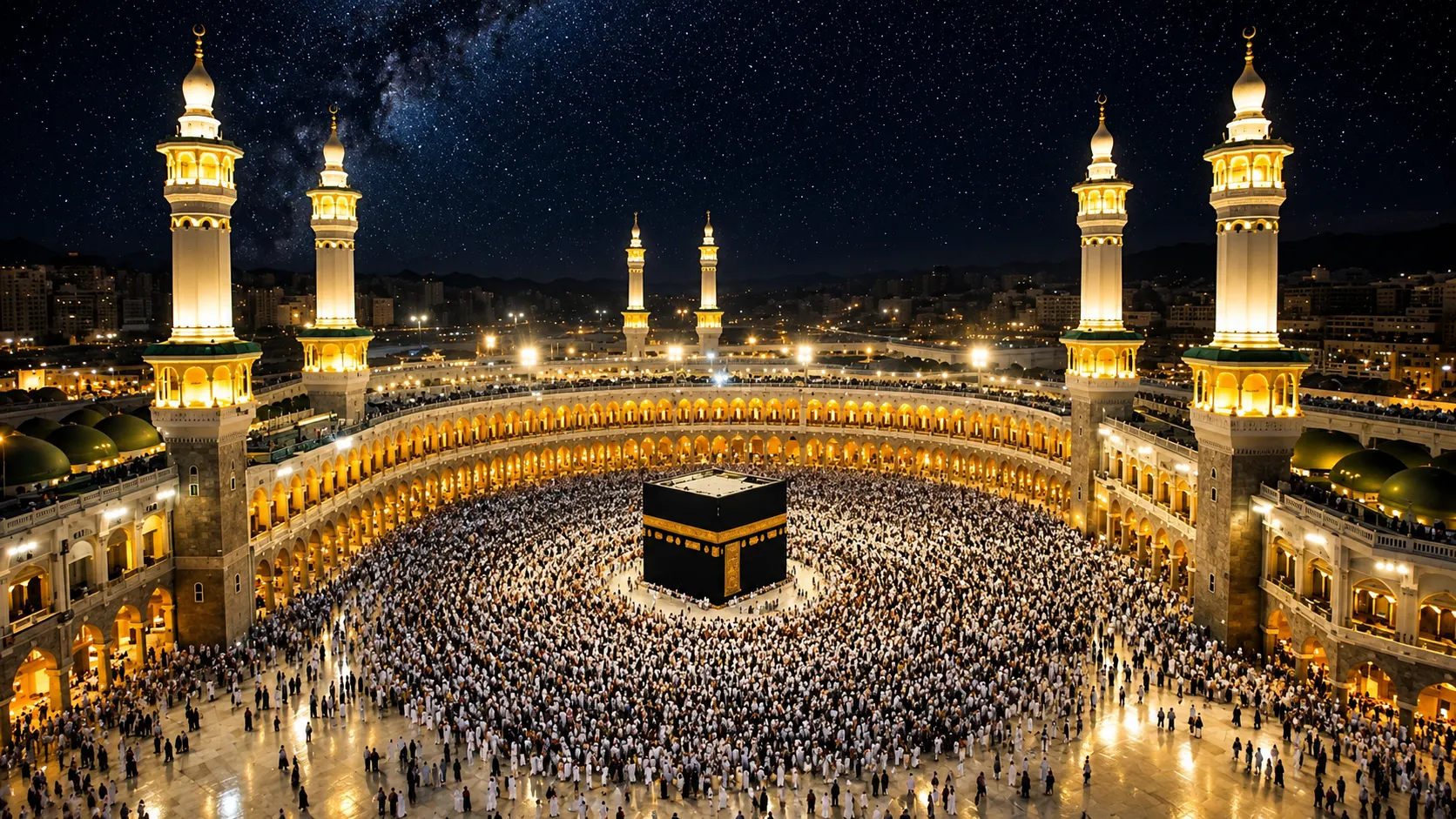
Delhi: The Kaaba is regarded as one of the most important religious sites in the world. Located in the city of Mecca in Saudi Arabia, this sacred structure is considered the most revered center of Islam. Every year, millions of Muslims travel here to perform Hajj and Umrah, while billions of Muslims around the world face its direction during their five daily prayers. The Kaaba is not merely a religious structure; it is also a symbol of faith, history, and spiritual unity.
How did Kaaba begin?
According to Islamic beliefs, the foundations of the Kaaba date back to the earliest period of human history. It is believed that this site was originally designated for the worship of Allah. However, over time, the structure was either destroyed or underwent significant changes.
Later, Allah commanded Prophet Ibrahim (Abraham) and his son Prophet Ismail to rebuild this sacred site. According to Islamic tradition, they constructed the walls of the Kaaba together and established it as a center for monotheistic worship. For this reason, the Kaaba is considered an important symbol of the Abrahamic tradition.
The significance of Mecca and Kaaba
The Kaaba stands at the center of Masjid al-Haram in Mecca. Its shape is approximately cubical, which is why it is called the “Kaaba.” In Arabic, the word Kaaba is associated with the meaning of a cube or a square-shaped structure.
In Islam, the Kaaba is referred to as “Baytullah,” meaning “The House of Allah.” This does not imply that Allah resides within a building; rather, it is a symbolic title that signifies honor and sanctity.
The Pre-Islamic era
According to historians, even before the rise of Islam, the Kaaba served as an important religious center in the Arabian Peninsula. During that time, various Arab tribes had placed their idols there. Historical accounts suggest that hundreds of idols surrounded the Kaaba, and people visited the site to worship different deities.
However, Islamic tradition maintains that the Kaaba was originally a center of monotheistic worship, but over time, polytheistic practices became associated with it. This is why, with the advent of Islam, it was re-established as a place dedicated solely to the worship of one God.
Prophet Muhammad and Kaaba
In the 7th century, Prophet Muhammad began preaching the message of Islam. At that time, many influential people in Mecca opposed his teachings. In 630 CE, when Muslims peacefully entered Mecca, the Kaaba was cleared of idols.
Following this event, the Kaaba was dedicated exclusively to the worship of Allah. This is considered a significant event in Islamic history and marks the establishment of the Kaaba as the central religious site of Islam.
Black Stone (Hajar al-Aswad)
One corner of the Kaaba contains the famous Black Stone, known as Hajar al-Aswad. Various religious traditions and beliefs are associated with this stone. During Hajj and Umrah, pilgrims try to approach it or gesture toward it.
However, Islamic scholars emphasize that Muslims do not worship the stone. It is regarded as a historical and religious symbol deserving respect.
Center of the Qibla
In Islam, the direction faced during prayer is called the Qibla. Muslims living anywhere in the world turn toward the Kaaba when offering their prayers. This practice connects the global Muslim community to a shared spiritual center.
The concept of the Qibla is not merely a way of determining direction; it also symbolizes unity and equality among Muslims worldwide.
Hajj and Kaaba
Hajj is one of the Five Pillars of Islam. Every Muslim who is physically and financially able is expected to perform Hajj at least once in their lifetime.
During Hajj, pilgrims circumambulate the Kaaba in a ritual known as Tawaf. The sight of millions of people moving around the Kaaba together is considered one of the largest religious gatherings in the world. It represents a remarkable example of religious devotion and global unity.
Kaaba Today
Over the centuries, the Kaaba has undergone renovations and reconstructions due to floods, natural events, and maintenance work. Its current structure is the result of historical construction efforts and later restorations. It is covered with a special black cloth known as the Kiswah, which is replaced every year.