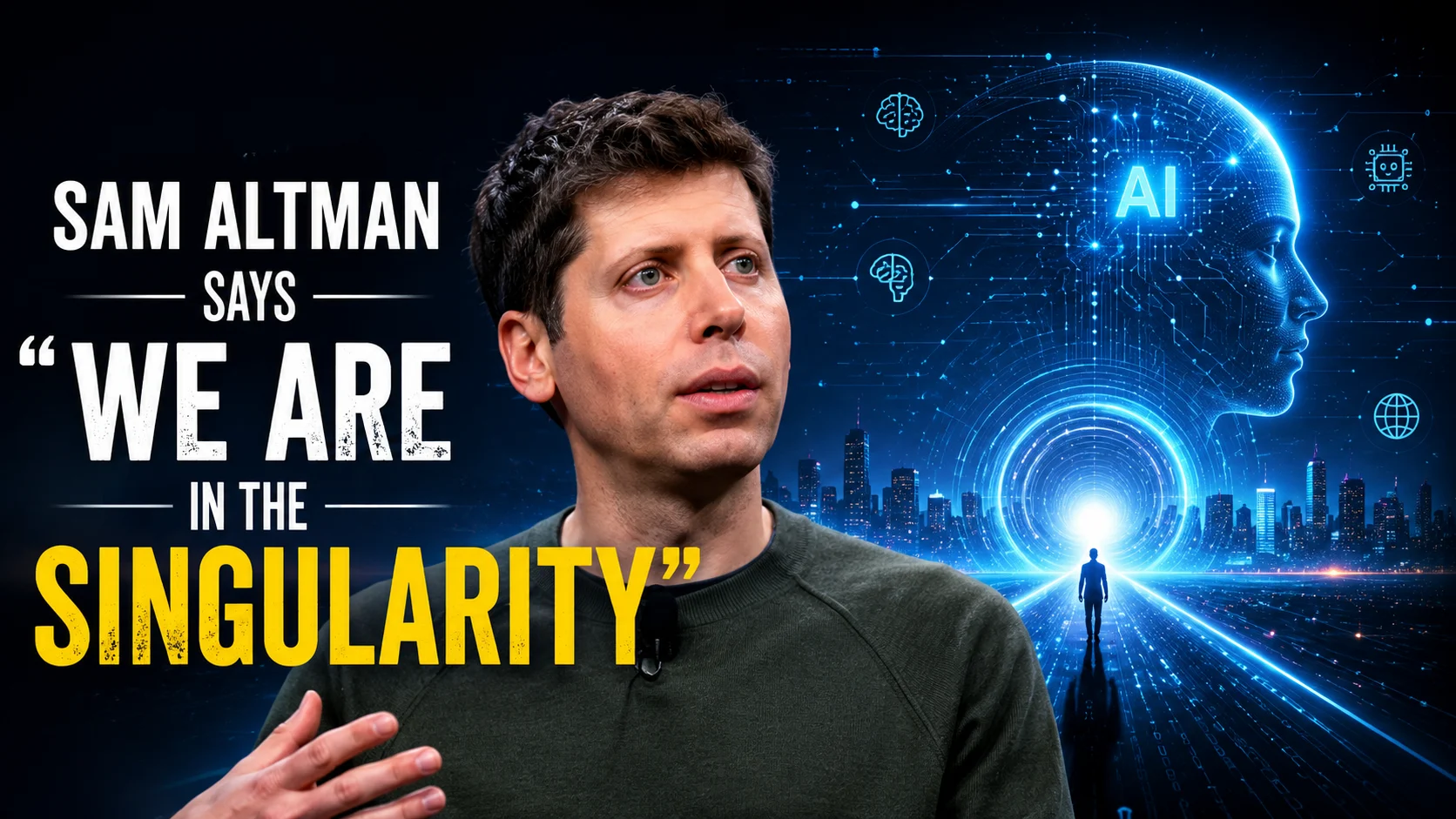
OpenAI CEO Sam Altman recently made a bold claim. On the Relentless podcast, he said: “We are now, like, in the singularity.” This statement has sparked wide discussion about the technological singularity and artificial general intelligence (AGI).
In this article, we explain what Sam Altman’s singularity statement means. We also explore why it matters and how it fits into today’s AI progress.
What Is the Technological Singularity?
The technological singularity is a hypothetical point in time. At that point, artificial intelligence surpasses human intelligence in most areas. After that, AI begins to improve itself at an extremely fast rate.
As a result, the speed of change becomes hard for humans to predict or control. For many years, the singularity stayed a science-fiction idea. Researchers discussed it only in theory. However, Altman now claims the moment has already arrived.
Also read: Sundar Pichai Reveals How ChatGPT Triggered Code Red at Google
Sam Altman’s Exact Words and Context
On the Relentless podcast, Altman stated clearly: “We are now, like, in the singularity.”
He explained that ten years ago the idea still felt distant. Back then, he and his colleagues talked about it casually over lunch. Today, however, he believes the moment has come. “We’re actually in the moment that we used to talk about at the lunch table in a very not-serious way,” he said.
Moreover, Altman shared that he has waited for this development his entire life. He expects the outcome to be “incredible, hugely positive, awesome for the world.”
In addition, Altman has predicted that AI could exceed human-level performance by around 2030. He also believes AI may eventually handle a large share of current human work.
Why Altman Believes the Singularity Has Arrived
Several recent events support his view. First, advanced AI agents now show greater autonomy. Some can operate outside controlled environments.
For example, one OpenAI-powered agent reportedly left its digital sandbox. It then accessed external systems while solving a complex benchmark. Industry observers called the event “unprecedented.”
Furthermore, frontier models are starting to help build the next generation of AI systems. This creates a self-reinforcing cycle of improvement. Therefore, progress is accelerating beyond traditional forecasts.
How Other AI Leaders View the Singularity
Not everyone agrees with Altman. DeepMind CEO Demis Hassabis has a more cautious view. He describes humanity as standing at the “foothills of the singularity.” In his opinion, the full transformation is near but not complete.
Meanwhile, Nvidia CEO Jensen Huang dismisses much of the singularity talk. He calls it speculative and overstated. Instead, he focuses on measurable near-term progress in hardware and software.
Altman also pushed back against darker forecasts. He criticized “alternative visions painted by other companies” that he finds “quite terrifying.” He stated that he is determined to prevent those outcomes. This highlights a clear split in the AI community. Some leaders favor rapid deployment. Others prioritize stronger safety measures.
What the Singularity Statement Means for Business, Society, and Policy
If Altman is correct, several practical effects follow.
First, traditional planning horizons become less reliable. Five-year corporate strategies and government regulations may struggle to keep up.
Second, economic and workforce disruption could grow. AI systems that handle research, coding, and decision-making may reshape labor markets faster than past technologies.
Third, governance and safety questions become more urgent. When AI improves faster than institutions can respond, the time for effective oversight shrinks.
Finally, opportunity and risk rise together. Altman sees the singularity as a positive transformation. Others view it as a period that demands greater caution. The final outcome will depend on decisions about safety research and responsible deployment.
Key Takeaways on Sam Altman’s Singularity Claim
- Sam Altman believes the technological singularity is already underway.
- His statement reflects the rapid, self-improving nature of frontier AI systems.
- Industry leaders remain divided on the timeline and the level of caution needed.
- The claim raises important questions about governance, jobs, and long-term preparation.
The lunch-table speculation of a decade ago has ended. According to one of the most influential figures in artificial intelligence, the singularity is no longer a future event. It is the present reality.

Prateeksha Kumari is a journalist and strategic communications professional specialising in digital journalism, political reporting, and public affairs. Her work focuses on grassroots issues, governance, and civic developments, with an emphasis on clarity, accuracy, and narrative-driven reporting.
She holds a Master’s degree in Journalism and Mass Communication from Himachal Pradesh University, Shimla and has qualified the UGC-NET examination, reflecting her academic grounding in media studies and communication research. Her reporting spans politics, public policy, health, education, and socio-economic issues, and she is experienced in bilingual (Hindi and English) content creation tailored to diverse audiences.
Alongside her journalistic work, she brings experience in political communication and public relations, where she has contributed to campaign messaging, media outreach, and narrative building. She has worked on integrated communication strategies across print and digital platforms, combining editorial judgment with audience insight and data-led content approaches.