
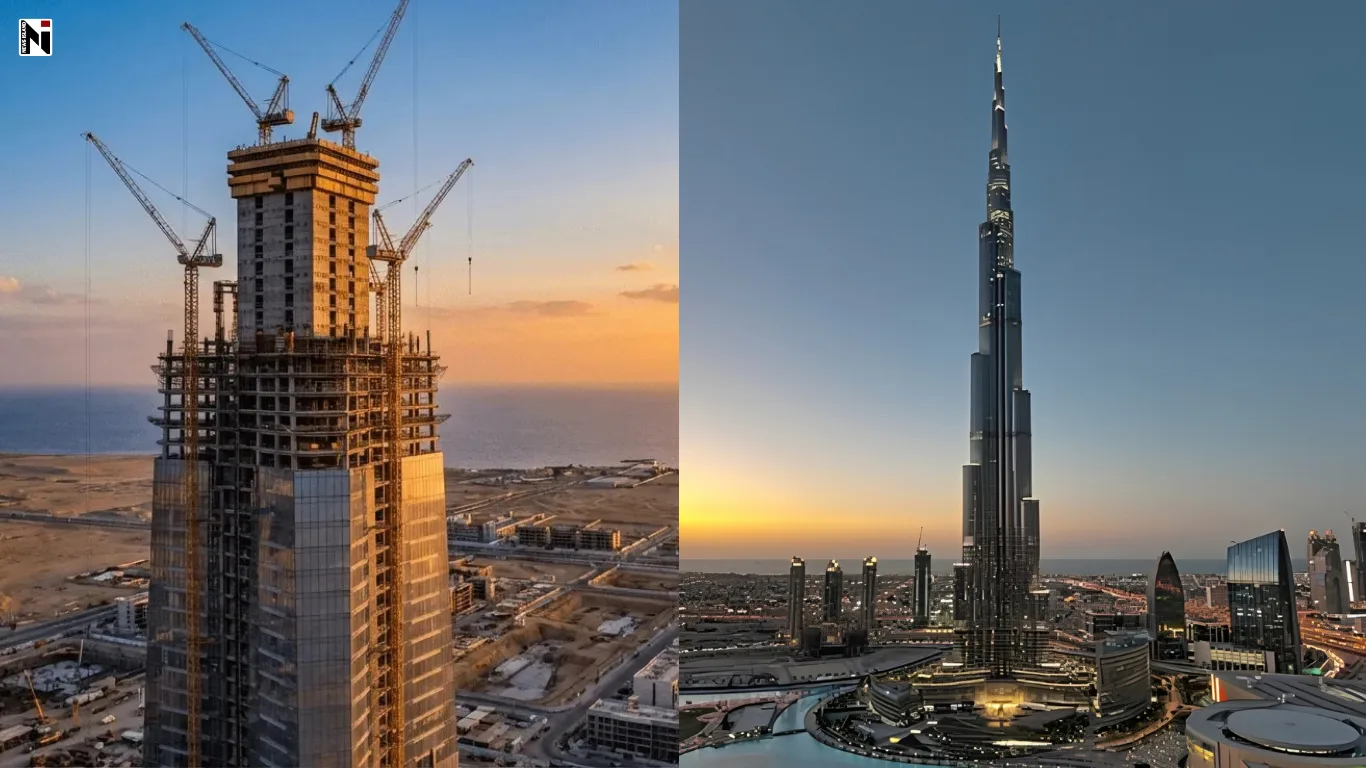
Jeddah Tower construction has resumed after an eight-year halt. Here’s how Saudi Arabia’s 1,000m skyscraper could surpass Burj Khalifa
New Delhi: Dubai’s iconic Burj Khalifa has held the title of the world’s tallest building for the past 16 years. Standing at 828 metres, the skyscraper now faces a challenge from a Saudi Arabian project designed to rise more than 1,000 metres into the sky.
The project is called Jeddah Tower.
If developers complete the tower according to its current design, it will stand more than 172 metres taller than the Burj Khalifa and could become the world’s first building to cross the one kilometre mark.
But Jeddah Tower’s story goes far beyond its extraordinary height. Developers began construction in 2013, but the project stalled at around 63 floors in 2018. After nearly eight years of uncertainty and delays, construction finally resumed in 2025.
The Dream of a More Than 1,000 Metre Tower
Developers are building Jeddah Tower as the centrepiece of Saudi Arabia’s Jeddah Economic City project. US based architecture firm Adrian Smith + Gordon Gill Architecture designed the tower.
The project also has a connection to Dubai’s Burj Khalifa. Architect Adrian Smith was part of the design team behind the Burj Khalifa.
Jeddah Tower’s planned height exceeds 1,000 metres, compared with the Burj Khalifa’s official height of 828 metres. If developers reach the planned height, Jeddah Tower will add more than 172 metres to the current world record.
The tower will include luxury residences, offices, a hotel and other commercial facilities. It will also feature a high-altitude observation facility. Developers see the tower not simply as a skyscraper, but as the landmark centrepiece of the wider Jeddah Economic City development.
Why Did Construction Stop in 2018?
Developers started building Jeddah Tower in 2013 and initially expected to complete it around 2020. However, events in Saudi Arabia after 2017 significantly disrupted the project.
In 2017, Saudi authorities launched a major anti corruption campaign that detained several prominent business and political figures. Among those detained were Prince Alwaleed bin Talal and Bakr Bin Laden, a senior figure at the Saudi Binladin Group.
The Saudi Binladin Group served as the main contractor for Jeddah Tower, and the developments surrounding the company affected the project.
The company had already faced scrutiny following the 2015 Mecca crane accident, which killed more than 100 people.
Against this backdrop, construction on Jeddah Tower came to a halt in 2018. By then, workers had completed around 63 floors, putting roughly one third of the tower’s structural work in place.
However, the eight year delay did not stem from a single cause. After the 2018 halt, the project entered a prolonged period of uncertainty and restructuring. The COVID-19 pandemic in 2020 then created additional disruption for the construction sector and large-scale development projects.
2024: The Project Gets a Fresh Start
After years of delays, efforts to revive Jeddah Tower accelerated in 2023 and 2024.
In October 2024, Jeddah Economic Company signed a new agreement with the Saudi Binladin Group to complete the tower.
The contract carries a value of around 7.2 billion Saudi riyals, equivalent to roughly $1.9 billion. The agreement set a construction period of approximately 42 months for the remaining work.
The deal gave the stalled project a new construction plan and a clearer path toward completion.
Construction Resumes in January 2025
A few months after signing the new contract, construction crews returned to the site.
On January 20, 2025, workers resumed construction with concrete pouring, marking the project’s official restart.
The tower then began climbing rapidly once again.
Project updates released in 2026 showed the structure had crossed the 100 level mark. By August 2026, the tower had reached approximately Level 106 and around 430 metres in height.
Thousands of workers were involved at the site, while crews continued concrete, façade and other construction activities.
Jeddah Tower, therefore, no longer represents simply an old mega project that once stalled. Construction has resumed and the structure is once again rising rapidly.
Why Is Building a One-Kilometre Tower So Difficult?
The tower’s enormous height creates some of its biggest engineering challenges.
As a skyscraper approaches 1,000 metres, engineers must deal with increasingly complex wind effects and structural loads. The tower therefore uses a distinctive aerodynamic form rather than a conventional straight skyscraper design.
Its three-sided shape helps engineers manage the impact of wind on the structure.
But wind represents only one challenge. Engineers must also manage the building’s structural strength, elevator systems, movement caused by wind, occupant comfort, façade systems, water supply and electricity.
At this scale, every additional metre creates another layer of engineering complexity.
Could Jeddah Tower Really Break Burj Khalifa’s Record?
If developers complete Jeddah Tower at its planned height, the numbers leave little doubt.
The proposed 1,000-plus-metre height would put it well above the Burj Khalifa’s 828 metres.
But Jeddah Tower has not broken the record yet.
At around 430 metres, the tower still has a long way to go before it reaches its planned height. The developer currently targets August 2028 for completion.
However, a target date does not guarantee completion. Projects of this scale can face engineering, construction, financing or scheduling challenges that push timelines further.
If the current plan stays on track and developers complete the tower at more than 1,000 metres, Jeddah Tower will not only take the title of the world’s tallest building from Burj Khalifa but could also become the first building in history to cross the one kilometre height mark.
That makes Jeddah Tower’s story about far more than a race for height.
It is the story of an ambitious project that stalled at 63 floors in 2018, spent years in uncertainty, and finally returned to active construction in 2025.
Now, as the tower rises again, Saudi Arabia is once again aiming at the record that Dubai’s Burj Khalifa has held since 2010.


