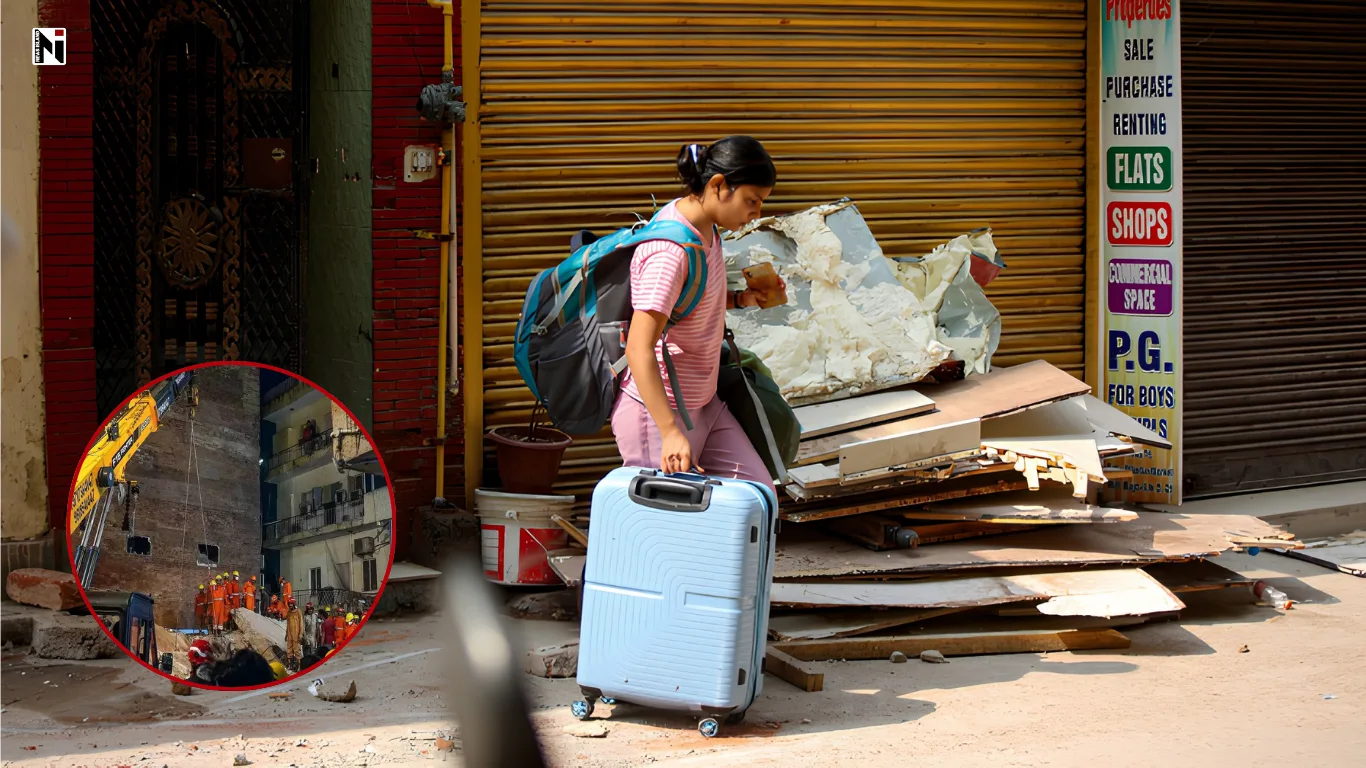
New Delhi: After seven people died in a PG building collapse and the backlash that followed, the Delhi government appears to have finally woken up from its deep sleep. Education Minister Ashish Sood has said that the government will formulate a comprehensive policy to regulate coaching institutes and PG accommodations across Delhi, with the safety of students living in these properties as a key focus.
But the question is simple: Did it really take the death of seven people for the government to realise that thousands of students are living in privately run accommodations with little clarity about safety, rent or accountability?
If students studying in one of the country’s biggest educational hubs, in the national capital itself, cannot feel safe in the place they call home, then where are they supposed to feel safe?
The government regularly carries out encroachment drives across Delhi. MCD teams remove structures in the name of enforcement, sometimes leaving poor families without a roof over their heads. But what about the properties that continue to accommodate students despite questions over their safety and compliance?
Who is checking these buildings? And who takes responsibility when something goes wrong? These are not questions that emerged after the Satya Niketan collapse. Students have been dealing with the consequences of an unregulated accommodation system for years.
A Room in Delhi Comes at a Heavy Price
Delhi attracts thousands of students every year for higher education, government examinations and competitive exams. Many arrive from smaller cities and states and have little choice but to depend on private PGs and rental accommodations. For these students, a PG is not simply a temporary room. It becomes their home for months or even years.
Many PGs operate in overcrowded neighbourhoods, where space is limited and rooms are often packed with beds. In shared accommodation, students may have little room beyond the space needed to sleep and move around. Private rooms, meanwhile, come at a considerably higher price.
In several student areas, four-sharing accommodation can start at around ₹10,000 per person, with the rent increasing as the number of occupants decreases, going upto 20-25 thousand.
The problem becomes worse when the amount students pay does not clearly correspond to what they receive. Facilities promised at the time of admission may not always be available after they move in, while electricity, food, maintenance and other charges can increase the final monthly cost.
What the Government Now Wants to Regulate
Authorities are considering registration numbers and a public platform where students and parents could access information about registered accommodations. The framework could also include requirements related to structural safety, fire-safety documentation, CCTV cameras, security arrangements and responsible wardens.
For larger PGs, the government could also consider dedicated security personnel. But registration alone cannot solve the problem. A government database cannot physically inspect a building. A registration number cannot prevent overcrowding. And a safety certificate means little if nobody verifies whether the property continues to meet the required standards.
The government will therefore have to inspect properties regularly and take action against those that violate the rules.
Also Read: WhatsApp Stops Supporting Older Android Phones, Android 6.0 or Above Now Required
Will Rent Regulation Actually Protect Students?
The proposed policy may also address rent and introduce area-wise guidelines. That could bring some much-needed transparency to a market where students often have limited bargaining power.
But rent regulation will only work if students can challenge violations. If an operator imposes an unexplained charge, increases rent without proper notice or refuses to return a security deposit, students need a clear authority to approach and a process that actually delivers a result.
The government has said it will consult students, parents, PG operators, student organisations and relevant departments before finalising the policy. The policy should address complaints related to food, water, electricity, privacy, security deposits, notice periods, refunds and overcrowding. It should also provide a clear mechanism for students to report violations and seek action.
The government has indicated that it wants to introduce the policy within around one to one-and-a-half months, although a broader legal framework could take longer. Its effectiveness will depend on enforcement. Officials will need to inspect PGs, verify safety documents, act against violations and respond to complaints. The Satya Niketan collapse has brought the issue of student accommodation safety into focus. The government must now ensure that the proposed policy addresses the concerns raised by students and establishes clear accountability.