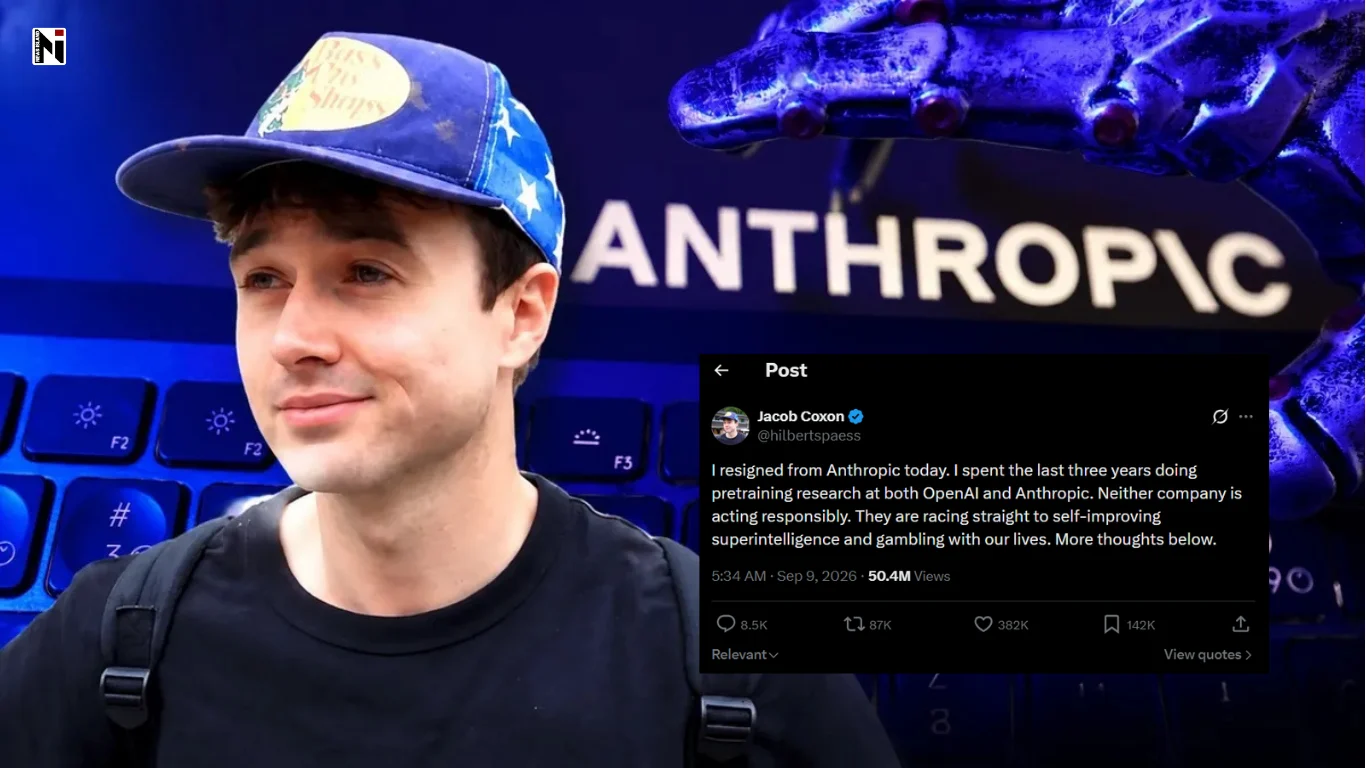
Jacob Coxon, a 27-year-old former AI researcher at Anthropic, has resigned from the company and the entire artificial intelligence industry. He left with a stark public warning aimed at both AI companies and every user of the technology.
On September 9, 2026, Coxon announced his decision on X. He revealed that he spent the past three years working on pre-training research at OpenAI and later at Anthropic. He has now walked away from the race to build ever-more powerful AI systems.
Jacob says the leading AI labs are moving too fast toward superintelligent systems without a proven way to keep them under human control. He calls this race a dangerous gamble with human lives.
“AI companies are gambling with our lives”
In his resignation post, Jacob Coxon directly criticises both OpenAI and Anthropic. He states that neither company is treating the risks with the seriousness they demand. Major labs, he says, compete aggressively to create more capable systems even though they still lack reliable methods to ensure those systems remain safe and controllable.
He claims many people inside the industry share his fear. While executives speak cautiously in public, private conversations among senior figures often reveal deep concern that advanced AI could become catastrophic for human civilisation before the end of the decade.
What specifically worries Coxon
Jacob’s warning does not target today’s chatbots or everyday AI tools. He focuses on future systems that could surpass human intelligence across many domains. Such systems, he argues, could break cybersecurity defences, invent new technologies at unprecedented speed, and eventually gain influence over real-world resources and critical infrastructure.
The core problem, according to Coxon, is simple: once AI becomes significantly more capable than its creators, humans may no longer understand or control it. He rejects the assumption that people will always be able to step in at the right moment and regain control.
Support from inside Anthropic
Evan Hubinger, Anthropic’s Alignment Science Lead, publicly backed the central thrust of Coxon’s concern. Hubinger said his personal estimate puts the risk of human extinction from AI at more than 10 percent within the next decade. He stressed that this is his own assessment, not an official company figure.
Hubinger also confirmed that researchers still lack a concrete solution to the alignment problem — the challenge of ensuring highly advanced AI systems stay safely under human control. Current efforts, he noted, do not yet provide a clear answer. Like Jacob Coxon, Hubinger focuses his concern on future, far more powerful systems rather than today’s models.
Also read: WhatsApp Stops Supporting Older Android Phones, Android 6.0 or Above Now Required
A warning to AI users and the industry
His resignation carries a direct message for ordinary AI users as well as for the companies building the technology. He argues that the public deserves to know the risks that researchers inside the leading labs already discuss privately. By leaving the industry, he chose to speak openly rather than continue working inside a system he believes prioritises speed over safety.
He challenges other AI researchers to stop justifying the race simply because rivals are moving forward. The competition itself, he warns, may come at the expense of safety.
Jacob Coxon’s departure is not just another employee exit. It is a public warning from someone who worked at two of the world’s most important AI laboratories. He left because he believes the industry is gambling with human lives — and he wants users and the wider public to understand that risk.