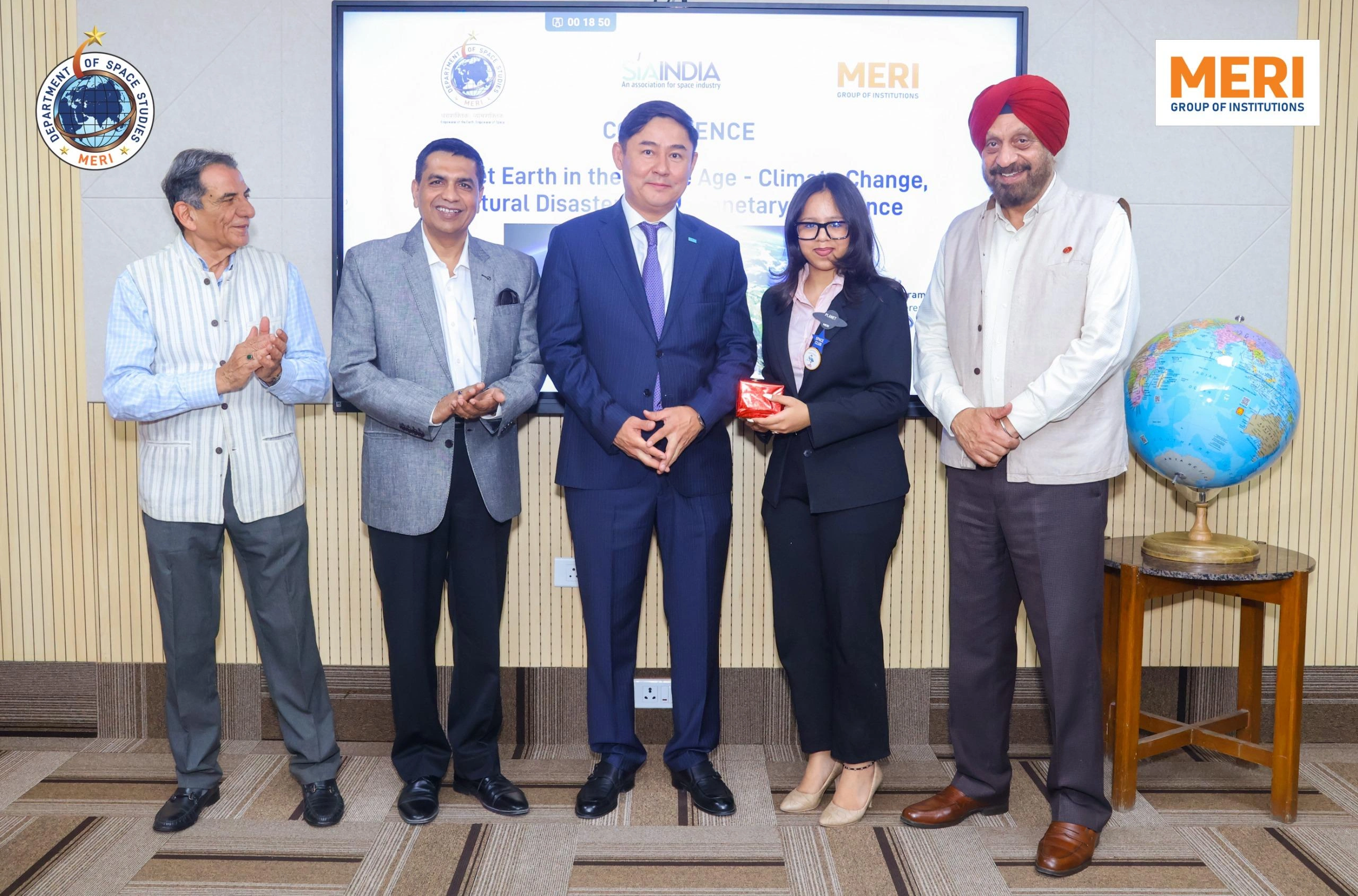
The Department of Space Studies at Management Education & Research Institute (MERI) DSS hosted a landmark conference to commemorate Earth Day 2026, examining the intersection of space technology and planetary health. The event serves as a strategic “curtain raiser” for India’s upcoming climate and space endeavors.
Global Cooperation & New Infrastructure
The conference highlighted a burgeoning partnership between India and Kazakhstan, focusing on using satellite imagery for geospatial intelligence, agricultural monitoring, disaster detection, and water management.
A major outcome was the intent to formalize the space cooperation between India and Kazakhstan. Addressing the assembly, Ambassador Azmat Yaskarev emphasized the synergy between the two nations:
“There is immense bilateral potential in space technologies for sustainable development. By combining India’s technological capabilities with Kazakhstan’s strategic geography and agricultural monitoring experience, we can tackle challenges like land degradation and flood detection more effectively.”
The conference also saw the inauguration of a new GIS Lab at MERI and the release of the PharmaTech 2026 report, which explores the cutting-edge convergence of space environments and pharmaceutical research. These steps are designed to build a service-driven ecosystem that moves beyond raw data to actionable AI insights.
The Climate Challenge
Scientists delivered a sobering reality check, noting that 2024 was the warmest year on record, with global temperatures exceeding the 1.5°C threshold.
- Atmospheric Rise: CO₂ levels have surged by 45%, rising from 280 ppm to over 420 ppm.
- Health Risks: High pollution levels are now linked to increased rates of diabetes, heart disease, and adverse pregnancy outcomes.
- Forecasting Progress: The IMD now utilizes 32-petaflop supercomputers to achieve 80-84% accuracy for day-one weather predictions. Empowering Future Leaders
The MERI Space Club recognized student Janya Batra for her work on planetary resilience and formally welcomed the RKS School Space Club (Dhruva). These youth groups are now tasked with developing district-level digital twin models to predict localized disasters like cloudbursts.
Moving forward, the results from this summit will inform the India Space Congress this June, focusing on refining predictive models for a warming world.

Prateeksha Kumari is a journalist and strategic communications professional specialising in digital journalism, political reporting, and public affairs. Her work focuses on grassroots issues, governance, and civic developments, with an emphasis on clarity, accuracy, and narrative-driven reporting.
She holds a Master’s degree in Journalism and Mass Communication from Himachal Pradesh University, Shimla and has qualified the UGC-NET examination, reflecting her academic grounding in media studies and communication research. Her reporting spans politics, public policy, health, education, and socio-economic issues, and she is experienced in bilingual (Hindi and English) content creation tailored to diverse audiences.
Alongside her journalistic work, she brings experience in political communication and public relations, where she has contributed to campaign messaging, media outreach, and narrative building. She has worked on integrated communication strategies across print and digital platforms, combining editorial judgment with audience insight and data-led content approaches.