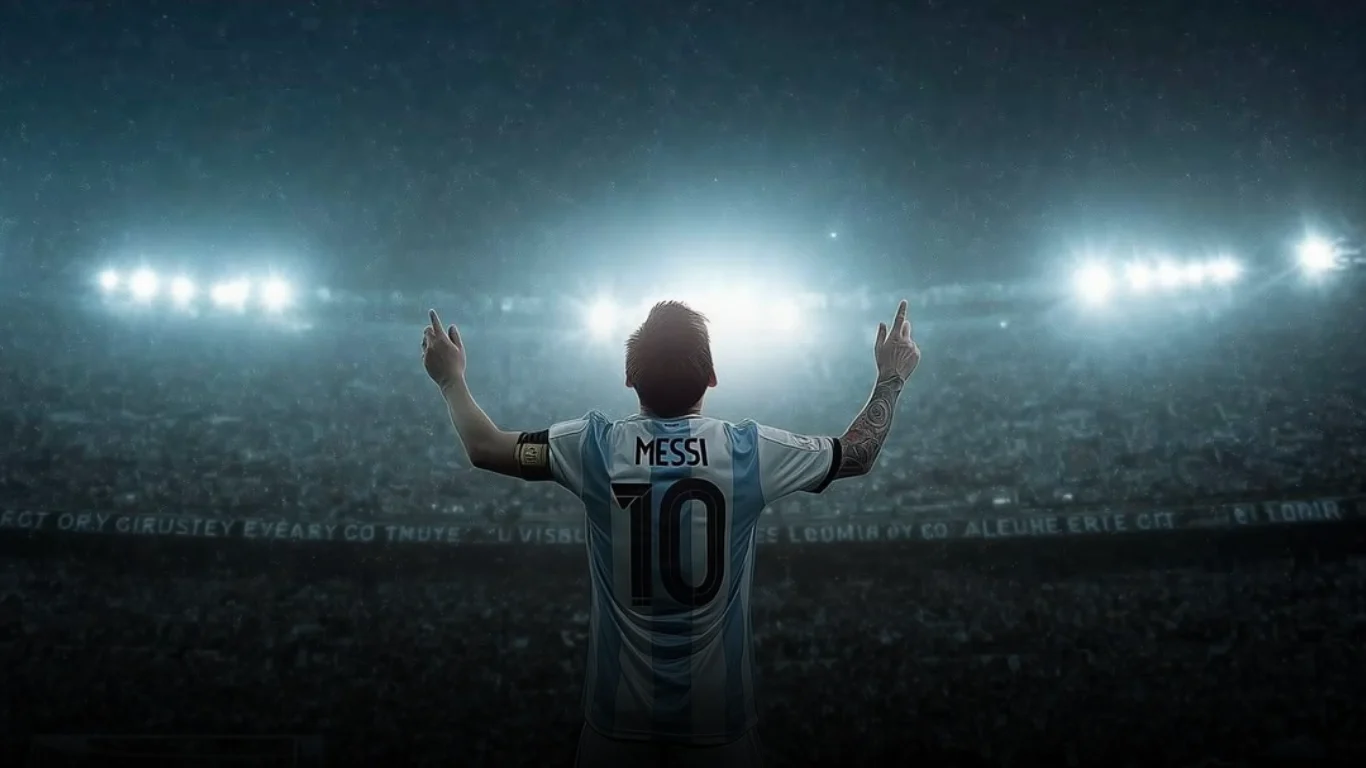
207 matches, 125 goals, 6 FIFA World Cups, 3 World Cup Finals, and an international career that future generations may remember not just through numbers, but through stories.
New Delhi: Messi… a name that perhaps there is hardly any football fan in the world who does not know. In fact, even people who do not watch football know who Messi is. For millions of football fans around the world, this legendary player is not just a footballer they respect, but an emotion they feel. Watching him play has always taken the excitement of fans to another level. His magical touches, breathtaking dribbling past defenders and incredible finishing in front of goal have captivated generations of football lovers.
But now, that magic will no longer be seen in the Argentina jersey.
After Argentina’s 1-0 defeat to Spain in the 2026 FIFA World Cup final, the decision that Messi fans around the world had feared for years finally came true. On August 31, 2026, Lionel Messi announced his retirement from international football. At the age of 39, Messi said goodbye to the team with which his journey had been filled with struggle, criticism, heartbreak, victories and unforgettable emotions.
Today, Messi stands as Argentina’s all-time leading international goalscorer and appearance holder, with 207 matches and 125 goals. But the journey that took him to these numbers is nothing short of a fairy tale.
2005: Messi Wears the Argentina Jersey for the First Time
Lionel Messi made his senior international debut for Argentina on August 17, 2005, against Hungary. He was just 18 years old at the time. But his international debut was nothing like what people today might imagine for one of the greatest footballers in history.
Just moments after coming onto the pitch, Messi was shown a red card following an incident involving Hungary’s Vilmos Vanczák. He was sent off almost a minute after making his senior international debut.
The player whose name is now associated with 125 international goals began his Argentina career with just a few moments on the pitch and a red card.
But perhaps that was the first sign of Messi’s story: the road ahead was never going to be easy.
2006 World Cup: The World Saw the First Glimpse of ‘Messi Magic’
The 2006 FIFA World Cup was the first major international stage of Messi’s career. At the tournament in Germany, he made his World Cup debut against Serbia and Montenegro in Argentina’s group-stage match.
At just 18 years old, Messi did more than simply participate in the World Cup. He scored a goal and provided an assist in that match, announcing himself on the biggest stage. He became one of Argentina’s youngest World Cup goalscorers and gave the world its first real glimpse of what this young Barcelona star could do on the international stage.
Perhaps nobody imagined at the time that this young player would go on to become one of the biggest figures in World Cup history over the next two decades.
2010: Messi Wears the Captain’s Armband for the First Time
Messi’s journey toward becoming Argentina’s captain is also a special story.
During the 2010 FIFA World Cup, Javier Mascherano was Argentina’s captain. However, when Mascherano was rested for the group-stage match against Greece, Messi wore the captain’s armband for the first time.
Messi was only 23 years old at the time.
It was initially a responsibility given to him for just one match, but that temporary role would eventually become permanent.
2011: Messi Becomes Argentina’s Full-Time Captain in Kolkata
September 2, 2011, was a special day for both Messi and Indian football fans.
Argentina faced Venezuela at the Salt Lake Stadium in Kolkata. It was in this match that Messi took the field as Argentina’s full-time captain for the first time. Alejandro Sabella had appointed him as the national team’s permanent captain.
Argentina won the match 1-0, giving Messi a winning start to his era as captain.
Today, whenever Messi is remembered wearing Argentina’s iconic No. 10 jersey and the captain’s armband, it is hard to forget that day in Kolkata when his legendary leadership journey began.
2014: The World Cup Final and an Unfinished Dream
For years, one question surrounded Messi’s international career: could he lead Argentina to a World Cup victory?
At the 2014 World Cup in Brazil, Messi guided Argentina to the final. He produced a brilliant tournament and won the Golden Ball as the best player of the competition.
But in the final, Germany defeated Argentina 1-0 through Mario Götze’s extra-time goal.
For Messi, it was more than just the loss of a World Cup final. Once again, Argentina’s dream of winning a major trophy remained unfulfilled.
Then came consecutive Copa América final defeats against Chile in 2015 and 2016, increasing the pressure on Messi.
And then came a moment that shook the entire football world.
2016: Messi Said, ‘That’s Enough’
In the 2016 Copa América Centenario final, Argentina lost to Chile on penalties. Messi missed his penalty during the shootout.
It was Argentina’s fourth major final defeat involving Messi the 2007 Copa América final, the 2014 World Cup final, and the 2015 and 2016 Copa América finals.
After the match, an emotional Messi announced his retirement from international football.
He said that his journey with the national team was over. Messi was only 29 years old at the time. Years of criticism, repeated final defeats and the immense pressure of failing to win a major trophy with Argentina had finally taken their toll.
It seemed that Messi’s story with Argentina had come to an end.
But the story was far from over.
From Retirement to Comeback: Messi Changes His Decision
Not long after announcing his retirement in 2016, Messi changed his decision.
He realized that Argentina had a team capable of winning trophies in the future and that he wanted to be part of that journey. Following conversations with new coach Edgardo Bauza and reconsidering his decision, Messi returned to the national team.
His comeback came against Uruguay in a World Cup qualifier, where he scored Argentina’s winning goal.
The player who had said he would no longer play for Argentina was once again back on the pitch wearing the same jersey.
And that was where the most beautiful chapter of Messi’s Argentina story began.
2021: Argentina Finally Wins a Major Trophy with Messi
After years of disappointment and criticism, Messi finally won a major international trophy with Argentina at the 2021 Copa América.
Argentina defeated Brazil 1-0 in the final to become champions. For the first time, Messi lifted a major senior international trophy with Argentina.
For Messi, this trophy was much more than a title. It was an answer to all those who had spent years asking:
“What has Messi won with Argentina?”..Now, he had the answer in his hands.
2022: Messi Completes the Greatest Story in Qatar
Then came the 2022 FIFA World Cup.
In Qatar, Messi achieved what the world had been waiting years to see.
He led Argentina throughout the tournament and scored twice in the final against France. After the match ended 3-3 and went to a penalty shootout, Argentina defeated France to win the FIFA World Cup for the first time in 36 years.
Messi won the Golden Ball as the tournament’s best player. He became the first player in World Cup history to win the Golden Ball twice.
And perhaps most importantly, the player who had spent years being told that he was a legend at club level but had not won enough with Argentina had finally become a World Cup champion with his country.
The dream that remained unfinished in 2014 was finally completed in 2022.
2024: Another Copa América for Messi and Argentina
Even after winning the World Cup, Messi’s journey did not stop.
At the 2024 Copa América, Argentina defeated Colombia in the final to lift the trophy. With this victory, Messi added another major international title to his collection with Argentina.
Now he had the World Cup, the Copa América and a legacy with Argentina that he had dreamed of since the beginning of his career.
2026: Messi’s Final World Cup
Then came the 2026 FIFA World Cup Messi’s sixth and final World Cup.
Messi once again made history at the tournament. He increased his World Cup appearances to 34 matches, the most in FIFA World Cup history.
During the 2026 World Cup, Messi scored a hat-trick against Algeria, becoming the oldest player to score a hat-trick in FIFA World Cup history at the age of 38 years and 357 days.
He also created another remarkable record by scoring in nine consecutive World Cup matches, the longest scoring streak in World Cup history.
By 2026, Messi had played 34 World Cup matches and scored 21 goals. He finished second on the all-time World Cup goalscorers’ list, behind Kylian Mbappé’s 22 goals.
And perhaps the most emotional record of all was that Messi played in six World Cups and reached three World Cup finals with Argentina in 2014, 2022 and 2026.
The Final World Cup: The Last Chapter of the Story
In the 2026 World Cup final, Argentina faced Spain.
It was Messi’s final World Cup match. Argentina gave everything, but Spain defeated them 1-0 in extra time to lift the trophy.
With that defeat, Messi’s World Cup chapter came to an end.
But even in that final, he added another record to his incredible legacy. At 39 years and 25 days, Messi became the second-oldest player to appear in a World Cup final and the oldest outfield player ever to play in a World Cup final.
Argentina did not win the trophy, but Messi once again left his mark on football history.
And Then Came the Final Goodbye…
On August 31, 2026, Messi finally announced his retirement from Argentina’s national team.
There was both pain and satisfaction in his words. Messi said that the decision was difficult for him, but he felt that the time had finally come. He also acknowledged that he had given everything he had to Argentina and that it was now time to make room for the younger generation.
After the 2026 World Cup final, Messi had worn the Argentina jersey for the final time.
Now, that jersey will take the field without Messi.
There will be no more familiar No. 10 running down the touchline, no Messi walking onto the pitch wearing the captain’s armband, and no Argentina fans waiting for him to produce something that only he could do.
207 Matches, 125 Goals… But Messi’s Story Is Much Bigger Than Numbers
Messi’s Argentina journey ends with 207 matches, 125 goals, six World Cups, three World Cup finals, one World Cup trophy and two Copa América titles. But his legacy goes far beyond these numbers. From the heartbreak of 2014, 2015 and 2016 to his comeback, the Copa América triumph in 2021 and the unforgettable World Cup victory in 2022, Messi’s story is one of pain, patience, comeback and redemption. After 21 years, the Argentina jersey will now continue without its greatest No. 10. But Messi’s magic will never truly leave it. Some players play football, some win trophies, but legends like Messi become a part of generations. Messi was never just a footballer he was an emotion.