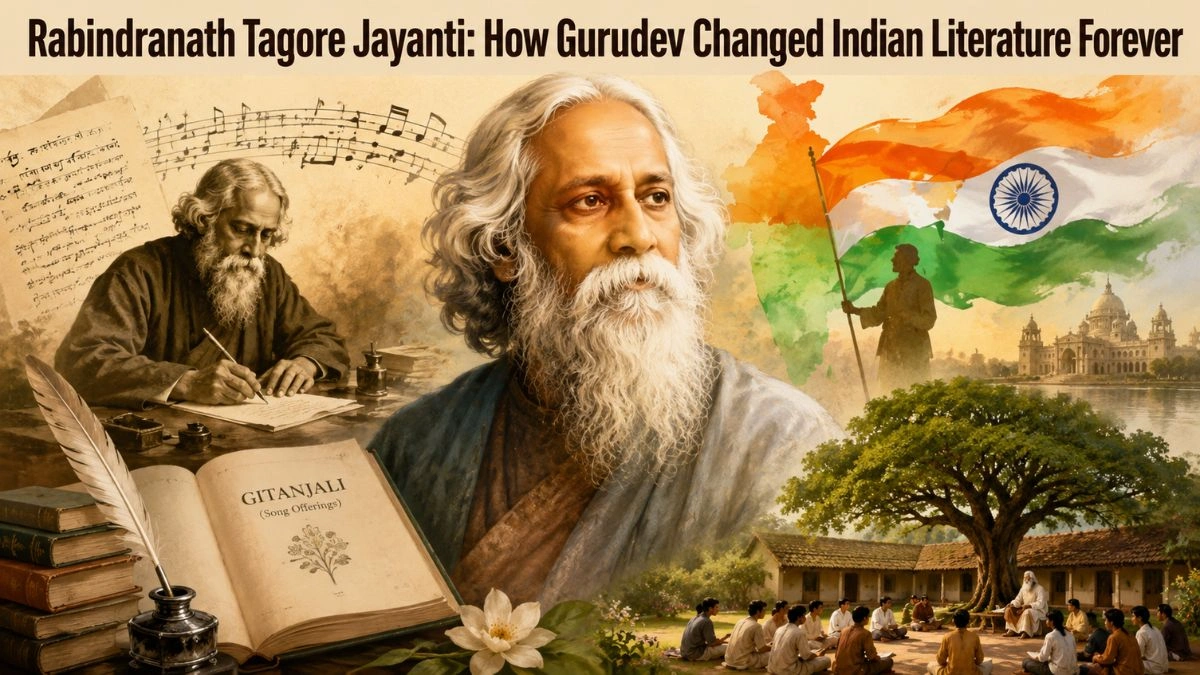
Rabindranath Tagore Jayanti celebrates the evergreen contribution of Gurudev towards Literature, music, education, and patriotism
Today, people across India are celebrating the birth anniversary of Rabindranath Tagore, one of the country’s greatest writers and thinkers. Popularly known as “Gurudev,” Tagore was a poet, novelist, playwright, composer, philosopher, painter, teacher, and social reformer. His work changed Indian literature and inspired people around the world.
Rabindranath Tagore was born on May 7, 1861, in Kolkata. In 1913, he was awarded the first Nobel Prize in Literature among Asians and Europeans for his poetry compilation “Gitanjali”. Till date, his poetry and songs continue to evoke admiration from all age groups.
Educational institutions, cultural forums, and artists across West Bengal and elsewhere in India are celebrating the Tagore Jayanti through various poetic recitations, singing competitions, and other programs.
Tagore: Changing Indian Literature
Rabindranath Tagore was responsible for introducing a new approach to Indian literature. The traditional Bengali literature had been based on set conventions and styles. Rabindranath introduced the use of simple language, deep feelings, human values, spirituality, and modernity in his poetry, fiction, essays, songs, and drama.
The collection of poems “Gitanjali” won fame all over the world after translation into English and named as “Song Offerings.” This work received much acclaim for its emotional and spiritual depth. The recognition with the Nobel Prize made Tagore an internationally recognized literary personality and brought much international appreciation for Indian literature.
Also Read: IPL PBKS vs SRH: Can Punjab hold Top Spot or will SRH Overtake?
Moreover, Tagore composed more than two thousand songs named as “Rabindra Sangeet”. These songs are now an integral part of Bengali culture, liked by all generations equally. The writer’s literature centered around humanity, independence, nature, education, love, and social harmony.
Jana Gana Mana to Amar Sonar Bangla
One of the greatest contributions of Tagore to India was writing the song “Jana Gana Mana” that went on to become India’s national anthem. It was originally written in Bengali as a part of the composition entitled “Bharoto Bhagyo Bidhata.”
It was first performed publicly at the Calcutta Session of the Indian National Congress on 27th December 1911. Thereafter, on 24th January 1950, the Constituent Assembly formally adopted its first stanza as the national anthem of India.
The anthem was translated into English during Tagore’s stay at Madanapalle, Andhra Pradesh. “Jana Gana Mana” has emerged as one of the most prominent symbols of the spirit of India.
Rabindranath Tagore was also the author of another patriotic song “Amar Sonar Bangla” that was adopted as the national anthem of Bangladesh when it gained its freedom from Pakistan in 1971. He wrote this song during the anti-partition movement in Bengal in 1905. Through this song, he expressed love for Bengal in terms of its soil, culture, and its citizens. Even till today, it evokes emotional sentiments in Bangladeshis.
As a result, Tagore occupies an eminent position in history as the lyricist of the national anthems of India and Bangladesh.
Experts have also claimed that the literary and philosophical ideas and style of Tagore influenced the formulation of the national anthem of Sri Lanka.
Tagore: Philosophy of Education and Freedom
Tagore’s philosophy was based upon ideas of humanity, freedom of thought, creativity, and world unity. One of his popular poems beginning with “Where the mind is without fear” is even being taught at educational institutes.
Tagore founded his own school in 1901 known as “Visva-Bharati,” earlier named “Santiniketan,” where he emphasized the connection between nature and education. His ideas about education differed from rote learning and classroom-based education.
Tagore was very critical about British rule in India. After the massacre at Jallianwala Bagh in 1919, he renounced the knighthood conferred on him by the British Government in protest. His decision made him an eminent personality of India’s struggle for freedom.
Why Tagore remains Inspirational even today?
Even today after nearly 80 years since his death in 1941, Rabindranath Tagore has a lasting impact on literature, music, patriotism, education, and culture. His philosophy of humanism, peace, freedom, and social harmony is inspiring for the present generation.
During each Tagore Jayanti, people post quotations from his poems, songs, and other thoughts in social media forums and cultural programs. Young readers have started reading his works once again and are getting inspiration out of his literary works.
From literature and music to patriotism and education, Tagore’s contribution continues to inspire people from different cultures and countries. He was not only a great poet of India or Bengal but also a voice of humanity worldwide.

khushisikarwar is an award-winning journalist and content creator who thrives on telling stories that matter. As a key contributor to Newsisland, [she] focus on cultural commentary, providing readers with thought-provoking insights.