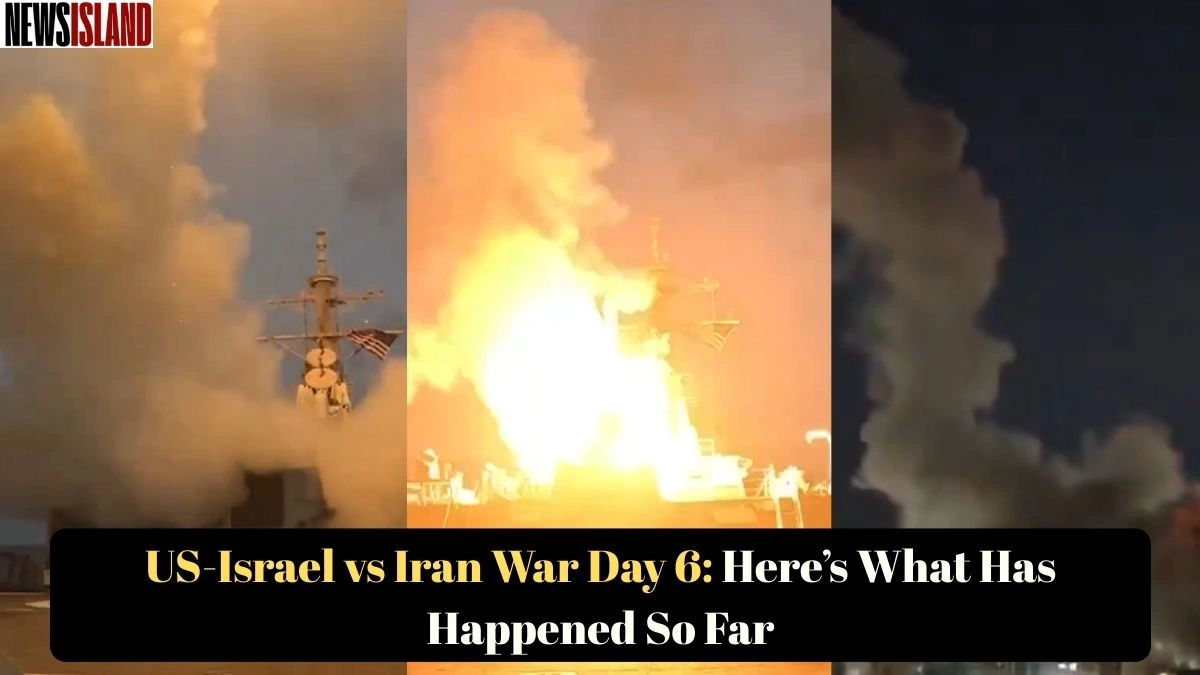
US-Israel vs Iran War Day 6: US-Israel Offensive on Iran Escalates as Missile Strikes, Naval Clashes and Leadership Losses Shake Region
US-Israel vs Iran War: The war involving Iran, Israel and the United States has entered its sixth day, with fighting spreading across the Middle East. Heavy airstrikes, missile attacks, drone strikes and naval clashes have already caused widespread destruction and hundreds of deaths.
The conflict began on February 28, 2026, when the United States and Israel launched a large military campaign against Iranian military bases, leadership compounds and strategic infrastructure. Iran quickly retaliated with missiles and drones, turning the crisis into a multi-front regional war.
Long-Standing Tensions Trigger the War
Tensions between Iran, Israel and the United States have been building for years. Israel and the US have repeatedly accused Iran of expanding its nuclear program and developing advanced missiles that could threaten regional security.
Iran denies the accusations and says its nuclear program is meant for peaceful purposes. However, tensions escalated sharply after nuclear negotiations collapsed earlier in 2026.
Soon after the talks broke down, US and Israeli forces launched coordinated strikes targeting Iran’s military and leadership facilities.
The attacks focused on military bases, missile launch sites, drone manufacturing centers, intelligence headquarters and command structures.
Major Iranian cities targeted in the strikes included Tehran, Isfahan, Qom, Karaj and Kermanshah.
Day 1 – February 28: Massive Airstrikes Kill Top Iranian Leaders
The war began with hundreds of coordinated air and missile strikes across Iran.
One of the most dramatic developments was the killing of Iran’s Supreme Leader Ali Khamenei, whose compound in Tehran was destroyed in the opening strikes. His death was later confirmed by Iranian state media.
Several senior Iranian leaders and military officials also died in the same attack, creating a major leadership crisis in the country.
Key leaders killed on the first day included:
Abdolrahim Mousavi, Chief of Staff of the Iranian Armed Forces
Mohammad Shirazi, Head of the Military Office of the Supreme Leader
Saleh Asadi, Head of intelligence at Iran’s Khatam-al Anbiya military headquarters
Gholamreza Rezaian, Commander of Iran’s national police intelligence organization
Reports said around 40 senior Iranian officials were killed during the opening strikes.
A devastating airstrike also hit a girls’ school in Minab, killing more than 150 people, most of them schoolchildren.
Iran responded the same day by launching ballistic missiles and drones toward Israel and US military bases.
Day 2 – March 1: Iran Launches Retaliation and Declares National Mourning
Iran intensified its retaliation on the second day of the war.
Missiles and drones targeted Israel and US military bases across the Middle East. Iran also declared 40 days of mourning for Supreme Leader Ali Khamenei and the other officials killed in the attacks.
Iranian President Masoud Pezeshkian announced that an interim leadership structure would guide the country during the crisis.
At the same time, Iran warned that it could close the Strait of Hormuz, one of the world’s most important oil shipping routes.
Nearly 20 percent of global oil supplies move through this narrow waterway.
Day 3 – March 2: Hezbollah Enters the Conflict
The conflict expanded further on the third day when the Lebanese militant group Hezbollah launched rockets into northern Israel in support of Iran.
Israel quickly responded with airstrikes targeting Hezbollah positions across Lebanon, including areas near Beirut.
Although no additional senior Iranian leaders were reported killed that day, the leadership vacuum caused by earlier assassinations continued to destabilize Iran’s command structure.
Meanwhile, the United States deployed more military forces to the region, including aircraft carriers, destroyers and strategic bombers.
Day 4 – March 3: Heavy Bombing Raises Civilian Death Toll
US and Israeli aircraft carried out intense bombing operations across Iran.
The strikes targeted missile factories, drone facilities, naval bases and command centers linked to Iran’s military and the Islamic Revolutionary Guard Corps.
Human rights organizations reported that more than 1,000 civilians had been killed during the first several days of bombing, while thousands were injured.
Large parts of infrastructure in Tehran and other cities suffered heavy damage.
Day 5 – March 4: Naval Warfare Expands the Conflict
The war expanded into the sea on the fifth day.
A US submarine reportedly sank the Iranian warship IRIS Dena in the Indian Ocean near Sri Lanka using a torpedo. The attack killed more than 80 Iranian sailors and marked a major escalation in naval warfare.
At the same time, Israel intensified airstrikes on Hezbollah targets in Lebanon after additional rockets were fired into northern Israel.
Inside Iran, political and religious leaders began discussions about choosing a successor to Ali Khamenei. His son Mojtaba Khamenei emerged as one possible candidate, although no final decision has been announced.
Day 6 – March 5: Missile Exchanges Continue Across the Region
On the sixth day of the war, Iran launched another large wave of missiles toward Israel.
Air-raid sirens sounded across major cities including Tel Aviv and Jerusalem as Israeli air-defense systems attempted to intercept incoming rockets.
Iran also launched drones and missiles toward US-linked military facilities in several Gulf countries.
By the sixth day, the conflict had spread across multiple regions including Iran, Israel, Lebanon, the Persian Gulf and parts of the Indian Ocean.
Experts warned that the conflict could turn into a wider regional war if more countries or militant groups join the fighting.
Also Read: MEA Calls Claim of US Navy Using Indian Ports ‘Fake’ Amid Iran Tensions
Advanced Weapons Used in the War
The conflict has involved advanced modern weapons.
The United States and Israel have used stealth aircraft, fighter jets and precision-guided bombs to strike Iranian military infrastructure. Officials say thousands of targets have been hit during the first several days of the campaign.
Iran has fired hundreds of ballistic missiles capable of traveling long distances and carrying large explosive payloads.
Iran has also deployed large numbers of attack drones targeting military bases and strategic facilities across the region.
Naval forces including submarines and warships have also taken part in military operations across the Persian Gulf and the Indian Ocean.
Multiple Countries Affected by the Fighting
Although Iran, Israel and the United States remain the main participants, the conflict has affected several countries across the Middle East.
Missile alerts and security incidents have been reported in Kuwait, Bahrain, Qatar, the United Arab Emirates, Saudi Arabia, Jordan and Oman.
International shipping routes in the Persian Gulf have also faced disruption due to the fighting.
Casualties and Humanitarian Impact
Early estimates show heavy casualties across the region.
In Iran, more than 1,000 civilians have reportedly been killed and thousands injured in airstrikes and missile attacks.
Israel has reported dozens of deaths and hundreds of injuries caused by Iranian missile strikes.
Several American soldiers have also died in attacks targeting US military facilities in the region.
Thousands of civilians have fled their homes in border areas of Israel and Lebanon.
Who Holds the Military Advantage
Military analysts say the United States and Israel currently hold the advantage because of their superior airpower and advanced missile defense systems.
Their forces have been able to strike targets deep inside Iran while intercepting many incoming missiles.
However, Iran still possesses large missile stockpiles and strong regional allies, meaning the conflict could continue for an extended period.
What Could Happen Next
War could escalate further if more regional groups join the conflict.
Iran could attempt to close the Strait of Hormuz, which would disrupt global oil supplies and push energy prices higher.
Cyberattacks targeting infrastructure could also become part of the conflict.
Another possibility is that international pressure forces both sides to enter negotiations and agree to a ceasefire.
Global Impact of the Conflict
The war has already begun affecting the global economy and international travel.
Oil prices have increased due to fears of supply disruption. Airlines have canceled or rerouted flights across the Middle East because of safety concerns.
Several countries have also started evacuating their citizens from the region.
A Growing Global Crisis
Six days after the fighting began, the war between Iran, Israel and the United States has become one of the most serious geopolitical crises in recent years.
The conflict has already included large-scale airstrikes, missile attacks across multiple countries, naval battles and the deaths of several top Iranian leaders including Supreme Leader Ali Khamenei.
With civilian casualties rising and tensions spreading across the Middle East, global leaders fear the war could escalate even further unless diplomatic efforts succeed in stopping the fighting.

khushisikarwar is an award-winning journalist and content creator who thrives on telling stories that matter. As a key contributor to Newsisland, [she] focus on cultural commentary, providing readers with thought-provoking insights.