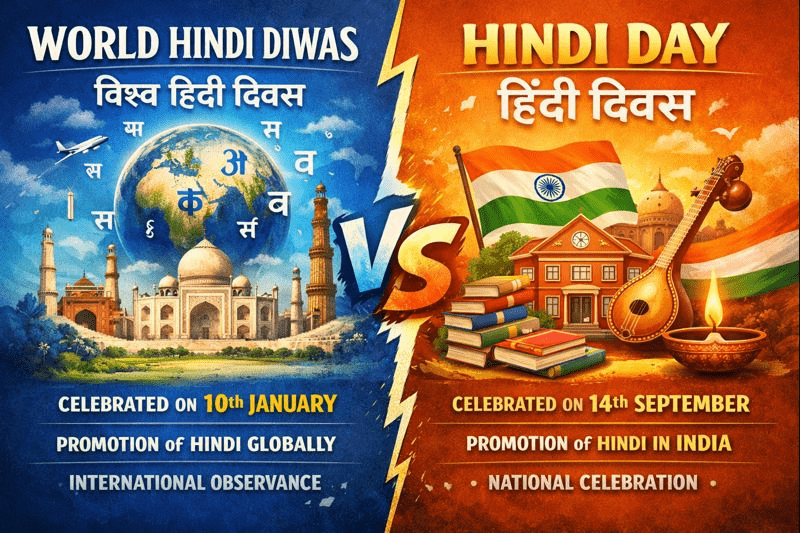
World Hindi Diwas and Hindi Day are often confused. This explainer breaks down the key differences in date, purpose, historical background, and global significance of the two observances
New Delhi: Hindi is celebrated twice every year—once in September and again in January. As a result, many readers ask a simple question: Is Hindi Day the same as World Hindi Diwas?
The answer is no.
Although both observances promote the Hindi language, they serve different purposes. Moreover, they differ in date, scope, and historical context. Because of these differences, Hindi is commemorated twice each year—not as repetition, but as recognition of two distinct roles the language plays.
Different dates, different meanings
Hindi Day, officially known as Rashtriya Hindi Diwas, takes place every year on September 14.
World Hindi Diwas, in contrast, is observed on January 10.
Importantly, these dates reflect separate milestones. One marks a constitutional decision within India. The other highlights Hindi’s emergence on the global stage.
Purpose – national and global focus
The key difference lies in where Hindi receives emphasis.
On the one hand, Hindi Day highlights Hindi’s role within India. It reinforces the language’s use in governance, administration, education, and public life.
On the other hand, World Hindi Diwas focuses on Hindi beyond India. It draws attention to its growth among the Indian diaspora and its acceptance in international and cultural forums.
Historical context behind the observances
Hindi Day marks September 14, 1949. On that day, the Constituent Assembly adopted Hindi in the Devanagari script as one of India’s official languages under the Constitution.
World Hindi Diwas traces its roots to January 10, 1975. The first World Hindi Conference took place on that date. Later, in 2006, authorities formalised the day as an annual global observance to acknowledge Hindi’s expanding international presence.
Also read: January 10: What special day is today in India and around the World
How the two days are observed
Across India, institutions actively observe Hindi Day. Schools, colleges, ministries, and public offices organise debates, essay competitions, and language programmes. At the same time, many departments increase the use of Hindi in official communication.
Meanwhile, World Hindi Diwas sees celebrations outside India. Indian embassies, cultural centres, and diaspora groups host seminars, poetry readings, and language workshops. These events highlight how Hindi adapts across regions and cultures.
Notably, the contrast is symbolic. On Hindi Day, Hindi dominates government files and circulars. On World Hindi Diwas, people speak the same language with accents shaped by Fiji, Mauritius, Suriname, or the Caribbean.
The difference in one line
Hindi Day celebrates Hindi as India’s official language whereas other celebrates Hindi as a global language.
Read more news on NewsIsland.

Prateeksha Kumari is a journalist and strategic communications professional specialising in digital journalism, political reporting, and public affairs. Her work focuses on grassroots issues, governance, and civic developments, with an emphasis on clarity, accuracy, and narrative-driven reporting.
She holds a Master’s degree in Journalism and Mass Communication from Himachal Pradesh University, Shimla and has qualified the UGC-NET examination, reflecting her academic grounding in media studies and communication research. Her reporting spans politics, public policy, health, education, and socio-economic issues, and she is experienced in bilingual (Hindi and English) content creation tailored to diverse audiences.
Alongside her journalistic work, she brings experience in political communication and public relations, where she has contributed to campaign messaging, media outreach, and narrative building. She has worked on integrated communication strategies across print and digital platforms, combining editorial judgment with audience insight and data-led content approaches.