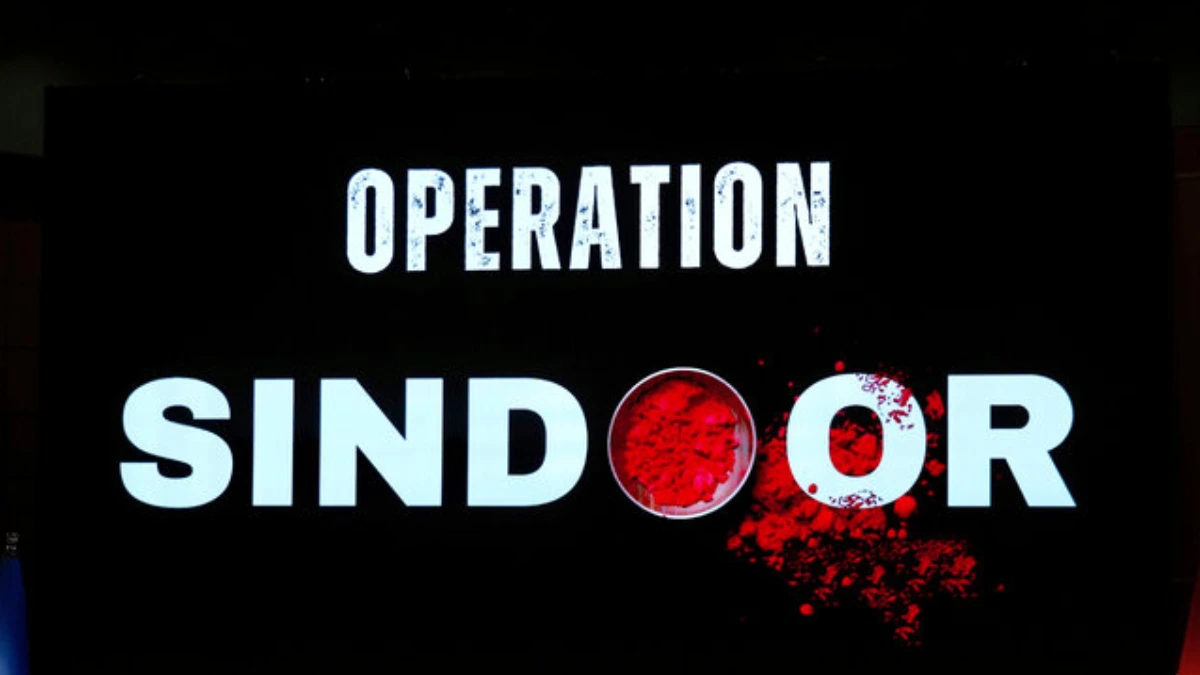
New Delhi: It has been a year since ‘Operation Sindoor’ was launched by the Indian Army on May 7, 2025, which was a direct response to a horrific terrorist attack in Pahalgam, Jammu and Kashmir.
This military operation marked a major shift in India’s way of dealing with terrorism, characterized by precision strikes, national resolve, and a clean refusal of any dialogue involving nuclear blackmail or the sponsors of terrorism.
This incident, which began as a targeted operation in response to the killing of 26 innocent civilians (mostly tourists), evolved into a brief yet intense four-day confrontation with Pakistan.
Pahalgam Attack
On April 22, 2025, terrorists struck in the scenic Baisaran Valley near Pahalgam. Armed with AK-47s and M4 carbines, they targeted civilians enjoying pony rides and picnics, separating victims by religion in a brutal, religiously motivated assault. The attack claimed 26 lives and injured over 20 others, making it one of the deadliest strikes on civilians in the region in years.
India linked the attack to Pakistan-backed groups, primarily Lashkar-e-Taiba (LeT) and its proxy The Resistance Front (TRF), along with Jaish-e-Mohammed (JeM) and Hizbul Mujahideen affiliates. The incident shocked the country and prompted swift diplomatic and military preparations.
Also Read: Rabindranath Tagore Jayanti: How Gurudev Changed Indian Literature Forever
The Week before May 7
India didn’t react impulsively. In the two weeks between the Pahalgam massacre and Operation Sindoor,were Non-military action was initiated.
India closed the Attari-Wagah border. The Integrated Check Post at Attari was shut with immediate effect. The Indus Waters Treaty — a water-sharing agreement between the two countries dating back to 1960 — was suspended. India sent a decisive message: “Blood and water cannot flow together.”
On 5 May, the Indian Ministry of Home Affairs announced civil defence drills across seven states — the first such exercises since 1971 — including air raid warning sirens and blackout procedures.
At the same time, the military was quietly changing its position. The Indian Air Force mobilised around 400 aircraft, with its transport fleet conducting more than 500 sorties during late April and early May.
Several S-400 missile system batteries were repositioned to Adampur, Bhuj, and Bikaner. Pakistan, watching all of this, declared on April 30 that a military strike by India was imminent.
Prime Minister Narendra Modi changed his X profile picture and posted:
“A year ago, our armed forces displayed unparalleled courage, precision and resolve during #OperationSindoor.
23 Minutes on May 7, 2025
On May 7, 2025, between 1:05 and 1:30 a.m. (IST), airstrikes carried out by the Indian Air Force hit nine locations inside Pakistan and Pakistan-occupied Kashmir. It was codenamed Operation Sindoor.
Significantly, this was the first time since 1971 that India struck across the international boundary
the settled and accepted border between India and Pakistan. That alone made it historic.
The targets were carefully chosen.
Lashkar-e-Taiba, Jaish-e-Mohammed, and Hizbul Mujahideen were among the groups whose infrastructure was targeted in the strikes, according to Indian military spokespeople, who added that no Pakistani military facilities were attacked.
Among the sites hit were the JeM headquarters at the Jamia Masjid Subhan Allah compound in Bahawalpur — deep inside Pakistani Punjab — and LeT facilities in Muridke.
This military operation marked the first combat use of BrahMos cruise missiles against Pakistan, the first deployment of the S-400 system in an actual conflict
between nuclear-armed nations, and the first large-scale electronic warfare engagement involving the Rafale’s SPECTRA suite.
Defence Minister Rajnath Singh shared a detailed tribute:
“On the anniversary of Operation Sindoor, we salute the valour and sacrifices of our armed forces, whose courage and dedication continue to safeguard the nation.
Masood Azhar acknowledged that a strike on the headquarters of Jaish-e-Mohammed in Bahawalpur killed 10 members of his family and four of his aides.
On May 8, Rajnath Singh stated that the strikes had killed at least 100 militants.
During the initial strikes, at least 125 fighter jets from both sides were present at standoff ranges
making it the largest aerial engagement in recent times involving fourth-generation fighter jets
Four-Day Escalation and Ceasefire
India’s strikes were not the end — they were the beginning of a tense, four-day escalation.
Pakistan responded with drone swarms, cross-border shelling, and missile attempts. India’s air defenses, including S-400 systems and indigenous solutions like Akashteer, effectively countered most threats. Indian forces carried out retaliatory actions against select radar and military installations.
Hostilities de-escalated by May 10, 2025, following Director General of Military Operations (DGMO) communications and a ceasefire.
The brief conflict highlighted evolving warfare tactics, such as the heavy use of drones and the importance of rapid mobilization
Sometimes described as elements of an enhanced “Cold Start” approach.
Home Minister Amit Shah paid tribute, stating:
“One year since Operation Sindoor, we remember the bravery of our forces who delivered justice for the Pahalgam martyrs.
Broader strategic measures
Beyond military action, India implemented several non-kinetic steps:
Suspension of the Indus Waters Treaty.
Closure of the Attari-Wagah border and suspension of trade.
Revocation of visas and cultural bans.
Diplomatic isolation of Pakistan and efforts to counter disinformation.
Moreover, these measures applied significant economic and international pressure while reinforcing India’s stance that “blood and water cannot flow together.”
External Affairs Minister S. Jaishankar updated his profile picture to commemorate the anniversary and referenced the operation in line with India’s consistent diplomatic messaging on zero tolerance for terrorism.
Lessons learned and lasting impact
One year later, military analysts point to several key takeaways:
The effectiveness of affordable drone swarms and the need for robust counter-drone systems.
Advantages of shoot-and-scoot mobility in air defenses.
Enhanced integration among Indian forces (jointness) and progress in self-reliance under Atmanirbhar Bharat.
Also Read: IPL RCB vs LSG Today: Can Bengaluru Continue Their Dominance?
What separated Operation Sindoor
India’s previous responses — the 2016 surgical strikes after Uri, the 2019 Balakot airstrike after Pulwama — was its scale, depth, and clarity of purpose.
Operation Sindoor was unique in many ways. It was the subcontinent’s first non-contact war, marked by technology-driven kinetic activity involving missiles and drones. Neither side physically crossed the other’s territorial space.
The most significant strategic achievement was posing a fundamental challenge to Pakistan’s nuclear doctrine.
By treating terrorist attacks originating from Pakistani soil as acts of war, I
ndia signalled its intent not to let Pakistan’s nuclear capability deter it from using force
carving out space for military action below the nuclear threshold.

Amulya Shrivastav is a journalist who loves cricket and enjoys telling stories around it. Her interest in the sport is what led her to choose journalism as a career. She holds a Master’s degree in Journalism and writes mainly on sports, while also exploring topics like politics, health, tech, and lifestyle. Her work focuses on simple, engaging storytelling that connects with readers.