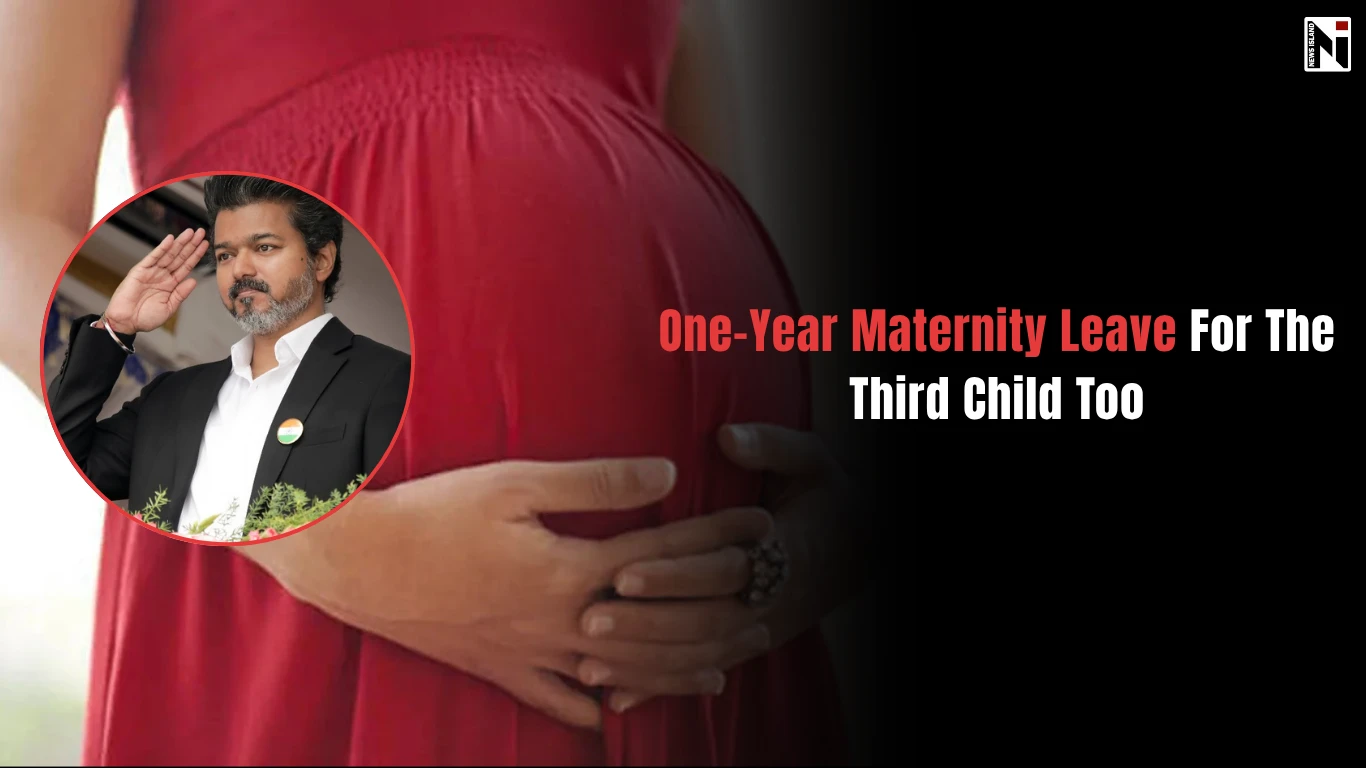
Tamil Nadu has announced that women government employees will be eligible for 365 days of maternity leave after the birth of a third child. The decision comes as the state faces growing concerns over declining fertility and an ageing population
New Delhi: The Tamil Nadu government has announced that women government employees who give birth to a third child will be eligible for 365 days of maternity leave, compared with the existing 12-week entitlement.
The announcement was made in the Tamil Nadu Assembly on August 18 by Human Resources Management Minister D. Sarathkumar. However, the detailed Government Order required to operationalise the decision has not yet been issued.
As a result, while the announcement marks a significant policy shift, the precise eligibility criteria, applicable conditions and date of implementation will become clear only after the Government Order is notified.
The decision also comes against the backdrop of Tamil Nadu’s changing demographic profile. While the state has historically pursued population-stabilisation measures, it is now witnessing declining fertility alongside a growing elderly population.
The move to extend maternity leave for a third child therefore reflects a broader policy debate around women’s welfare, employment rights, family choices and changing demographic realities.
What Has Tamil Nadu Announced?
Tamil Nadu already provides up to 365 days of maternity leave to women government employees for their first two children.
The state increased this entitlement from nine months, or 270 days, to one year in August 2021.
For a third child, however, the leave was limited to 12 weeks, or 84 days.
The latest announcement proposes to remove that distinction and extend the 365-day entitlement to the third child as well.
The change would apply to women government employees. It would not automatically extend to women working in private companies, whose maternity benefits are governed by the applicable labour laws and employment rules.
One point remains important: the Assembly announcement is not the same as an immediately operational Government Order. The final rules will determine how and when the new entitlement applies.
Why Has the Decision Drawn Attention?
The maternity leave announcement comes at a time when Tamil Nadu is increasingly discussing its demographic future.
State Health Minister K. G. Arunraj recently said Tamil Nadu’s Total Fertility Rate (TFR) has fallen below 1.4, while the replacement level is generally considered to be around 2.1. He also said that around 16% of the state’s population is above the age of 60.
A falling fertility rate means fewer children are entering the population. At the same time, a growing elderly population increases the demand for healthcare, social support and other services.
This creates a different policy challenge from the one India faced several decades ago, when governments focused heavily on reducing population growth and encouraging smaller families.
For states with fertility rates below replacement level, the question is no longer only how to slow population growth. It is also how to prepare for a smaller working-age population and a larger elderly population.
That does not mean Tamil Nadu’s maternity leave decision was introduced solely as a population measure. The government has presented it primarily as a measure related to women’s welfare and maternity protection.
But the demographic context makes the decision particularly significant.
What Does the Law Provide for a Third Child?
Under the Maternity Benefit Act, as amended in 2017, eligible women are generally entitled to 26 weeks of maternity benefit for their first two surviving children.
For a woman who already has two or more surviving children, the statutory maternity benefit is limited to 12 weeks.
This does not mean that a woman having a third child is excluded from maternity benefits altogether. The difference lies mainly in the duration of the benefit.
The Supreme Court addressed this issue in 2025 in K. Umadevi vs Government of Tamil Nadu. The court clarified that having more than two children does not completely exclude a woman from maternity benefits under the Maternity Benefit Act.
The judgment also considered maternity benefits in the context of women’s health, dignity and reproductive rights.
Government employees, however, may also be governed by separate service rules. This is particularly important in Tamil Nadu, where state service rules provide maternity leave beyond the statutory minimum in certain circumstances.
How Did Tamil Nadu Reach the Current Position?
Tamil Nadu’s service rules have historically provided up to 365 days of maternity leave for eligible women government employees, subject to conditions including the number of surviving children.
The rules relating to a third child have changed in recent years. Following the Supreme Court’s 2025 judgment, the question of maternity leave for government employees having a third child received renewed attention.
In 2026, Tamil Nadu amended its rules to limit maternity leave for a third child to 12 weeks. The Madras High Court subsequently considered the amended provision in June 2026 and upheld the 12-week limit in the case before it.
The latest Assembly announcement now proposes to restore the 365-day entitlement for a third child.
The sequence is important because it shows that the current announcement is part of an ongoing legal and policy debate, rather than an entirely new issue.
How Do Other States Compare?
Tamil Nadu is not the only state dealing with the question of maternity benefits for a third child.
However, the policies differ considerably. Some states provide longer maternity leave, some allow benefits for a third child under specific circumstances, and some have changed two-child restrictions through legislation or court decisions.
There is no single policy followed across India.
Sikkim: A Broader Pro-Family Approach
Sikkim provides one of the more extensive examples of a state responding to declining fertility.
In 2022, the Sikkim government increased maternity leave for women government employees from six months to 365 days. The benefit was later extended to temporary, contractual and probationary women employees.
The state has also introduced other measures aimed at supporting families, including incentives linked to the birth of a second or third child, IVF assistance and childcare support.
Sikkim has linked these measures to concerns over its declining fertility rate.
Its approach therefore goes beyond maternity leave and combines workplace benefits with broader family-support measures.
Himachal Pradesh: Relief Through Court Orders
Himachal Pradesh follows a different approach. Courts in the state have considered several cases involving maternity leave for women with a third child.
In one case, the Himachal Pradesh High Court ruled that maternity leave could not be denied solely because a woman had a third child. Her first two children had been born before she joined government service.
In 2026, the Himachal Pradesh Health Department approved 180 days of maternity leave for a woman after the birth of her third child. The decision followed a High Court order.
This is different from Tamil Nadu’s proposed 365-day policy. The Himachal Pradesh cases involve specific circumstances and judicial relief. They do not create a blanket one-year maternity-leave entitlement for every third child.
Rajasthan: Third Child and Government Service Rules
Rajasthan has also changed some of its rules concerning employees with more than two children.
The state had previously linked the two-child norm to certain government service conditions. In 2018, it removed a provision requiring compulsory retirement after an employee had a third child.
In 2023, the state also provided relief from provisions that could affect promotion because of a third child.
In August 2026, the Rajasthan High Court ruled that a woman government employee could not be denied maternity benefits solely because she was seeking a second maternity leave after having a third biological child during service.
Again, this does not amount to a 365-day maternity leave policy for a third child. It is a different legal and administrative approach to the issue.
Uttar Pradesh: Restrictions With Exceptions
Uttar Pradesh provides another example of a more restrictive approach. Under Rule 153, women government employees are generally entitled to 180 days of maternity leave. However, restrictions apply when an employee already has two or more living children.
The rules provide exceptions in certain circumstances. For example, where one of the existing children has an incurable disease, disability or another serious condition from birth, maternity leave may be granted for another child.
The third child therefore does not automatically qualify for the same maternity leave as the first two children.
Haryana: An Older Example
Haryana also has an older precedent on maternity leave for a third child. A government clarification issued in 1973 stated that maternity leave could be granted to a woman government employee for up to three living children.
However, this provision should not be treated as equivalent to Tamil Nadu’s current policy. Service rules and maternity regulations have changed over the decades.
The Haryana example is still relevant. It shows that maternity benefits for a third child have been part of India’s government service-policy debate for many years.
Is Tamil Nadu Changing Its Population Policy?
It is too early to draw that conclusion from the maternity leave announcement alone.
Tamil Nadu has long been recognised for its progress in education, healthcare and population stabilisation. Its fertility rate is now well below the replacement level. At the same time, the share of elderly residents is rising.
This demographic shift brings new challenges. Fewer young people could eventually mean a smaller working-age population. A growing elderly population could also increase demand for healthcare and social security.
The policy debate is changing as a result. Governments once focused mainly on controlling population growth. They must now also consider how to support families, women and future generations in states where fertility has fallen sharply.
The proposed 365-day maternity leave fits into this wider debate. Its immediate stated purpose, however, remains employee welfare and maternity protection.
The Larger Question
The Tamil Nadu announcement is about more than the number of days a government employee can take leave after childbirth. It raises wider questions about maternity policy in a country where states face very different demographic realities.
For women employees, longer maternity leave can allow more time for recovery and newborn care. For governments, such policies are also linked to women’s workforce participation, family support and demographic change.
Tamil Nadu’s proposed 365-day maternity leave for a third child could therefore become an important test. It comes as the demographic challenge shifts from population growth to declining fertility and population ageing.