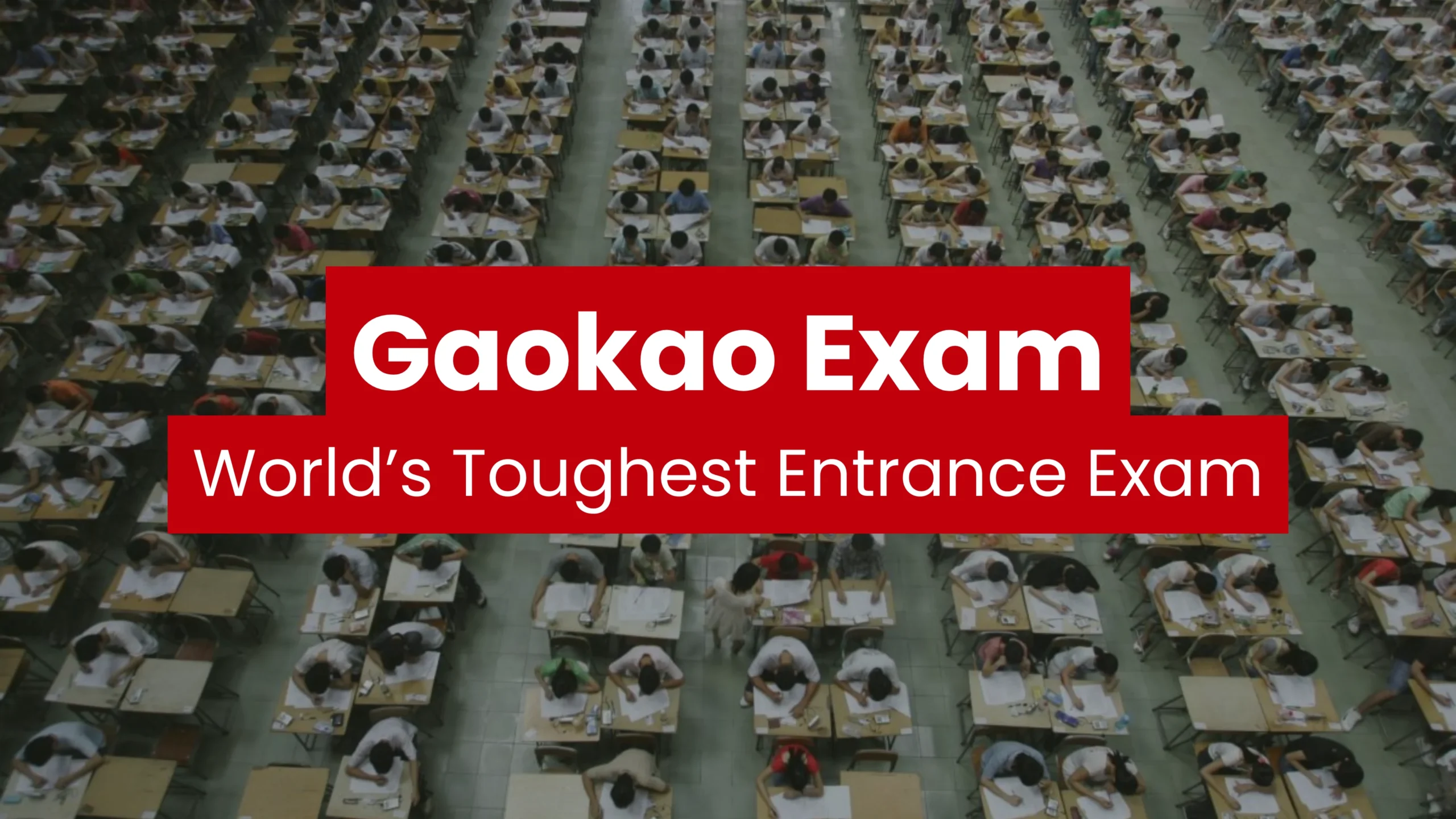
New Delhi / Beijing: Recent controversies in India regarding paper leaks in competitive examinations such as NEET have once again raised serious questions about exam security and transparency. Amid these concerns affecting the future of millions of students, global attention has once again shifted to China’s education system and its highly competitive university entrance exam — the Gaokao.
Around 13 million students appear for this exam every year. It determines admission into China’s top universities and plays a decisive role in shaping the academic and professional future of students.
What Is the Gaokao Exam?
The Gaokao is China’s national-level university entrance examination for students completing secondary education. It is not just an exam but a defining moment in the lives of millions of students.
The difficulty level of this exam can be understood from the fact that China’s entire higher education admission system revolves around it. Based on performance in Gaokao, students gain admission into top universities across the country.
Reports suggest that due to the extremely high number of candidates, it is considered the largest and one of the most competitive entrance examinations in the world.
13 Million Students Appear Every Year
In 2026, approximately 12.9 million (around 13 million) students registered for the Gaokao examination. Although this number is slightly lower than the previous year, it still remains far higher than any other national exam system globally.
The decline is linked to China’s changing demographic structure and challenges in the job market. Rising youth unemployment and uncertainty in career opportunities have led some students to opt for vocational training instead of traditional university education.
Despite this, the pressure of Gaokao remains extremely high. It is still considered the most important pathway to social and economic success in China.
China Comes to a Standstill During the Exam
One of the most distinctive features of Gaokao is the strict environment created during the examination period.
To ensure a peaceful and distraction-free atmosphere, strict measures are implemented across cities. Traffic is diverted, noise near exam centers is prohibited, and construction activities are temporarily suspended.
Police and administrative authorities remain on high alert.
In many places, it appears as though the entire country slows down to allow students to focus entirely on their examination.
Strict Security Measures
Gaokao is treated as a highly sensitive national process in China. Its security arrangements are often compared to a military-level operation.
Question papers are prepared in highly secure environments, and in many cases printed under strict surveillance in controlled facilities.
During transportation, police escorts ensure safe delivery of exam papers. Examination centers are monitored through CCTV cameras and strict supervision.
Reports also suggest that the entire process is designed to eliminate any possibility of paper leaks or malpractice.
Advanced Technology to Prevent Cheating
China uses advanced technology to prevent cheating and ensure fairness in the Gaokao examination.
These include:
Facial recognition systems
Drone surveillance
Metal detectors
Smart device blocking systems
AI-based monitoring tools
In recent years, special measures have also been taken to prevent cheating through smart glasses and other high-tech devices.
Strict Punishment for Cheating
Cheating in Gaokao is not just considered an exam violation but a serious criminal offense.
If a candidate is found guilty of cheating, their exam results can be cancelled and they may be barred from future examinations.
In severe cases, offenders may face imprisonment of 3 to 7 years along with fines.
This strict enforcement is one of the reasons China claims to have one of the most secure examination systems in the world.
Pressure on Students’ Lives
Preparation for Gaokao is a major part of students’ lives in China. Reports suggest that students follow highly disciplined routines and study for long hours.
The level of competition is extremely intense, and success in this exam is often considered a life-changing moment.
Comparison with India’s NEET Exam
In India, recent controversies involving NEET and other competitive examinations have raised concerns about paper leaks and administrative challenges.
In this context, comparisons are being drawn between India’s exam system and China’s Gaokao.
Both systems are similar in that they determine the future of millions of students and are highly competitive. However, the key difference lies in the level of centralized control and security enforcement.
China’s Gaokao system is known for its strict and centralized security structure, whereas India has recently faced debates over exam leaks and regulatory challenges.
Ultimately, Gaokao continues to be seen as a symbol of extreme academic competition and rigorous examination discipline in China.