
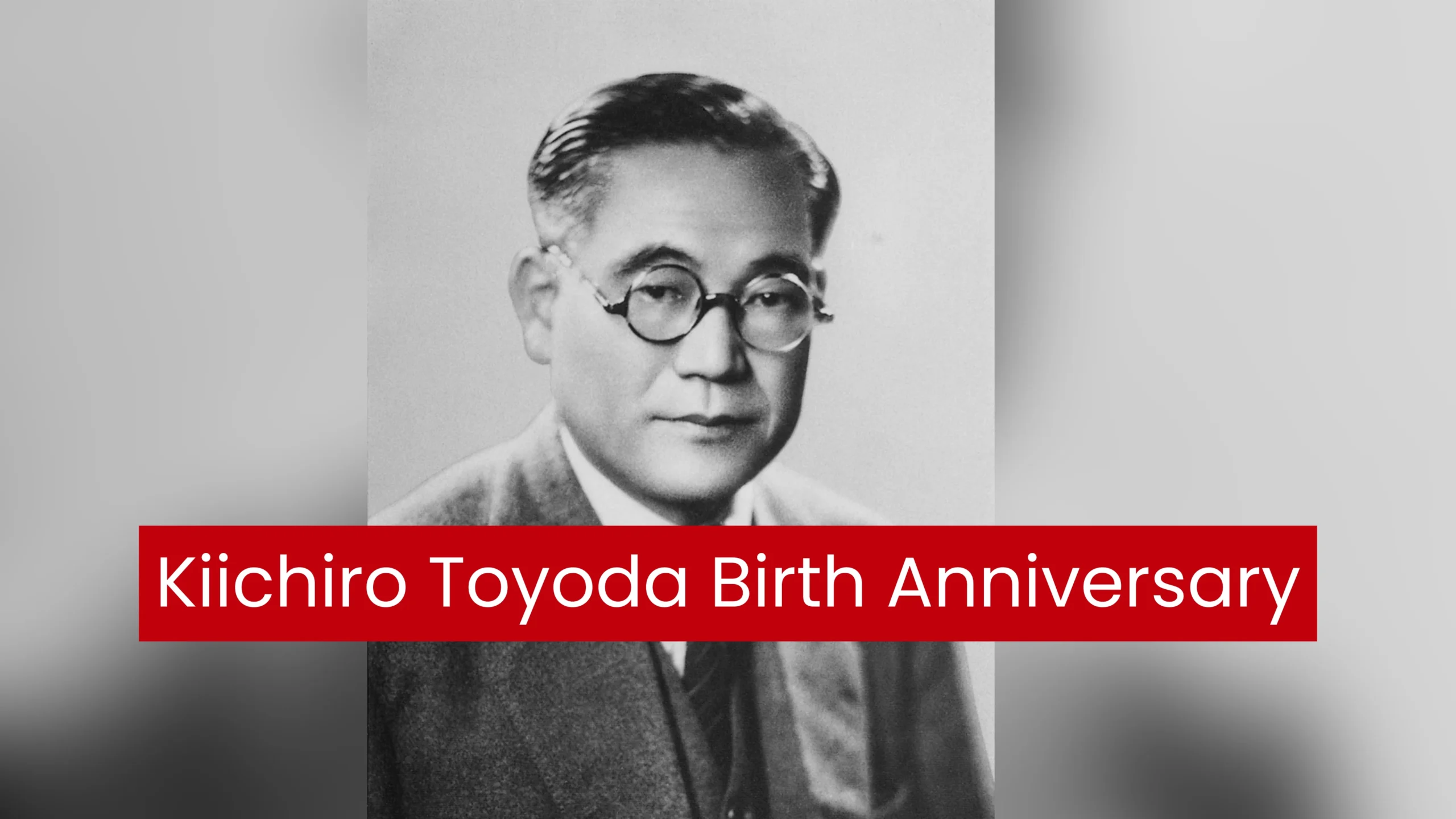
New Delhi: Every year on June 11, the world remembers Kiichiro Toyoda, the visionary engineer who founded Toyota Motor Corporation. Today, Toyota stands among the world’s largest automobile manufacturers, producing millions of vehicles annually. However, its journey began with one man who chose innovation over certainty and believed Japan could build its own automobiles when most people doubted the idea.
Who Was Kiichiro Toyoda?
Kiichiro Toyoda was born on June 11, 1894, in Yamaguchi Village, Shizuoka Prefecture (now Kosai City), Japan. He was the eldest son of Sakichi Toyoda, one of Japan’s greatest inventors and a pioneer of the country’s industrial revolution.
Unlike most children, Kiichiro grew up surrounded by factories, machines and new inventions. Consequently, he developed a deep interest in engineering and industrial technology from an early age.
A Young Engineer With a Big Vision
Kiichiro later studied engineering at the University of Tokyo, where he strengthened his technical knowledge. More importantly, he constantly looked beyond textbooks and tried to understand where modern industry was heading.
At that time, the Toyoda family had already built a successful textile machinery business. Naturally, many expected him to continue expanding the family enterprise. However, Kiichiro had a different dream. He believed the future belonged to automobiles.
The Journey That Changed His Life
In 1929, Kiichiro traveled across Europe and the United States. During his visit, he saw roads filled with automobiles and factories producing vehicles on a large scale.
As a result, he became convinced that cars would shape the future of industrial development. Instead of importing foreign vehicles forever, he wanted Japan to create its own automobile industry.
That decision would eventually transform Japanese manufacturing forever.
How Toyota Began
After returning to Japan, Kiichiro persuaded his family and colleagues to invest in automobile manufacturing. Although many considered the move risky, he continued to pursue his vision.
Finally, in 1933, Toyoda Automatic Loom Works established an automobile division. Kiichiro and his team carefully studied foreign vehicles, dismantled engines and adapted their designs to suit Japanese roads and conditions.
Soon afterward, the company produced its first prototype in 1935 and introduced the Toyoda AA in 1936, proving that Japan could manufacture its own passenger cars.
Why Toyoda Became Toyota
Interestingly, the company did not keep the family surname.
During a branding exercise in 1936, the name Toyota replaced Toyoda because it was easier to write in Japanese and was believed to bring good fortune. The following year, Toyota Motor Corporation officially came into existence.
Today, that name is recognized in almost every country around the world.
Leadership During Difficult Times
Success did not come easily. After World War II, Toyota faced severe financial problems and struggled to survive. Labor disputes and economic uncertainty pushed the company to the brink of collapse.
Instead of protecting his position, Kiichiro chose to step down as president. He believed the company’s future mattered more than personal authority.
Therefore, business leaders continue to cite his decision as an example of responsible and selfless leadership.
A Legacy That Changed the Automobile Industry
Kiichiro Toyoda passed away on March 27, 1952, at the age of 57. Although he never witnessed Toyota’s global success, his vision laid the foundation for one of the most trusted automobile brands in history.
Over the following decades, Toyota expanded across Asia, Europe and North America while becoming a leader in quality, reliability and manufacturing efficiency.
Toyota’s Five Most Iconic Cars
1. Toyota Corolla
Introduced in 1966, the Corolla became one of the best-selling cars in history thanks to its affordability, reliability and fuel efficiency.
2. Toyota Land Cruiser
Known for exceptional durability and off-road performance, the Land Cruiser has earned a legendary reputation in deserts, mountains and challenging terrains across the world.
3. Toyota Prius
Launched in 1997, the Prius became the world’s first mass-produced hybrid vehicle and accelerated the global adoption of fuel-efficient technology.
4. Toyota Hilux
The Hilux is famous for its toughness and dependability. Consequently, businesses, governments and adventure enthusiasts rely on it in some of the world’s harshest environments.
5. Toyota Camry
For decades, the Camry has remained one of the world’s most successful sedans because it combines comfort, safety, performance and long-term reliability.
Why Kiichiro Toyoda’s Story Still Matters
As the world marks Kiichiro Toyoda’s 132nd birth anniversary, his journey continues to inspire entrepreneurs, engineers and innovators.
He walked away from the certainty of a successful textile business and embraced an industry filled with uncertainty. Moreover, he proved that vision, persistence and calculated risk-taking can transform an idea into a global enterprise.
If Sakichi Toyoda helped modernize Japan through machines, Kiichiro Toyoda helped put the nation on wheels. As a result, Toyota evolved from a small experimental division into one of the world’s most influential automobile companies and a symbol of innovation recognized across the globe.


