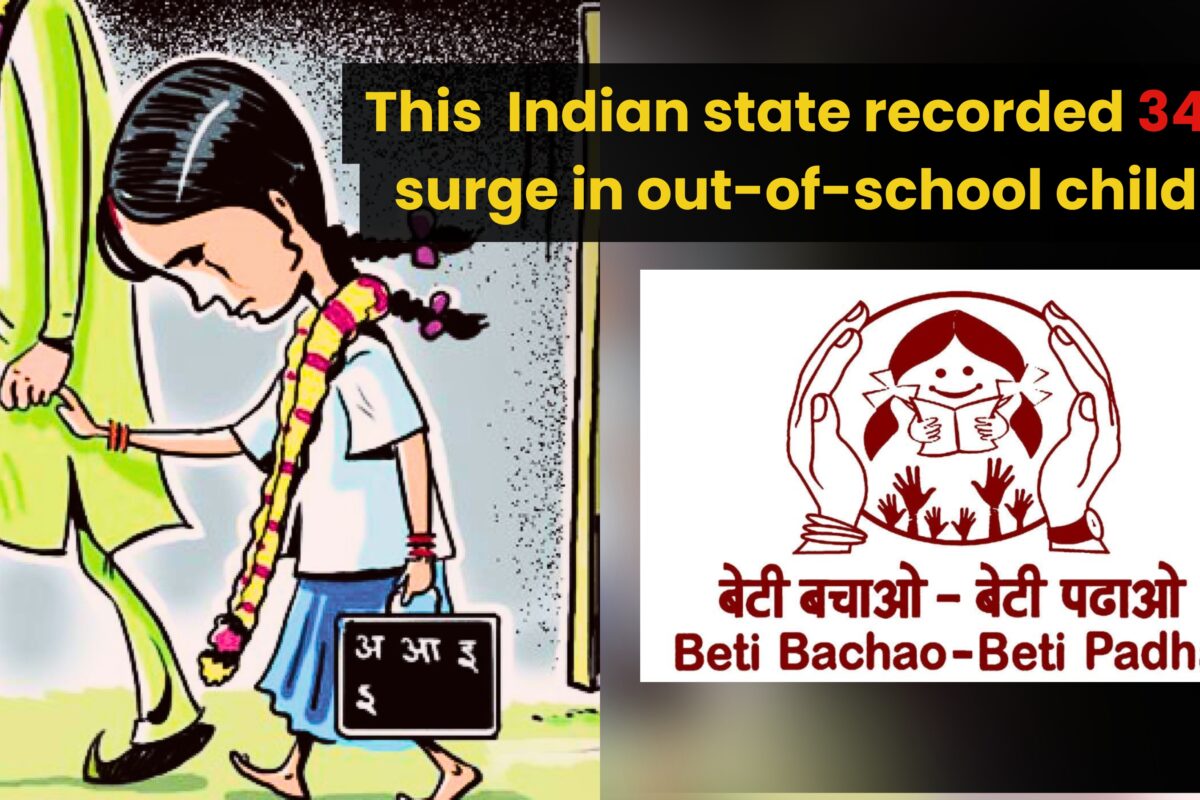
Official data reveals a 340% jump in out-of-school children in Gujarat in 2025–26, with nearly 1.1 lakh adolescent girls pushed out of classrooms
New Delhi: India’s education data signals a quiet but deepening crisis. Large numbers of children, especially adolescent girls, continue to exit classrooms. Official figures placed before Parliament in December 2025 reveal that in the academic year 2025–26, one Indian state recorded a 340 per cent surge in out-of-school children. The spike exposes gaps that national enrolment figures often fail to capture.
Over the past five years, India identified 65.7 lakh children as out of school or never enrolled. Nearly half of them—29.8 lakh—were adolescent girls. The data points to a familiar fault line. Retention weakens sharply when girls reach secondary school age. At that stage, education collides with poverty, migration, unpaid labour, and social restrictions.

Gujarat recorded the steepest rise. In 2025–26, the state reported around 2.4 lakh out-of-school children, the highest among all states. Nearly 1.1 lakh of them were adolescent girls.
The previous academic year tells a different story. Gujarat reported about 54,541 out-of-school children in 2024–25. The jump of more than 340 per cent marks a sudden break, not a gradual shift.
Why girls leave school in large numbers
Education researchers and civil society groups point to several overlapping pressures. Many families under economic stress ask adolescents to work or manage household duties. Seasonal migration breaks learning continuity. School mergers and closures increase travel distance. For girls, safety concerns and lack of transport often become the final barrier.
Early marriage and unpaid domestic labour also continue to pull girls out of classrooms. These pressures affect rural and semi-urban areas the most.
Gujarat is not an exception. In 2025–26, Assam reported around 1.51 lakh out-of-school children. More than 57,000 were adolescent girls. Uttar Pradesh recorded nearly 99,218 out-of-school children, with girls accounting for over 56,000.
Across states, the trend remains consistent. The risk of exclusion rises sharply once girls enter adolescence.
These figures differ from annual dropout rates reported by schools. Survey-based identification captures children who are entirely outside the education system. Many are not enrolled anywhere. Classrooms no longer count them. Official success metrics rarely reflect their absence.
Behind the statistics are lives shaped by constraint rather than choice. Girls pushed into household work, farms, factories, or early marriages rarely return to formal education. Each year spent outside school widens the gap. Re-entry becomes harder with time.
The data presents an uncomfortable reality. Despite decades of focus on enrolment, adolescent girls remain the most fragile link in India’s education chain. For millions, the classroom door closes not due to lack of ability, but because survival and circumstance leave no room for schooling.
Read more stories on NewsIsland

Prateeksha Kumari is a journalist and strategic communications professional specialising in digital journalism, political reporting, and public affairs. Her work focuses on grassroots issues, governance, and civic developments, with an emphasis on clarity, accuracy, and narrative-driven reporting.
She holds a Master’s degree in Journalism and Mass Communication from Himachal Pradesh University, Shimla and has qualified the UGC-NET examination, reflecting her academic grounding in media studies and communication research. Her reporting spans politics, public policy, health, education, and socio-economic issues, and she is experienced in bilingual (Hindi and English) content creation tailored to diverse audiences.
Alongside her journalistic work, she brings experience in political communication and public relations, where she has contributed to campaign messaging, media outreach, and narrative building. She has worked on integrated communication strategies across print and digital platforms, combining editorial judgment with audience insight and data-led content approaches.