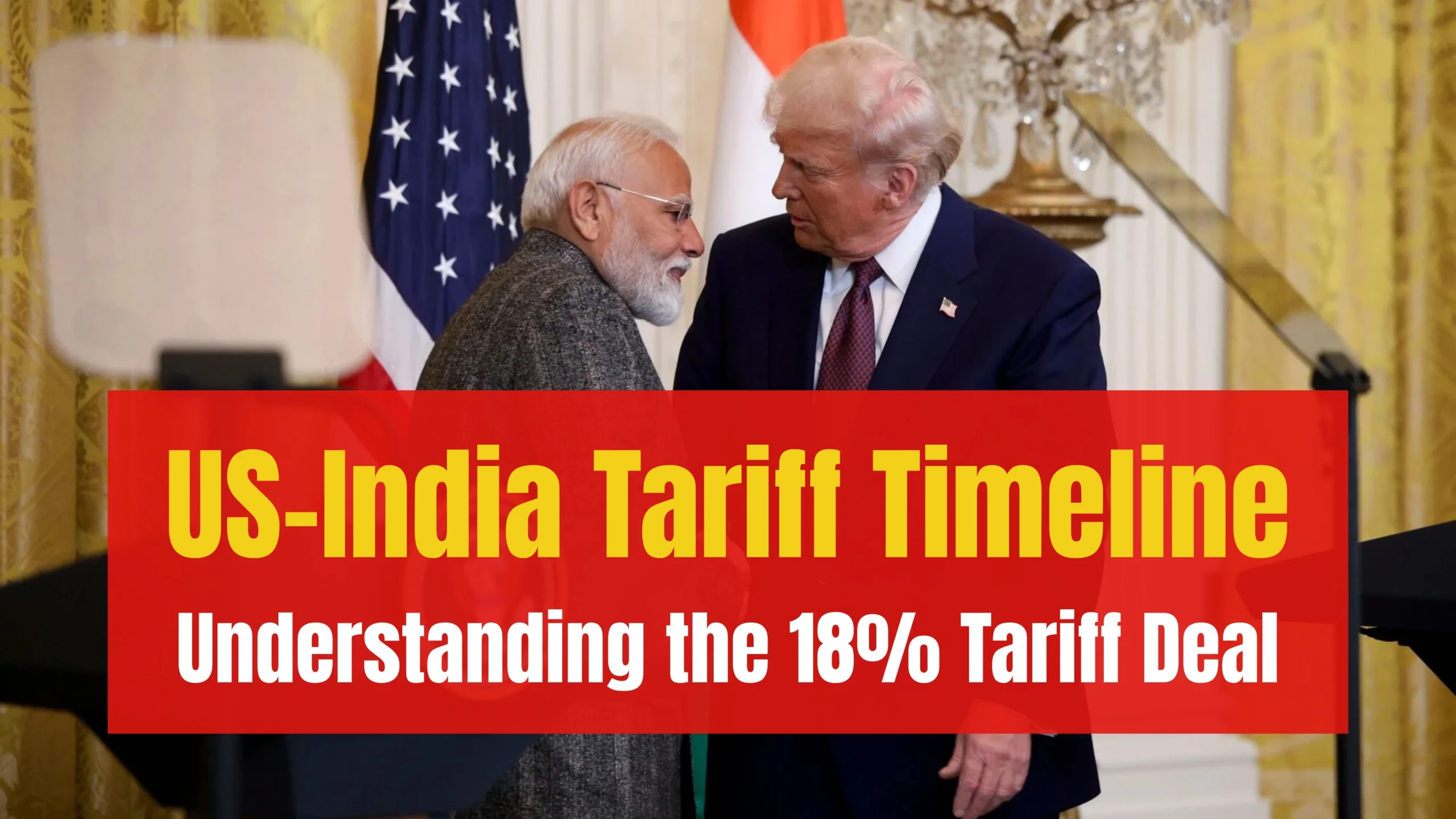
A long arc shaped by protectionism, liberalisation, and geopolitics—explaining how tariff shifts between Washington and New Delhi
Trade tariffs between the United States and India are often discussed in technical or diplomatic language. Yet their effects are felt far beyond negotiating tables. From the price of imported almonds to factory jobs tied to exports, tariff decisions quietly shape household budgets and employment prospects.
The current 18% tariff arrangement is not the result of a single decision. Instead, it reflects a long trajectory of economic priorities, political pressure, and global geopolitics.
After Independence
Following Independence in 1947, India adopted a protectionist trade policy. High tariffs—often ranging from 30% to 50%, and even higher in agriculture and automobiles were designed to shield Indian farmers and manufacturers from competition with advanced economies. The goal was industrial self-reliance and job creation at home.
By contrast, the US maintained a low-tariff regime, with average duties around 2–3%, reflecting its mature industrial base and export-driven economy. This structural difference laid the foundation for recurring trade friction.
1976: GSP opens the US market to India
In 1976, the US extended the Generalized System of Preferences (GSP) to India. Under this programme, selected Indian exports, such as textiles, leather goods, engineering products, and gems, entered the US market at zero duty.
For Indian exporters, GSP meant access to one of the world’s largest consumer markets. Over time, it supported steady job growth in export-linked sectors, especially among small and medium enterprises.
1991: Liberalisation and a Shift in Trade Policy
A major turning point came in 1991, when India launched wide-ranging economic reforms in response to a balance-of-payments crisis. The reforms marked a decisive shift away from inward-looking protectionism towards liberalisation, deregulation, and greater integration with the global economy.
As part of this transition, India began gradually reducing import tariffs, dismantling industrial licensing, and encouraging exports and foreign investment. Although tariff levels remained higher than those in advanced economies, the direction of policy changed. Trade with the US expanded steadily, and bilateral economic engagement deepened beyond traditional goods to include services, technology, and investment.
These reforms laid the groundwork for the more stable tariff relationship that followed in the next decade.
2000–2017: Stability despite differences
From the early 2000s to 2017, tariff relations remained largely stable. India continued to levy higher duties on US goods, particularly in farming and automobiles, while Indian exports enjoyed low or zero tariffs in the US through GSP and MFN rates.
For ordinary Indians, this translated into two parallel realities. Export-oriented industries benefited from strong US demand, supporting jobs. At the same time, some American products, such as apples, nuts, and motorcycles, remained expensive in India due to high import duties.
2018: When tariffs turned political
In 2018, tariffs moved from trade policy into political signalling. The US imposed duties on steel (25%) and aluminium (10%) imports under national security provisions, including on Indian shipments.
Simultaneously, India’s 100% tariff on large American motorcycles became a public flashpoint after sharp criticism from Washington. What had long been accepted as a development-related imbalance was now framed as “unfair trade”.
2019: GSP withdrawal and retaliation
In June 2019, the US withdrew GSP benefits for India, citing limited market access for US firms, high Indian tariffs, and regulatory barriers in areas like medical devices and agriculture.
Although the average tariff increase on Indian exports was modest, the impact was real for smaller exporters. India responded by imposing retaliatory tariffs on US products such as apples, almonds, and walnuts.
2020–2024: The Pandemic pause
The COVID-19 pandemic temporarily cooled tariff tensions. Global attention shifted to supply-chain resilience and economic recovery. While some steel and aluminium measures were softened and a few retaliatory duties eased, deeper trade talks stalled. The underlying disputes, however, remained unresolved.
2025: Sharp Escalation Through “Reciprocal Tariffs”
In 2025, the US sharply raised tariffs on Indian goods under a new “reciprocal tariff” framework, arguing that countries with high import barriers should face similar treatment. Indian exports were hit with duties of around 26%.
Subsequently, additional penalties—linked to India’s continued purchase of Russian oil amid geopolitical tensions—pushed effective US tariffs on some Indian exports close to 50%.
India chose not to retaliate broadly. Instead, it focused on negotiations and diversifying export markets, signalling a clear intent to avoid a full-scale trade war.
2026: From 25% to 18%
In February 2026, following high-level engagement, both sides agreed to de-escalate. US tariffs on Indian goods were reduced to 18%, and additional penalties linked to oil imports were removed. India, in turn, committed to eliminating tariffs and certain non-tariff barriers on US products.
What this means for Indians today
For ordinary Indians, tariffs matter in three concrete ways: jobs linked to exports, prices of imported goods, and overall economic momentum. Higher tariffs squeeze exporters and can weaken employment, while lower tariffs generally support trade and growth.
The current arrangement shows that US–India tariffs are no longer just about trade balances. They are now tied to geopolitics, energy choices, and strategic bargaining. While tensions have eased for now, the relationship remains fluid.
In practical terms, the tariff story is unfinished. It will continue to influence how easily Indian products reach global markets and how much Indians pay for what they import—making it a quiet but powerful force in everyday economic life.
Read More Stories on NewsIsland

Prateeksha Kumari is a journalist and strategic communications professional specialising in digital journalism, political reporting, and public affairs. Her work focuses on grassroots issues, governance, and civic developments, with an emphasis on clarity, accuracy, and narrative-driven reporting.
She holds a Master’s degree in Journalism and Mass Communication from Himachal Pradesh University, Shimla and has qualified the UGC-NET examination, reflecting her academic grounding in media studies and communication research. Her reporting spans politics, public policy, health, education, and socio-economic issues, and she is experienced in bilingual (Hindi and English) content creation tailored to diverse audiences.
Alongside her journalistic work, she brings experience in political communication and public relations, where she has contributed to campaign messaging, media outreach, and narrative building. She has worked on integrated communication strategies across print and digital platforms, combining editorial judgment with audience insight and data-led content approaches.