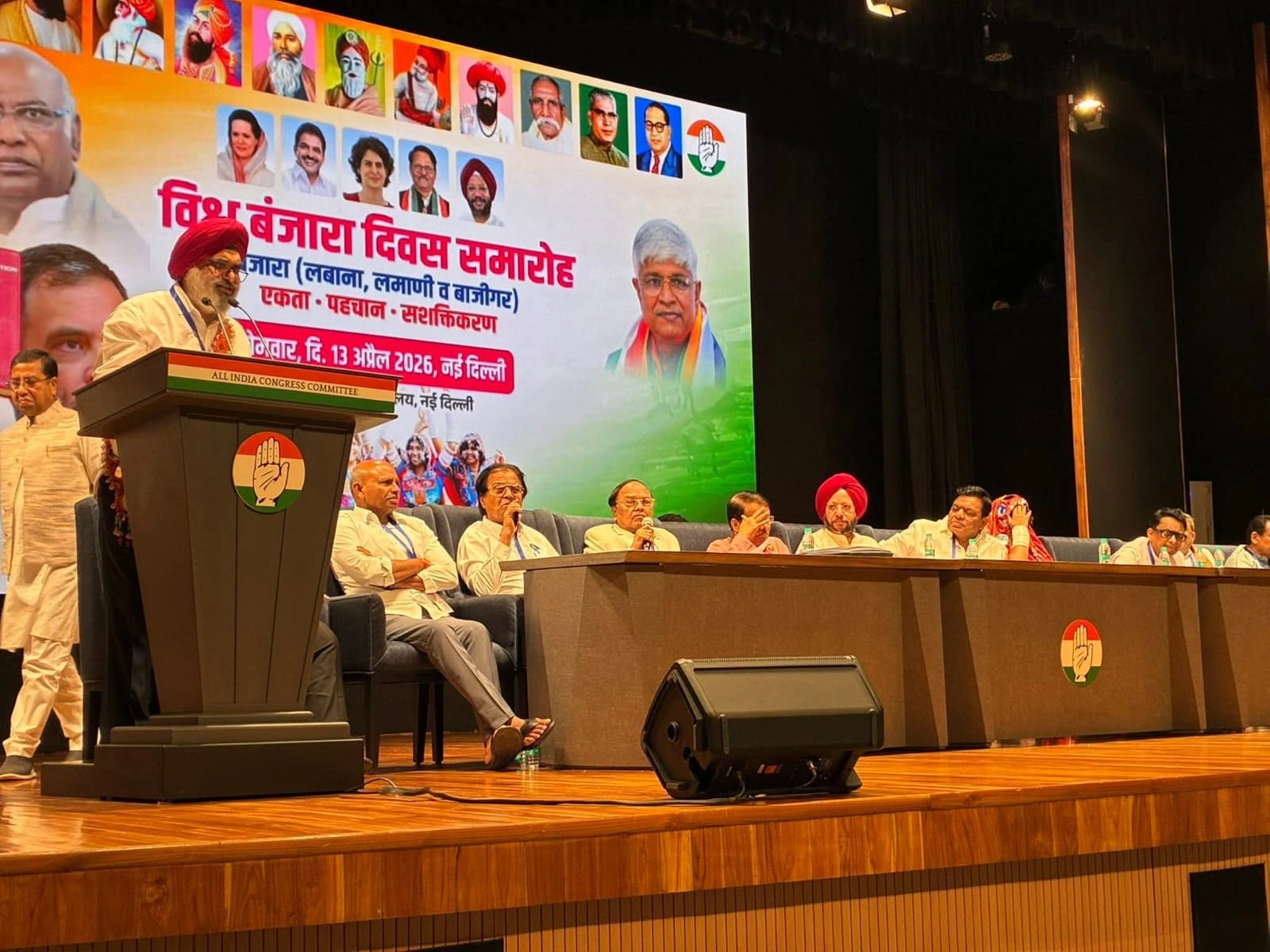
A grand celebration of World Banjara Day was held at Indira Bhawan, the Congress party headquarters, where leaders highlighted the history, cultural heritage, rights, and current challenges of the Banjara community. The event was attended by K. Raju, Gurdeep Singh Sappal, and Rajendra Pal Gautam, among others.
Addressing the gathering, Congress leaders described the Banjara community as a strong pillar of India’s economic, social, and cultural framework for centuries. They noted that before the development of modern transportation, the Banjaras managed one of the most organized trade and transport networks in the country, supplying essential goods such as grains, salt, horses, metals, and spices, thereby playing a crucial role in the economy.
The leaders also paid tribute to historical figures Lakkhi Shah Banjara and Makhan Shah Labana, calling them influential traders and pioneers of early supply chain systems. Their trade networks extended across regions and even internationally, functioning much like modern logistics companies that ensure large-scale distribution of goods.
Highlighting historical injustices, the speakers pointed out that the British government introduced the Criminal Tribes Act in 1871 to weaken the economic independence of communities like the Banjaras. The law labeled several communities as “criminal,” severely affecting their traditional occupations, mobility, and dignity.
They added that after Independence, the Congress government repealed this law in 1952, restoring dignity and rights to these communities. The leaders also stated that the Congress party has worked to bring the Banjara community into the political mainstream and demonstrated its commitment to social justice by enabling two Chief Ministers from the community.
The event also acknowledged the spiritual and national contributions of the Banjara community. Leaders said that during the time of the Sikh Gurus, Banjaras provided essential supplies, materials, and protection in difficult circumstances, playing an important role in safeguarding faith and humanity. They also showed courage and dedication in resisting foreign invaders.
Expressing concern over the present situation, the leaders noted that despite having a population of over 150 million, the Banjara community remains underrepresented in governance and policymaking. They stressed the need to improve education, skill development, entrepreneurship, and political awareness, with a special focus on empowering youth and women.
The leaders further highlighted that several historical and cultural heritage sites of the Banjara community exist across the country, including important land in the Delhi region. They called for concrete policies and institutional support for the preservation, documentation, and development of these heritage assets.
The programme was organized under the leadership of S. P. Singh Labana, National Coordinator (Scheduled Caste Department) and In-charge of the DNT Task Force (North–North East). His efforts in managing the event were appreciated by the leaders.
Prominent attendees included Dr. T. C. Rathore, Rajesh Rathore, Ashok Bartiya, Sanjay Rathore, Balram Naik, Shankar Naik, Sadhu Singh Dharmasot, Prithvi Rathore, Karamjit Kaur, Ram Mullu Naik, Belaiya Nayak, J.P. Panwar, and Ravindra Naik, along with several other dignitaries.
Concluding the event, the leaders reiterated that the Congress party has consistently supported the Banjara community by ensuring respect, dignity, and identity. They affirmed that the party will continue to provide a strong platform for the community’s empowerment, cultural preservation, and protection of rights, and urged the community to move forward through education, unity, and leadership.

Mansi Sharma is a journalist covering Global Affairs, and wellness, known for turning complex ideas into sharp, engaging narratives. Her work is driven by curiosity, depth, and a constant urge to question and explore. When she’s not writing, you’ll often find her diving into new ideas—preferably with a cup of coffee in hand, one sip at a time.